Greece History
The History of the Minoans
Splendid as they are with their remarkable architectural logic their hypnotic art and the richness of cultural artifacts they spoke a language we dont understand and they wrote in a script which we cant read. So the voices of the Minoans their stories their history as they understood it is lost to us. Even if we do by some miracle decipher their writing and penetrate the mists of their language we may not end up with much of anything. For all of their writing seems to be one thing accounts and records. The Minoans were after all a great mercantile people and they kept profoundly accurate records of their transactions. So much of what we know of Minoan history is nothing more than a good guess and good guesses are I should warn especially prone to being wrong.
The archaeological evidence points to only a few reasonable certainties about Minoan history. Around 3000 BC Crete was settled by a people who probably came from Asia Minor who by 2000 BC was already living in cities trading with other nations in the Mediterranean and employing a hieroglyphic system of writing probably derived from Egyptian hieroglyphics. This hieroglyphic writing would eventually evolve into a linear script. They built magnificent palace centers at Knossos, Phaistos and Kato Zakros these palaces seem to have dominated Cretan society. We have no idea what language they spoke but they certainly spoke a non Hellenic language and probably spoke a non Indo European language. Homer writing almost eight hundred years after the collapse of the Aegean palace civilizations in Book Nine of The Odyssesy gives a list of people living on Crete among that group he lists are the Eteo-Cretans who are probably the original Minoans.
This group persists as an independent group until around 140 BC their language Eteo-Cretan was probably a near relative of the language of the Minoans. The Greeks called non Hellenic languages barbaric from the word barbar which means speaking nonsense bar bar bar bar. They called people who spoke barbaric languages barbarians so the Greeks in many ways distinguished themselves from other people by the language they spoke. The EteoCretans then originators of Greek civilization itself had become the barbarians in the Greek world.
All archaeological evidence suggests that the Cretan states of the first half of the second millenium BC were bureaucratic monarchies. While the government was dominated by priests and while the monarch seemed to have some religious functions the principle role of the monarch seemed to be that of chief entrepreneur or better yet CEO of the Cretan state. For the Cretans operated their state as a business and entrepreneurship seemed to be the order of the day.
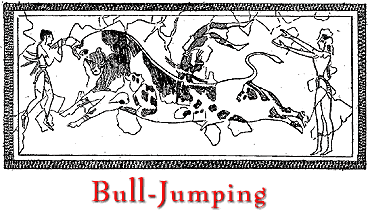
While the bulk of the population enjoyed the wealth of international trading the circumstances of that trade was tightly controlled from the palace. Beneath the king was a large administration of scribes and bureaucrats who carefully regulated production and distribution both within the state and without. This administration kept incredibly detailed records which implies that they exercised a great deal of control over the economy. In order to facilitate trade the Cretans and their Aegean relatives developed the most advanced navy that had ever been seen. While scholars earlier believed that Crete must have been a thalossocracy that is a sea power that view has been seriously challenged. The Cretans probably did not develop a military navy as did the Egyptians but concentrated solely on trade and mercantilism. They did build what looks like warships but it seems that these warships were most likely mercantile ships with the capability of defense against pirates. Their trade was extensive. The Egyptians were highly familiar with the Cretans who even appear in Egyptian art. Cretan artifacts turn up all over Asia Minor and they seem to have been involved in trade with the tribal clans living on the Greek mainland. All of this concentrated mercantile activity produced great wealth for the Cretans which went into massive building projects art and technological development. The Cretans for instance seem to be the only people in the ancient world that would construct multi room buiidings for a large part of society including even the poorest people. The common household in the ancient world of course was a single room this would be the norm up until the 1600's in Europe. The Cretans were the first to build a plumbing system in their buildings.Cretan society seems to be the first leisure society in existence in which a large part of human activity focussed on leisure activities such as sports. In fact the Cretans seem to have been as sports addicted as modern Americans the most popular sports were boxing and bulljumping. Women actively participated in both of these sports. The immense concentration of wealth in such a small population led to an explosion of visual arts as well. Unlike the bulk of the ancient world the Minoans developed a visual culture that seems to have been solely oriented around visual pleasure rather than visual utility political, religious, or otherwise.