Arsenal began its history 115 years ago in 1886 at the Royal Arsenal (below), a
huge government munitions works based in Woolwich, Kent. They were originally known
as Dial Square, as one of the workshops within the Arsenal was called Dial Square,
the name chosen to represent the team. However at a meeting at the Royal Oak, next
to Woolwich Arsenal Station, on Christmas day 1886 the name of Dial Square was
changed, and a combination of Royal Oak and Woolwich Arsenal resulted in the regal
sounding name Royal Arsenal.The name was later changed to Woolwich Arsenal in 1891.
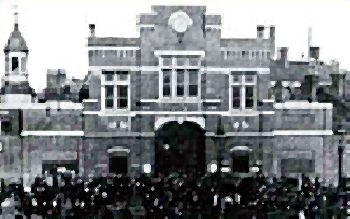 The Royal Arsenal
They played their first match at Plumstead Common. They soon joined the old Second
Division playing regularly against professional clubs. The problem with South
London at that time was that it was difficult to get to; attendances were therefore
low. After short spell in the First Division their lack of attendances (and
consequent lack of money) meant that they had mediocre players. By 1913 they were
back struggling in the Second Division. There would be three turning points in the
history of the club that would transform them into one of the most famous in the
world.
The first turning point was the move to North London. The club chairman wanted to
merge Woolwich Arsenal with Fulham but that plan fell through. So a ground was found
near a theological college in Highbury not far from Gillespie Road Underground
station on the Piccadilly Line. Access was good from all parts of London, and the
area was residential thus supplying supporters. Tottenham Hotspur, four miles away,
objected to the move but were over-ruled; the South London club maintaining that
there was enough potential support for both clubs.
In 1915 the move was completed and the club dropped the Woolwich from its name to
become Arsenal. However, it was still an average Second Division team. In 1919
Arsenal won election to the First Division when it was expanded to 22 clubs. This
was the second turning point in Arsenal's history. Since this election was at the
expense of neighbours Tottenham, this set the enmity between the two clubs that
lasts to this day.
The 1920s saw Arsenal as an average First Division club usually finishing in the
middle of the table. The third turning point in Arsenal's history occurred when
Herbert Chapman was appointed manager. He had made Huddersfield Town the dominant
team in the 20s. Highbury was the platform he needed to try out his new ideas. He
took Arsenal to 2nd in the First Division in 1926 and to the FA Cup Final in 1927.
They lost 0 - 1 to Cardiff City (the only time that the FA Cup has gone out of
England). This was still the best that Arsenal had done so far in their history.
It was during the 1930s that Arsenal became a football force. Chapman built a new stadium complete with marble halls, set up under-soil heating so that matches could
be played in all weathers, set up the best medical facilities in the country to
treat players, and began youth schemes to train young players. His proposals to
number shirts and have floodlights were rejected by the football authorities. His
innovations showed he was a man ahead of his time. Tactically, Chapman was astute
enough to attack the weaknesses of other teams while playing to Arsenal's
strengths. Outside of football, Chapman, had the tube station's name changed to
Arsenal. Chapman made Arsenal the most successful and richest club in the country.
Everybody wanted to beat them.
In 1930 Arsenal won their first trophy, the FA Cup, beating Chapman's old club,
Huddersfield Town, 2 - 0. In 1931, Arsenal became the first London club to win the
First Division Championship. They set up a new points total which was not bettered
for 30 years. In 1932, Arsenal almost became the first club this Century to win
both the FA Cup and the League. They finished 2nd in both, losing the FA Cup Final
1 - 2 to Newcastle United. In 1933, 1934, 1935 Arsenal were Champions, one of only
three clubs to win three consecutive Championships. They had their upsets however:
in 1933 they lost a cup game to Walsall of the old Third Division, a team that cost
less than Arsenal's boots. Chapman died during this period, but he is considered to
have been the first modern football manager. In 1934, England played an
international game with seven Arsenal players, still a record. 1936 saw a second FA
Cup win (1 - 0 against Sheffield United). During that season, Ted Drake set a
record by scoring 7 goals in an away game at Aston Villa. A fourth Championship was
captured in 1938 before World War II stopped competitive football for six years.
In 1947, professional football resumed but the ravages of war left Arsenal weaker.
They were almost relegated from the top division. They rallied in 1948 leading from
start to finish to capture their fifth Championship. Towards the end of that
season, a match against second placed Manchester United attracted over 82,000
people. That remains the highest ever attendance for a league game in England.
1950 saw a third FA Cup win (2 - 0 against Liverpool). Arsenal won the Cup without
leaving London. They were back at Wembley in 1952 but lost 0 - 1 to Newcastle
United after an injury. This was in the days before substitutes were allowed. In
1953, a win in the final match gave Arsenal their 7th Championship, then a record.
They finished equal on points to Preston North End but had scored more goals!
The next 17 years were barren for Arsenal followers. The lack of trophies was made
worse by the fact that Tottenham had their golden period between 1960 and 1967.
During those years Tottenham became the first club this century to win the FA Cup
and League in the same season (1961), retained the Cup in 1962, became the first
English club to win one of the new European trophies (1963), and won the FA Cup
again in 1967.
In 1961 the League Cup had started. Arsenal reached the final of this trophy
(called the Micky Mouse Cup by some!) in 1968 but lost 0 - 1 to Leeds United. A
year later they returned to the final and faced Third Division Swindon Town.
Arsenal were hot favourites. In fact they lost 1 - 3 after extra time. A flu virus
was partially blamed but this was Arsenal's lowest point in recent times. Little
did they know that it was to be the beginning of a new golden age.
Although they'd won nothing, Arsenal had finished high enough in the League to
qualify for the one of the European competitions that had began during the late
1950s. In the end they won the European Fairs Cup by beating one of Belgium's best
sides, Anderlecht, over two games. Arsenal lost 1 - 3 in Belgium but a packed
Highbury saw their team win 3 - 0 to take their first trophy for 17 years.
1971 was a classic year for Arsenal. One Monday in May, thousands were locked out
of Tottenham's ground as Arsenal won 1 - 0 in the final League game of the season.
This result allowed Arsenal to overhaul Leeds United and take their eighth
Championship. Five days later they came from behind to beat Liverpool 2 - 1 in the
FA Cup Final to become only the second club this Century to 'do the double'. A year
later, Arsenal returned to Wembley but lost 0 - 1 to a Leeds United side looking
for revenge.
Arsenal reached the FA Cup Final in three consecutive years during the 70s, the
first time a club had done so this Century. The first Final was lost 0 - 1 to
Ipswich Town, the second won 3 - 2 against Manchester United, the third lost 0 - 1
to West Ham United after a gruelling four match semi-final against Liverpool.
Most disappointing of all was what happened after the 1980 Final. Arsenal had also
reached the final of the Cup Winners Cup, another European competition. The game
was against the Spanish club, Valencia. It ended 0 - 0 after extra time and Arsenal
lost on penalties.
The early 80s were quiet. In 1986 George Graham became manager of Arsenal. He
turned out to be Arsenal's most successful manager. In 1987, Arsenal finally won
the League Cup (by this time called the Littlewoods Cup). They beat old rivals
Tottenham in the semi-final, and came from behind to take the final 2 - 1 against
Liverpool. 1988 saw Arsenal squander a 2 - 1 lead to lose 3 - 2 against Luton Town.
In 1989, Arsenal went to Liverpool for the final game of the season needing to win
by two clear goals to be Champions. Leading by only a goal, as Liverpool began to
celebrate, Arsenal scored a last minute goal to win 2 - 0 and snatch the
Championship from under the noses of the Liverpool supporters.
Two years later (1991), Arsenal lost only one League game (a record for the 20th
Century) to take their 10th Championship with a frustrated Liverpool finishing
second. Only Liverpool have the won the Championship more times.
In 1993 Arsenal completed a unique cup double by becoming the only club to win the
League Cup (now called the Coca Cola Cup) and the FA Cup in one season. They won
both finals by 2 - 1 against Sheffield Wednesday, the winning goal in the FA Cup
coming in the last minute of extra time. Their appearance in 12 FA Cup Finals was a
record.
1994 saw Arsenal win their second European trophy, beating the Italian club Parma,
1 - 0 in Copenhagan. They reached the 1995 final only to lose 1 - 2 to a last
minute goal against Real Zaragosa. By this time George Graham had left under a
cloud.
Arsene Wenger became Arsenal's first foreign manager in 1996. In 1998, Arsenal
completed the double for the second time in their history. Coming from 12 points
behind, Arsenal won ten games on the trot to beat Manchester United to the
championship. In the FA Cup final Arsenal beat Newcastle United by 2 - 0.
The following year they finished second in the League and reached the semi-final of
the FA Cup.
In 2000 Arsenal agin finished second in the League and reached the final of the
UEFA Cup. They lost on penalties to the Turkish club, Galatasaray after a 0 - 0
draw. A year later they finished second in the League for the third year running
and played in the FA Cup final in Cardiff, losing to Liverpool, 1 - 2.
In the League, Arsenal's 75 consecutive years in the top division is a League
record.
|





