Arsenal Unveil New Crest 02 February 2002
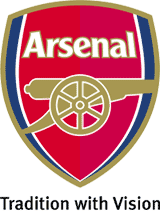
Following extensive research and consultation, Arsenal Football Club is delighted to announce the unveiling of its new Club crest (see right).
The new crest will appear on all Club properties from May 2002 to coincide with the appointment of a new Club sponsor and possible construction of the stadium at Ashburton Grove.
The decision to create the new crest was two-fold. Principally, as the current crest incorporates many separate elements, which have been introduced over a number of years, there is uncertainty surrounding its exact origination. As a consequence, the Club is unable to copyright this crest.
Secondly, it has always been one of the Club's primary objectives to embrace the future and move forward. With a new stadium on the horizon and the Gunners consistently challenging for domestic and European honours, it is the ideal time to introduce a new crest. The new Arsenal Crest
Prior to the design process, the Club consulted a cross section of key individuals and organisations, including supporters, to ascertain their views on Arsenal's brand values.
In conclusion, those interviewed believed that Arsenal is very much an institution that combines the traditions of the past with a visionary outlook on the future. These attributes have enabled the Club to naturally evolve the present day crest by retaining both the shield and the cannon - which reverts back to first ever published cannon (1922) that faced eastwards - as well as adapting it into a more modern, European style.
Arsenal Chairman Peter Hill-Wood said:
"The new crest has been selected as it delivers the values of Arsenal in a clear and unique way but more importantly, it retains the traditional features such as the cannon and the shield which are synonymous with Arsenal Football Club.
"I would also like to stress that this change is an evolution not a revolution. We are not a football club that changes for change's sake. We are extremely mindful of the special bond our supporters have with the present crest but are also confident that our supporters will be proud of the new design."
All the Club's communication, from stadium signage to the crest on the playing and training kit will change in May 2002. From Saturday February 2nd, the Club's retail outlets will be offering 10% off most Arsenal merchandise which features the present Club crest.
|
The History of Arsenal's Club Crest
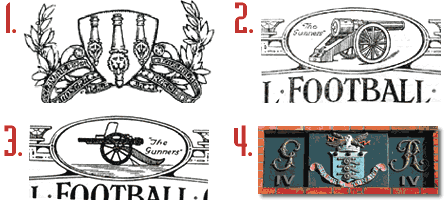
In 1888, just two years after the formation of the Club, Arsenal, who were then called Royal Arsenal, adopted its first crest (1). This was based largely on the coat of arms of the Borough of Woolwich. The Club was based in the Borough from its formation until 1913, playing at Plumstead Common; Sportsman Ground; Manor Ground; Invicta Ground and the Manor Ground again before heading across London to Highbury, Islington.
The original badge comprised three columns, which, although they look like chimneys, are in actual fact cannons. The significance of the cannons to the Borough of Woolwich derives from the long military history surrounding the area. The Royal Arsenal, Royal Artillery Regiment and various military hospitals - which still dot the landscape today - were all prominent in the Borough.
The cannons on the original crest were obviously a reference to the military influence in Woolwich and despite the Club's ties with the area being cut 89 years ago, the cannon theme has developed throughout the years and has remained prominent on 'the Gunners' different crests down the years, including the new design. In the early days the crest was not as significant a part of a football club's identity as it is today. Shirts remained plain, unless commemorating a significant match, an F.A. Cup Final for example, and the crest was generally reserved for official headed stationary, matchday programmes and handbooks.
Following Arsenal's move north to Highbury in 1913, it wasn't immediately apparent that the Club would embrace the Woolwich Arsenal legacy and keep the cannon as a recognisable motif. The Club soon became just 'Arsenal', the Great War affected football for four seasons and recommencing in 1919/20 'normal' football took some time to settle. During all of this period there was no sign of a crest as such but, in the first matchday programme of the 1922/23 season, when the Gunners played Burnley, a new club crest (2) was revealed - a fearsome looking cannon, that would have sat proudly in the Royal Arsenal of Woolwich.
As can be seen the vertical cannons have gone with the new design featuring a single eastward pointing cannon. Whoever designed this robust looking weapon saw his handiwork used by the Club for just three seasons however, and for the start of the 1925/26 season, the Gunners changed to a westward pointing, narrower cannon (3) with the legend 'The Gunners' remaining next to it.
The derivation of the narrower cannon has never been officially confirmed, but the cannons on the crest of the Royal Arsenal Gatehouse in Woolwich (4) are uncannily similar to that used as the Gunners' symbol.
This cannon crest remained prominent in the Arsenal matchday programme and other publications for 17 seasons. It changed slightly through the years with the wording eventually disappearing, but, despite being usurped by the Victoria Concordia Crescit crest in 1949 it has remained a basic symbol of the Club ever since, featuring on official merchandise and stationary throughout the years right up until the present day.
The VCC crest (5), which the new crest replaces has been Arsenal's symbol since appearing in the first new style magazine matchday programme of season 1949/50. It would appear to have been in the minds of the Gunners hierarchy for at least a year prior to this. In the final matchday programme of the 1947/48 League Championship winning season, 'Marksman' (aka Harry Homer), the programme editor of the day, wrote: "...my mind seeks an apt quotation with which to close this season which has been such a glorious one for Tom Whittaker, Joe Mercer and all connected with The Gunners. Shall we turn for once to Latin? 'Victoria Concordia Crescit'. Translation: 'Victory grows out of harmony.'"
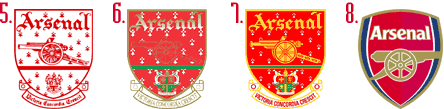
Two seasons later and Arsenal unveiled its new crest which incorporated Marksman's latin maxim. Tom Whittaker explained in the 1949/50 handbook (which also included the new crest) that the Club had been impressed by Marksman's motto and it had now been officially adopted by the Club. The new crest also featured 'Arsenal' in a gothic style typeface, the westward facing cannon, the Borough of Islington's coat of arms and ermine.
For the past 53 years this crest has remained largely unchanged (6), though at the start of this, 2001/02 season it was 'cleaned up' somewhat (7) for commercial reasons, with a solid yellow replacing the different tones of gold and Victoria Concordia Crescit written in a less ornate typeface.
The Club's identity has thus evolved over the years and the decision to formulate a new crest (8) in 2002 is two-fold. Firstly, as the VCC crest incorporates many separate elements introduced over a number of years, there has been uncertainty surrounding its exact origination. Consequently, the Club is unable to copyright the VCC crest. Secondly, it has always been one of the Club's primary objectives to embrace the future and move forward. With a new stadium on the horizon and the Gunners consistently challenging for domestic and European honours, the Club believes that this is the ideal time to introduce a new crest.
|






