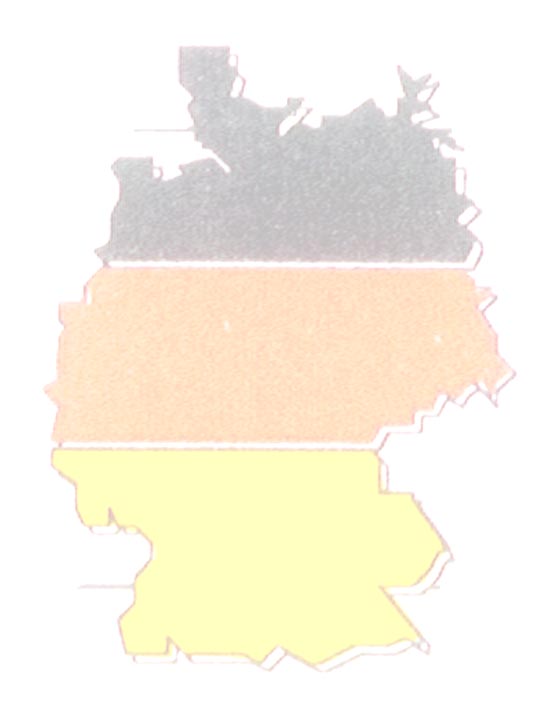
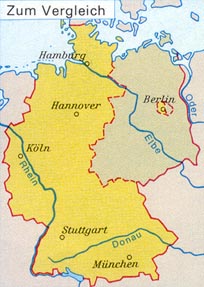
Germany lies at the heart of Europe and is surrounded by nine countries. Germany covers an area of 137,744sq miles (357,000sqkm) and is the third largest EC country after France and Spain. With a pupulation of 80 million, including 4,6 million foreigners, Germany is the most densely populated country in Europe and makes up 23% of the total EC pupolation.
Structure of the Federal Government:
The government consists of three parts: the legislature ( the Bundestag and the Bundesrat), the executice (Chancellor, cabinett, bureaucrazy) and the judicary.
The Bundestag (lower house of parliament) is the supreme legislative authority. Its members or deputies are elected for four years by the voting public (German citizens aged 18 and over) in direct, free, equal and secret elections in a procedure which combines the direct election of candidates with proportional representation.
The Bundesrat (upper house of parliament or federal council) is composed of representatives of the Laender ((state) governments.
The Bundesregierung (federal government) in Berlin consists of the federal chancellor and his cabinet of federal ministers. The federal chancellor is formely nominated by the federal president and elected by the Bundestag - in fact, each political party announces its chancellor candidate before the election, and the candidate of the winning party becomes the chancellor.
The Bundespraesident is the (federal president) is the head of the state of the Federal Republic of Germany. Elected for five years by the Bundesversammlung ( a constitutional body which exists only for that purpose), re-electable only once, the president is to a large extent a figurhead with a number of formal functions but little real authority. Nevertheless, as the representative of the Federal Republic in tis relations wiht other countries, the president performs an important role.
The Judiciary. Administration of justice in the Federal Republic is divided between the federation and the Laendet (state). There are "ordinary" courts for civil and criminal law, as well as special administrative, labour, social and fiscal courts. All of the lower courts are administrated by the Maender, and only in the final instance does a case come before e federal court.
|