(Edit
3/2.11.2005)
Maria-Goeppert- Mayer
Guest
Professor Inaugural Lecture,
The
walking bus: the gender
implications.
November
3rd, 2005
Professor
Margaret Grieco, D.Phil.(Oxon.), Professor of Transport and
Society,
Introduction:
I have great
pleasure in delivering here today at the Technical University of Braunschweig my inaugural lecture as Maria-Goeppert- Mayer Guest Professor. It is an honour, indeed. The specialist field of my guest
professorship is Gender and Transport and I am already engaged at TU-BS in
running two seminar series and delivering a course on this very important but
all too frequently neglected topic (http://www.geocities.com/gender_and_transport
). In thinking about this
inaugural, I wanted to focus on a topic which, whilst still in the expert field
of gender and transport, has an immediate and do_able action dimension for us all. This lecture is aimed at opening up the
prospect of transport education for civil society and has the goal of creating
greater interest, involvement and participation of the public in transport
planning and other contemporary planning processes.
In
particular, this inaugural lecture is about change in the field of gender and
transport; it is about citizen participation in transport planning and transport
provision in an increasingly environment-conscious civil world where the
requirement to share resources and share burdens more equitably is a visible
policy concern.
Historically,
women have been disadvantaged in respect of their opportunities for mobility and
in their access to services and health and wealth. Gender sensitive governance in respect
of transport policy issues is becoming a concern within the German speaking
world: the studies of Daniela Jauk and colleagues in
So academics
and policy institutions have begun their engagement with gender and transport
and changes are likely to result which better meet the needs and wants of
What is
the walking bus?
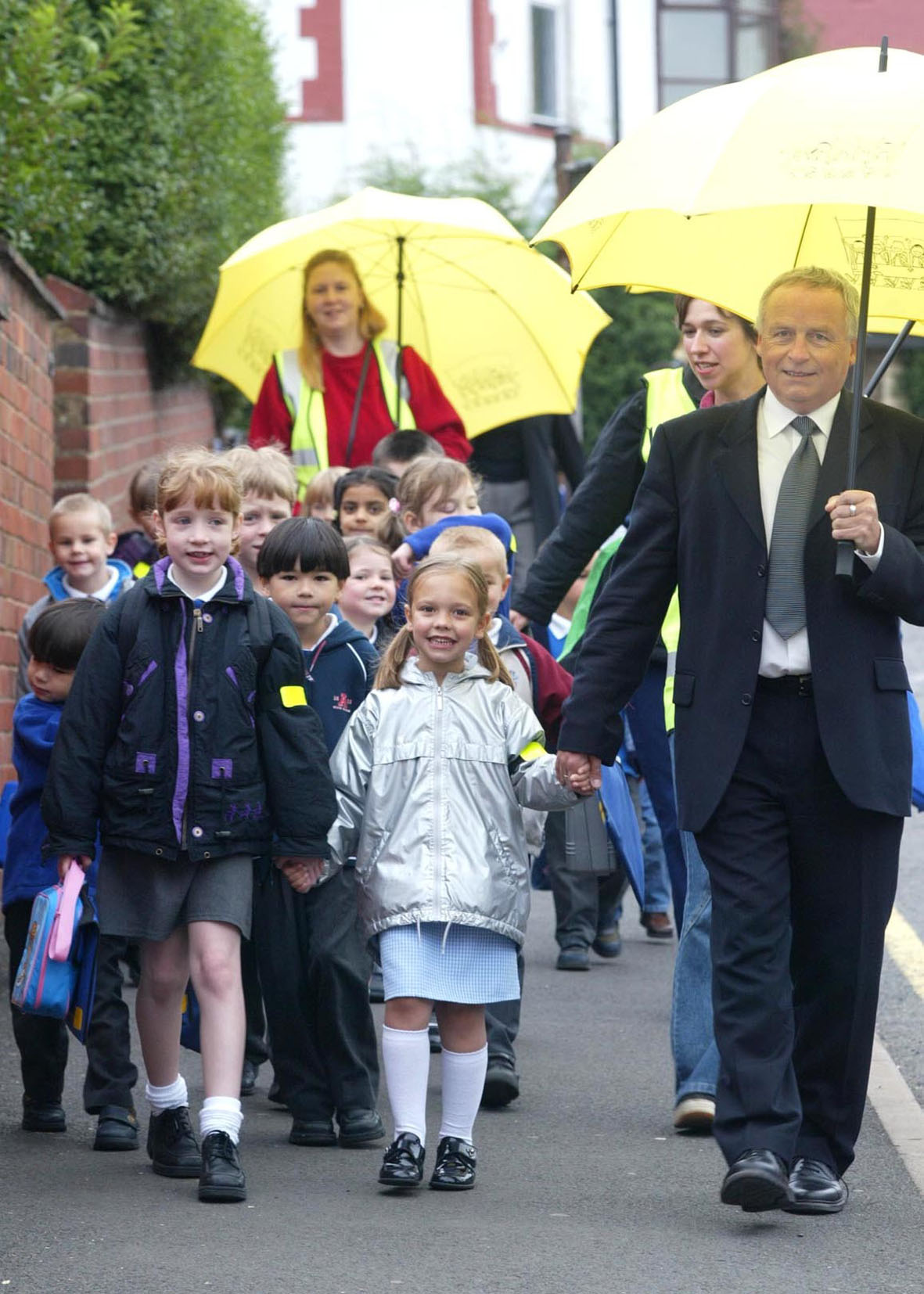
The walking
bus is a pedestrian group escort of children from their homes to school and
back. It relieves individual mothers of making these escort journeys every day
and is designed to cut down on automobile use and enhance the exercise regime of
young children. The walking bus has been adopted in many locations in the
The walking
bus is an Australian
invention[1]
but is actively promoted by British
governmental agencies at both the central and local levels and is dependent on
parent volunteers to 'drive' the bus and act as 'conductor/s'. The children walk
together in pairs, they are organised one pair behind another with adults at the
front, the back and at roadside boundary of this human 'crocodile', the children
wear reflective vests or other reflective markers on their persons. The walking bus calls at the house of
each child in the group or at set pick up points in an organised routing as it
makes its way between the childrens' neighbourhood and
the school. It has the
advantage that the children are able to walk to school without the prospect of
'stranger danger' and this frees mothers from either walking their own children
to school every morning, or, more importantly, for many purposes more related to
the preservation of the environment than the saving of women's time, from driving their children to
school. The walking bus does
generally require that children live within walking distance of the school but
it is also possible to organise walking buses within neighbourhoods to service
school bus pick up points which then shuttle children to school where these
distances are outside of children's walking capabilities.
The walking
bus we can already see has potential gender benefits: it can allow women to
increase their personal time (where previously they made the walking journey
every day) and enables them to directly participate in the planning of their
childrens' mobility. The 'walking bus movement' in Britain
has received substantial support from British governmental agencies at the level
of advocacy and information provision and now has a well developed support
structure with parent groups wishing to set up walking buses able to obtain
'walking bus kits' which contain information on how to plan a walking bus, the
equipment needed to run the walking bus such as reflective vests and information
on how effectively these services have been adopted and provided by communities
elsewhere (http://www.kentwalkingbus.org/) .
Walking buses
are organised in conjunction with the head teacher of the schools that they
serve and can be covered by insurance provisions. Governmental support, both local and
central, of the walking bus social movement has meant that institutional issues such
as insurance have received attention.
The risk assessment culture of contemporary Britain results in issues such as insurance
receiving close consideration and this is visible in the walking bus
literature (http://www.kentwalkingbus.org/). The primarily volunteer character of the
walking bus requires specific insurance as those 'staffing' it are not local
authority employees although many local government organisations have extended
their schemes so as to provide insurance cover for
volunteers.
This may be
happening in
The
positive contributions of the walking bus
There are
four important areas of discussion in terms of the positive contributions of the
walking bus which regularly appear in the literature:
Environmental
sustainability discourse: reduced emissions.
Urban
sustainability: reduce congestion.
Health
sustainability: reduce obesity.
Travel
behaviour education: early socialisation into walking sustains all three other
objectives.
Environmental
sustainability discourse: reduced emissions.
Policy
makers' focus and concerns have fallen upon the 'school run': the school run is a term
used to denote mothers driving
their children to school and dropping them off at the school gate in the morning
and returning to the school gate in the car to pick them up in the
afternoon. The morning run
coincides with other peak hour traffic and contributes towards morning
congestion and grid lock. Apart
from contributing towards congestion, the vehicles that compose the school run
create local congestion and parking problems in the neighbourhoods where schools
are located. The school run has
increasingly come to be viewed as an environmental nuisance to the
locality. And funds are being made
available for schools to develop travel plans which reduce the dependence on or
eliminate the school run: schools have thus become a front line in the British
Government's demand management
strategies to reduce congestion and, as a consequence, reduce emissions (see
|
Extract from NUT web site - http://www.teachers.org.uk/showwirearchive.php?id=1062067
(captured 18.10.2005 A new sterling 50
million action plan to tackle congestion caused by the school run has been
launched by the education and transport secretaries. |
This
central government initiative aimed at removing the school run has generated
resources for local authorities and individual schools in developing walking as part of their school travel
plans.
|
At
different points in time and in different documents, different negative aspects
of the school run are emphasised but the concerns about the environment figure
very frequently. The links between the school run, congestion and the
environmental damage of motorised traffic are repeatedly made in the promotion
and advocacy of the walking bus.
Urban
sustainability: reduce congestion.
As we have
already seen environment sustainability, the reduction of emissions, and urban
sustainability - the reduction of congestion and local neighbour nuisance - are
very much linked. By focusing on
the reduced use of the car in travel to school, both goals appear to be
met. But the walking bus is not the
only strategy that can be used: the prospect of cycle buses (groups of children
cycling under supervision) or the use of partway schemes which deliver children
to a point of lesser congestion
than the school gates and organise their walking journey for the rest of the way
can also be used. Shared car
schemes to deliver children to school presently operate separately from the
walking bus but could be organised
to work with the walking bus providing a more flexible arrangement for
situations of extreme weather conditions or out of normal hours journeys back home after
school clubs, etc.
Health
sustainability: reduce obesity.
One of the
strongest logics presented for the walking bus is the impact that walking in
childhood can have on short and long term wellbeing. Walking is seen by the
governmental and health policy agencies as a mechanism for reducing childhood
obesity in a context where childhood obesity levels are dramatically
increasing. The walking bus clearly
fits into this health policy
framework, however, in the British context, it is frequently pointed out that at the
same time as childhood obesity levels have been on the increase there has been a
public sector management policy of selling off the school playing fields in
which children previously took exercise.
To put the whole of the health burden on the walk to school is to fail to
pay attention to the important issue of the availability and accessibility of
substantial play areas for children in which informal sports and exercise can
take place spontaneously.
Travel
behaviour education: early socialisation into walking sustains all three other
objectives
An important
aspect of the walking bus movement is that it does provide an important vehicle
for early travel behaviour education.
The adult/child organisation of the walking bus provides a consistent
tool for the transmission of road safety knowledge and practice. The enjoyment of walking can become a
long term preference which carries into adulthood: such early socialisation into
walking if carried into adulthood would have impact on the environment, the
urban context and the health of populations. The research which establishes that this
is the case, and that the walking bus has these benefits, has not yet been done
but these are the claims that are routinely made for this
policy.
Although,
according to the evidence of Gliewe et al. (1998), the
majority of primary school children walk to school, in 1998, there was still evidence of the school
run within
It may very
well be that the advocacy and resource providing role of central British
government in the context of its policies of the demand management of the
private car explains this difference.
In order for the walking bus to be more widely diffused in
To summarise,
the experts seem to agree that the walking bus is good for children's health,
the health of the environment, the working of the urban area, and for the road
safety of children. But what about
the gender implications: are these all positive?
The
current constraints on the walking bus:
We have
talked about what the walking bus is and the rationales frequently provided for
its adoption but we have now to pose the question are there limitations to the
walking bus? Indeed, there are and
these are all too frequently neglected in what has become a major social wave of
adoption of the practice within the
Here we focus
on those we see as being the most important, there are others but for our
purposes today we will focus simply on four of these. In terms of the
constraints imposed or adjustments required to make the walking bus viable,
there are a set of four issues which must be considered; these are:
- The gender
implications in terms of the use of women's time.
- The seasonal
dimension and its impact on children's comfort levels whilst
walking.
- Pavement
design and the dangers of clustering large groups of children together on
small pavement spaces adjacent to busy traffic.
- Redesign of
land use patterns. http://www.eaue.de/winuwd/56.htm
The gender
implications in terms of the use of women's time.
Earlier, we
indicated that the walking bus could free individual mothers from making the
daily journey with their child to school.
But there are other gender implications of the walking bus.
There is a
question about the extent to which fathers also become involved in walking bus
arrangements: the journey of escorting children to their activities in many
contexts typically falls upon women.
There is an issue as to whether the walking bus cements the practice of
escorting children to school as a woman's task. There has been no research as far as we
can tell on the gender divide in the volunteer labour associated with walking
buses and we have seen no literature which discusses the way in which the
volunteering activity around the walking bus could be used to involve fathers in
its organisation. Interestingly on
the walking bus literature men are depicted as being involved but what the
demography of this involvement is is not
known.
An additional
element to consider is the complexity of the coordination with others the
volunteer rota of a walking bus may impose: or on a more routine daily basis,
the difficulties involved in ensuring that mothers can get their children ready
in time to put them on the walking bus or retrieve them from the walking bus at
the end of the day.
The car
escort journey of child to school or pick up of child from school may give the
individual mother greater and necessary flexibility in an urban context where
many activities she has to perform are greatly dispersed and have timetables
into which she must fit. The private car may be an important scheduling tool for
the busy mother in her organisation of the safe escorting of children to their
activities. Once again the research into walking buses has primarily been into
their safety and into children's perceptions of the arrangements, apart from
research which identifies exactly where walking bus projects have been
established, there has been no research as far as I can establish into the
scheduling difficulties faced by women around the walking bus arrangement and
any stresses which may result.
There are some indications in the literature that such problems do occur:
some walking buses only pick up children in the morning and do not deliver them
back in the evening due to the uncertainty of whether mothers will be there on
time to pick up their child. In the
event a mother is not there, then the bus driver and conductor would have to
take care of the child until the responsible adult turned
up.
Thinking
about developing a walking bus such factors need to be taken into consideration
but there is no clear guidance on them within the promotional literature. The
gender implications of the walking bus need to be more closely examined within a
better understanding of household travel and task organisation and arrangements
developed to cope with any general pattern of difficulties that is
observed.
The seasonal
dimension and its impact on children's comfort levels whilst
walking.
Children are
the most vulnerable of the users of the travel and transport system: requiring
children to walk for the good of the environment whilst adults ride needs to be
carefully considered. There are conditions in which walking is healthy for
children and there are seasonal conditions in which it is not. Almost every
image of the walking bus is taken on a sunny day with no rain in sight: this is
great marketing but is a poor register of travel and transport
reality.
The walking
bus needs to be considered with more attention to the seasonal dimension, most
particularly, with respect to extreme weather conditions. A walking bus which is combined with
alternative bad weather arrangements such as car sharing or demand responsive
transport systems may be a sensible path to take. As of yet, and in our search of the
literature, we have seen no discussion of this aspect: living half the year in
the extreme cold temperatures of the great lakes in north America and being
aware of the capabilities of new technology in the rapid rescheduling of shared
activities, we believe this is a major constraint in the present attractiveness
of the walking bus.
Pavement
design and the dangers of clustering large groups of children together on small
pavement spaces adjacent to busy traffic.
In
In many parts
of
In the
British context, the adoption of walking to school using walking buses as a
youth transport strategy in motorised urban space needs to be accompanied by the
redesign of pavement space if the walking bus is to live up to the many claims
made for it such as that of being an opportunity for child based
sociability. The walking bus in
narrow pavement space will make it difficult for other pedestrians to get past
and this creates transport safety dangers for both other pedestrians and
children. We know of no study
which has either observed the movement of children in a
walking bus along a narrow pavement environment nor do we know of any study
which has attempted to model the situation that, given our pavement design, must
be pervasive in many British cities.
In
Redesign of
land use patterns.
The
discussion of congestion, the environment and motorisation which sits at the
back of much of the discussion of the walking bus generally fails to engage with
the need for the redesign of land use patterns so that motorised travel becomes
less necessary and the need for the redesign of land use patterns so that they
are more attractive for walking.
The walking
bus largely takes the form that it does to counterbalance the dangers in the
traffic and transport environment already experienced by children on the way to
school. Linking neighbourhoods and
schools by traffic free paths or corridors is an important step that needs to be
taken if healthy walking is to become a practice. The availability and accessibility of
local schools lies in the hands of the planners and education authorities more
so than it does with the travel escort plans of neighbourhood parents. If children are taken to school by car
in the present, it may be regarded as an adjustment to bad or inconvenient land
use patterns which have become institutionalised at a large scale under
rationales of efficiency and cost savings.
The distances which separate schools and homes have often been
rendered relatively invisible as an urban land use problem because of the
uncharted escort labour of women in bringing children to the planned point of
their educational activities. The
intensification of congestion has revealed the issues with the scale of the
school run indicating the extent of gendered household travel activity. The policy focus has been to eradicate
the school run but the accompanying measures necessary have not been taken: the
redesign of land use so that children are schooled within their neighbourhood
catchment, the redesign of pathways to
schools that are child friendly and traffic free or the provision of green
public transport systems which take children the length of their journey without
the necessity of the household car being used have not received commensurate
investment.
The design of
car free cities has been a German interest for a long time. The walking bus movement perhaps
indicates that there is a future in such a direction ( http://www.eaue.de/winuwd/56.htm ).
Conclusion:
In this
inaugural lecture, which took the walking bus as a gender and transport topic
within the frame and spirit of the Maria Goeppert
Mayer funding that supported it, we have indicated that there are
indeed gender benefits to the walking bus but that more careful research is
needed into the specifics of this relationship. We have indicated that it is important
that complementary measures be taken by policy makers in their design of youth
transport strategies to make sure that not only are children walking but they
are walking in an environment safe from the dangers and fumes of adjacent
traffic.
In ending
this lecture, we want to identify three important areas for development and
further thinking around the introduction of the walking bus: they
are:
- Integrating child travel
and transport modes. Here we believe that children's travel
can be better integrated into a range of transport modes. There is no reason why a walking bus
should not join the tram together or make use of demand responsive transport
in its journeys. If only children
walk and adults continue to ride, there is an issue at the level of transport
equity. Children can take exercise in environments which are free from the
fumes of motorised traffic - walking to school is not the sole way to get
exercise. Correspondingly if children are provided with high quality
environments within which they walk to school, equity issues begin to be
addressed. Removing motorised
transport from the most vulnerable to solve the problems of the motorised
transport use of the wider society requires very careful consideration.
- Evaluating the options
and opportunities for flexible walking bus arrangements. Here we want to draw attention to the
benefits of making the most of new information communication technology and
enabling children to switch from walking bus to some other mode when
circumstances dictate.
Integrating some demand responsive transport options to pick up the
single child who stayed behind at school for a club or switching to demand
responsive transport for a walking bus when the weather dictates it would
provide a higher quality of transport service to
children and their mothers.
- Sharing the escort
load. Research needs to be
undertaken into the present gender patterns of the escort taskloads of walking buses. Strategies need to be devised for
rendering the burden more equitable between women and men. Walking buses may be good for
children's health, under certain conditions, but they must not be injurious to
gender equity in transport.
I
thank you for your time today and hope you enjoy reading this lecture again in
German or English on the internet on your screens at home. On screen, it will give you access to the resources to set
up a walking bus in your own community: I hope the cautions provided here will
prove unnecessary in each project you establish in this
area.
Supporting
references:
Katja Hartl & Daniela Jauk (2005) Gender sensitive governance in
the field of transport: Focus
Groups with 'Women from the street'.
Rudolf Gliewe (ADAC), Maria Limbourg
(
- http://www.tfl.gov.uk/tfl/travelwise/travelwise-safer-routes.shtml#walkingbused
- http://www.kentwalkingbus.org/
- http://www.warwickshire.gov.uk/Web/corporate/pages.nsf/Links/0B8207464CC5ADC580256C3F004B8361
German sites and
materials:
Rudolf Gliewe (ADAC), Maria Limbourg
(
Swizerland:
- The Pedibus,
Annex
1
Extracted from the
Transport For
(captured
18.10.2005)
|
What is a walking
bus?
This
is a good opportunity for children to socialise with pupils from other
year groups and gain valuable pedestrian skills at the same time. The bus
is highly visible as all participants are provided with fluorescent vests.
High visibility jackets may be available through your local council, or
you may have to obtain sponsorship from a local business or shop. A
trolley to carry bags is optional. Setting
up a walking bus The
first stage should be to identify the routes that parents and pupils are
currently walking. This can be done by a simple travel survey.
Incorporated into the survey should be a question asking parents if they
would be prepared to be an escort volunteer. The buses' success will rely
on having an enthusiastic co-ordinator and ample volunteers. The more
parent volunteers on the route, the less time each will have to commit.
The Royal Society for Prevention of Accidents recommends a ratio of 1
adult for every 8 children. Operation
of the bus It is
imperative that children are escorted by an adult at the bus stop, and
arrive at the agreed pick up time. If the child is late the bus does not
wait. The
walking bus co-ordinator keeps a register of children. A copy should be
available for the driver each day to keep an account of the child's
attendance. It may be an incentive to offer a form of reward for good
attendance on the bus. Children
who are driven to school by car can still join in a walking bus. Parents
could park near one of the bus stops and join the bus on
route! How
you can help Step
1 Step
2 Step
3 When
the school knows who the escorts and passengers are, the exact route(s) of
the bus(es) can be planned. A representative of
the Council will check routes to make sure they are safe. A 'dummy' run of
the routes with the passengers and as many of the escorts who can make it
will be made to work out the timings and make sure the bus(es) arrive at school on time. The school then decides
when it wants the buses to start and that's it! For
more information please contact either your school or School Travel Plan
Co-ordinator. |
|
|
Kent and
Medway: Schools participating in Walking Bus schemes: Annex 2
http://www.kentwalkingbus.org/
|
Schools
participating within each of the Walking Bus operational areas of
Joy
Lane Infants and Juniors, Whitstable (two schemes) St.
Peter's School, Herne Bay Infants School
(two schemes) St.
Stephen's School after school club Whitstable
Walking Buses (three schools linked by two buses) Thanet Council
area Draper's
Dover District Council
area St. Martin's School,
Markland Road St.
Mary's School Medway Unitary
Council area Parkwood After School Club,
Rainham St. Margaret's at Troy
Town, Rochester St. Peters Infant
School, Rochester St. William of Perth,
Rochester St. Nicholas Infant
School, Strood High Halstow Primary School,
Rochester Sam's
Place after School Club, Chatham Strawberry
Fields Day Nursery Meville
& Brompton Community Association Shepway Council area Ashford Council
area Woodchurch St.
Michael's, Sevenoaks Council
area Tonbridge & Malling
Council area St
St.
Peter and Gravesham Council
area Tunbridge Wells
Council area St
James Primary School Dartford District
Council area |
Annex 3. Some difficulties: easier to organise on
the way to school, harder on the way back. http://www.kentwalkingbus.org/
|
Briary
Profile Our Walking Bus has
only ever operated in the mornings and in the first months did not run on
Mondays. The reasons for this are the number of after-school clubs at the
school would make an afternoon run difficult to co-ordinate, plus we are
also concerned at the prospect of having to look after children if parents
do not turn up on time. It seemed easiest for both reasons to just operate
in the mornings. At the start there
were 13 children using it and this has now increased to 19. Currently
there are five adult helpers. Maxine Standen (Walking Bus Co-ordinator). |
