 |
| GALT LOCOMOTIVES The Home of the Little Purple Engine |
| Painting Techniques |
| Warning When spraying with paint, a similar well-ventilated area is required as to that for cellulose thinners. Spraying with paint also introduces into the air you are breathing, a fine mist of paint particles. Consequently, always use, at a minimum, a monkey/nasal mask, which fits tightly round the nose. It will not be able to stop all of the fine paint particles, but will make quite a bit of difference. And don�t as I did think �I just want to quickly touch up a small area, so I won�t bother with the mask�. Just try blowing your nose into a white tissue afterwards. Enough said !!! |
| Suggested Painting Process |
| Having never spray painted before a colleague gave me some help to make sure I did not fall into the usual trap, which I did straight away!!! As with everything there is an art to spray painting the correct way and its very easy for your brain to decide there is a better and easier way. Unfortunately, the brain is wrong. My colleague, who incidentally rebuilds and spray�s cars for a hobby, suggested the following methodology, which has so far appeared to work. |
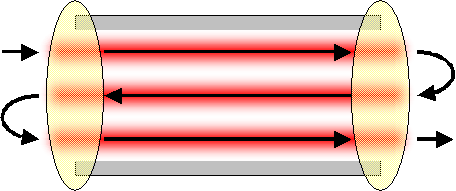
| When making my first attempt to spray paint, I fell into the trap of pressing the spray nozzle and zigzagging the spray across and down the item being sprayed. Not only did I get an uneven paint deposit, but it also resulted in an excessive build up of paint at the left and right edges, shown circled. |
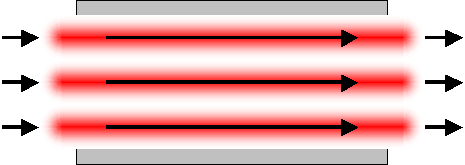
| Instead of make a zigzag motion when spraying, I used a left to right motion. Starting to spray before the left hand edge of the item being sprayed and stopping after the right hand edge of the item being sprayed, which I found gave a more even paint distribution. To finish of each item I then used a similar motion to spray round the edge of the item. |
| Another mistake I initially made was trying to get the finished surface coat I wanted in one attempt. Using two, three or more spray coats to fully cover an item is far better than attempting to do it in one, it just doesn�t work. Also, as I found out paint thickness, varies quite a lot and can be quite noticeable even after using fine wet and dry to rub it down. By using a number of lightly sprayed coating to build up the required painted surface not only appears to give a better overall finish, but it also allows for the odd mistake to be corrected. |
| Suggestion If you do make a mistake, stop and let the paint dry thoroughly and then use very fine (400 grit or better) wet and dry to rub down the mistake and its surrounding area. What ever you do, never use thinners, as I did on one occasion, to remove a mistake. This only makes things considerably worst and usually results in great deal of time and effort to make good the corrective work you were trying to use to correct the mistake. |
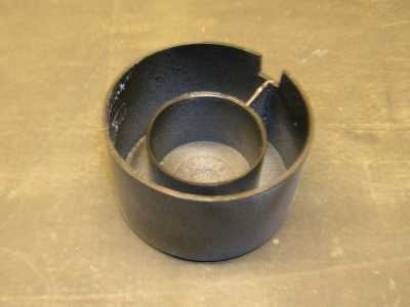
| Suggestion When spraying painting any of the small items such as the cab doors or the boiler, place the item on an upturned lid, shown right, from a spray paint can. This provides the opportunity to easily paint the items edges and make life easier when picking it up. |
| Suggestion In between painting coats, when the item being painted has dried, scrape off any paint residue, from the upturned edge of the lid. If you don�t, the paint tends to flake off and usually falls onto your newly painted surface of the next item. |
 |
 |
 |
 |
 |
 |
|
|
|
|
|
|
| Page last updated on : |
| 29/01/2006 |
| Copyright (c) GALT Locomotives 2006, all rights reserved |