|
 |
|


|
PEEL'S PARADIGMSCAROLINE HERSCHEL
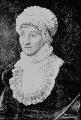
Caroline Herschel�s accomplishments are remarkable when you consider what life was life for women in Western Europe in the 1700s (and indeed, right up until the 1960s). Life was very constrained. Women were expected to achieve a certain age, then get married and have children, unless they were needed to stay at home and act as servants for the rest of the family. Maiden aunts traveled everywhere, not in search of adventure but to look after their relations. Indeed, that was how Caroline Herschel first got her start. Her brother William, a successful musician in Bath, England, sent for her from their parents home in Hanover (now Germany) to be his housekeeper. Once there, she became fascinated with his hobby of astronomy, and soon he recruited her as his apprentice, for he had need of her assistance. This article is laid out in chronological fashion. I begin with some insight into the history of science and astronomy up until the late 1700s. About 150 years before William Herschel, in 1609, Italian scientist Galileo Galilei heard of a Dutch invention of an instrument that brought distant objects closer to the eye. Galileo figured out the principle on his own and constructed his own telescope, which he turned on the stars. Immediately Galileo made a discovery that would -eventually - revolutionize mankind�s view of the Earth as the center of a perfect universe. Among many other observations, he saw that the planet Venus assumed the crescent shape, i.e., had phases, just like the Moon. This was something that was possible in the Copernican theory of the solar system (with the planets revolving around the Sun, not the Earth) but not in the Ptolemaic sysetm (everything revolving around the Earth). Many more astronomers throughout Western Europe began acquiring, or building their own telescopes to look at the stars. Observatories had been in existence for a long time - now they were being fitted with telescopes - which became larger and more cumbersome as time went on. Astonomers (as well as other scientists) also had to be careful in how they published their findings. Whichever religion was prominent in the location in which the astronomer found himself, dictated the religion of the astronomers who were allowed to live and work in that area. In 1616, Galileo�s book, Starry Messenger (in which he suggests the Earth revolves around the Sun) and Copernicus� book On the Revolutions of the Heavenly Spheres (published in 1543) were banned by the Catholic Church. Johannes Kepler, a Protestant, had fled to Germany in 1600 to because of religious differences in Austria. He became an assistant to Tycho Brahe during the last year of his life. He studied Mars In 1626 he is forced to flee from Linz, where he had fled from Prague due to the religious wars between Protestants and Catholics, finding refuge in Silesia. There he published his tables of planetary motion. In 1633, the Catholic Church forced Galileo to renounce his views publicly and say that the Earth is motionless, and that everything revolves around the Earth. He was then put under house arrest for the rest of his life. (Galileo was more in trouble for is supercilious manner than for his actual astronomical beliefs). Galileo died in 1642. In this same year Isaac Newton - who will discover the principles behind gravity - is born. In 1655, Christiaan Huygens, at the age of 26, begins experimenting with new ways of figuring lenses for microscopes and telescopes. With one of his new telescopes he sees a flat ring around Saturn, and later that year, discovers Titan, Saturn�s largest moon. In 1656, Huygens invents a pendulum clock, the first one accurate enough for scientific measurements. In this same year English scientist Edmund Halley is born.
In 1665, German scholar Athanasius Kircher published the most highly regarded geology book of its time, in which he described the Earth as riddled with caverns and tunnels in which dragons lived. [4] In 1675, the Royal Greenwich Observatory is founded at Greenwich, London, England. John Flamsteed is its first director, and Astronomer Royal. In 1682, 1682, Edmund Halley observed a comet, which he believed to the same one recorded as seen in 1456, 1531, and 1607, since its path through the sky is identical each time. He predicts it to return in 1758. In 1687 Isaac Newton published his Principia Mathematica which postulates his laws of gravity . The first viable explanation of why planets have elliptical orbits is also given in this book. (Kepler discovered that planets did have elliptical orbits, but did not know why this should be so, mathematically.) In 1714, German-Dutch physicist Gabriel Dante Fahrenheit devised a thermometer in which a thread of mercury expands upward into a thin tube containing a vacuum from a reservoir in a bulb filled with mercury. In this same year, a Hanoverian prince, George Louis ascended the throne of England as George I. Many Hanoverians (Germans) follow the Georges to court, which paved the way for one of the most famous astronomers, Friedrich Wilhelm Herschel to do so, many years later during the reign of George III. In 1715, Edmund Halley considered the saltiness of the sea and reasoned that if he could measure the salt content, he would be able to ascertain how old the Earth really was. He suggested the Earth was about a billion years old. In 1720, Edmund Halley bcame Director of the Royal Greenwich Observatory, after the death of John Flamsteed. In 1722, John Hadley, with the improved materials of the day, is able to produce a reflector telescope superior to the aerial telescopes of Christiaan Huygens. In 1727 Sir Isaac Newton died. In 1736, a French expedition under Pierre Louis de Maupertuis went to Lapland, near the North Pole, to measure the curvature of the Earth there. At the same time, another French expedition, under Charles de La Condamine, went to Peru, near the Earth�s equator, also to measure the Earth�s curvature. These two expeditions proved that Newton had been right, way back in 1687, and the Earth had an equatorial bulge. In 1738 Friedrich Wilhelm Herschel was born in Hanover. He was the eldest of six children. His father, Isaac, tended gardens to support his family. He was also a musician. In time, his mastery of music led him to secure a position as a bandsman in the Prussian army. He encouraged all of his six children to train in mathematics, French and music. In 1742, Swedish astronomer Anders Celsius devised the celsius scale for measuring temperature. Caroline Herschel was born in 1750.
 Buy Now
This article will continue next issue with the life of William Herschel.
 . .
|