|
General Information Regions: Links: Community of Portuguese-Speaking Nations Brazilian Institute of
Geography and Statistics |
Most of Brazil lies in the tropics, however, more than 60 percent of the
population lives in areas which are cooled either by altitude, sea winds or
polar fronts. Plateau cities such as São Paulo, Brasília and Belo Horizonte
have mild climates, and the southern cities of Porto Alegre and Curitiba have
a climate similar to that of southern Europe. Most of Brazil lies in the
southern hemisphere, where the seasons are the reverse of those in Europe and
the United States. Brazil
is the largest Latin American country, with an area of 3,286,470 sq. miles (8,511,965
sq. km), covering nearly half of the South American landmass. It is the fifth
largest country in the world after the Russian Federation, Canada, China and
the United States. Brazil's maximum width, 2,684 miles (4,319 km), is almost
the same as its maximum distance from north to south, 2,731 miles (4,394 km). Brazil is the only Portuguese speaking country in South America. Brazil’s
typical ethnic groups are Portuguese,
Germans, Italians, Spanish, Polish, mixed Caucasian and African, African,
Amerindian (mainly Tupi and Guarani linguistic stock), Japanese, and other
Asians and Arabs. Brazil
has common borders with ten territories: the Department of French Guiana and
the countries of Suriname, Guyana, Venezuela and Colombia to the north;
Uruguay and Argentina to the south; and Paraguay, Bolivia and Peru to the
west.
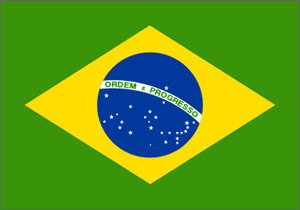
The Brazilian Official National Flag Sources of information: Brazilian Embassy in London, Brazilian Office
of Tourism and Brazilian Institute of Geography and Statistics |