
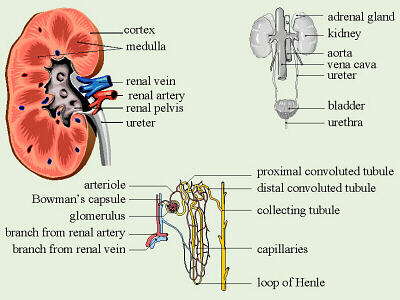
The kidney is composed of an outer layer, the cortex, and an inner core, the medulla. The kidney consists of (tubules) called nephrons. The �tops� of the nephrons are in the cortex, while their long tubule portions make up the medulla. Each nephron has a closely associated blood supply. Blood comes in at the glomerulus and transfers water and
Antidiuretic hormone (ADH) from the pituitary is one factor influencing urine production. ADH promotes water retention by the kidneys, and its secretion is regulated by a negative feedback loop involving blood water and salt balances. ADH helps the kidney tubules reabsorb water to concentrate the urine. When the blood water level is too high (when you�ve been drinking a lot of liquids), this acts as a negative feedback to inhibit the secretion of ADH so more water is released. Ethanol also inhibits secretion of ADH, so a person who consumes a lot of alcoholic beverages could excrete too much water (becoming dehydrated). Many diuretics work by interfering with ADH production, thus increasing the volume of urine produced. These diuretic effects are one reason why a person drinking beer (alcohol) or coffee (caffeine) needs to urinate more frequently.
When a person�s kidneys cease functioning, due to illness or other causes, renal dialysis can be used on a short-term basis to filter the person�s blood. However, it can�t do everything a person�s kidneys can. Typically a person is put on renal dialysis as a temporary measure to extend the person�s life until a kidney transplant can be found. While life saving, this procedure is often very inconvenient and stressful for the person. It requires spending long periods of time, several days a week, hooked up to the dialysis machine: the person�s blood must actually pass into the dialysis machine so the wastes can be filtered out, and then the blood is returned to the person�s body. This, combined with symptoms caused by the renal failure (the inability of the person�s kidneys to function) often preclude working at a job to earn the money to pay for the treatment. People can get by with one kidney, and the closest tissue match for a kidney transplant is often a sibling.
Some diseases and disorders of the urinary system include:
Nephritis - an inflammation of the glomeruli, due to a number of possible causes, including things like strep throat. Symptoms include bloody urine, scant urine output, and edema (swelling/puffliness). Another, more severe form, is due to an autoimmune attack on the glomeruli. Other types of nephritis affect the tubules.
Nephrosis also affects the glomeruli, and is characterized by excretion of abnormally large amounts of protein (often causing �foamy� urine) and generalized edema (water retension/swelling) throughout the whole body, especially noted as �puffy� eyelids. Because these people�s kidneys often do not handle sodium properly, a low-salt diet is usually prescribed.
Most urinary tract infections (UTIs) are caused by Gram negative bacteria such as E. coli. If there is an obstruction of the urethra, catheterization may be needed, but as a general rule, catheterization in cases of UTI is contraindicated because it can actually introduce pathogens and make the infection worse.
Kidney Stones - There are a variety of types of kidney stones depending on what conditions caused their formation. According to the Merck Manual, in the United States, about 80% are calcium oxalate (and/or other calcium-based stones), 5% are uric acid, 2% are cystine, and the other 13% due to magnesium ammonium phosphate or other causes. Stones may be microscopic to large �staghorn� stones that fill the whole renal pelvis. Often, as the stone is passed down the ureter, the person experiences much pain, and the affected kidney may even temporarily become nonfunctional. Stones may be broken up by ultrasound so they can be passed more easily, but large stones may have to be surgically removed. If possible, the underlying cause of the stone(s) should be identified and alleviated. For example, calcium stones might be caused by anything from a parathyroid gland problem to too much vitamin D to some forms of cancer to a genetic predisposition


