

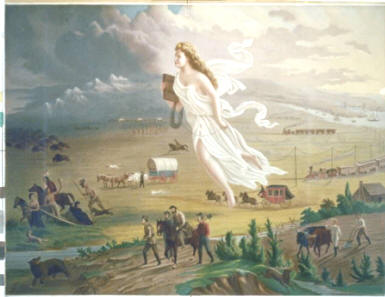
Manifest Destiny: The idea that America was destined to expand its boundaries over a vast area on the continent of North America fueled American Nationalism and a vision of social perfection. Westward expansion was a movement to spread both a political system and a racially defined society because of their belief in superiority of the white european descendence race. There was much controversy on differences in territorial goals such as by what means and how far they were to expand. Also, many who opposed the expansion did so becuase of fear that this would reopen opportunity for threat to a stable union. |
 |
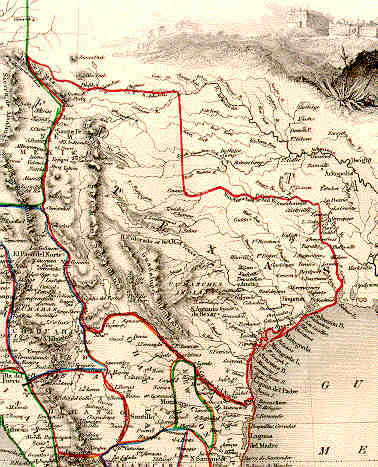 |
Americans in Texas: After refusing the Americans twice to int he purchase of Texas, the Mexican government made the foolish decision to allow American immigration to its lands.The Mexican government believed this would increase its revenue and also serve as a buffer to their expansion, so they desigened a colonization law in order to attract the Americans offering them cheap lands and exemption from taxes for four years. What the Americans had to do in exchange was bring more settlers. Stephen Austin was a very successful man who did this and established powerful American centers int his region who little by little began taking over. |
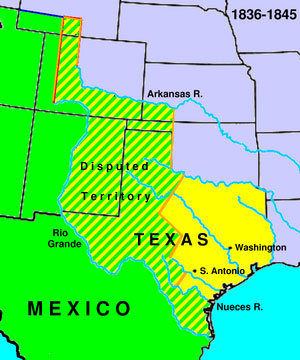
Tensions between the United States and Mexico: American settlers were unhappy with Mexican regulations and problems arose because of the cultural and economic ties the settlers still maintained, as well as the legalization of slavery which was illegal in Mexico since the 1830's. As a dictatorship was put into action due to instablility the settlers responded with revolts and the the proclamtion of their independce from Mexico.After a victory at the San Jacinto battle, the Americans won their independence from Mexico and it soon yearned for annexation from the U.S. but was rejected by many . it became one of the biggest issues of the 1844 election. |
 |
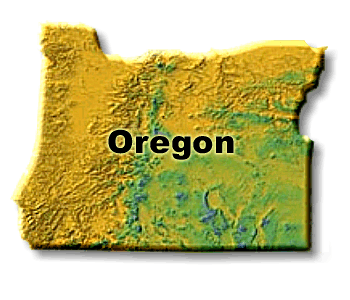 |
Oregon: Since there were disputes between claims over "Oregon Country" between the Americans and the British they came to an agreement called "joint occupation" (they both has equal access to territory). Neither country had much of a presence in this region at the time, but in the 1820's and 1830's a suddden interest arose especially within the missions to spread religion which encouraged white settlement into the region. By the 1840's the Americans significantly outnumbered the British and devastated the Indian population with a n epidemic which resulted in the destruction of the church by the indians. Soon, the settlers began urging U.S government to take possession of this territory. |
The Westward Migration: The migrations into the newly joined territories was a very large movement of Americans into the far west. Most southerners migrated to Texas while a large number came from the Old Northwest region.Many traveled in groups of families, some came alone, and very young, and others who sould not afford it arrived as farmers, but all the groups varied depending on the destination. All of the people were in search of a new life but differed in expectations. |
 |
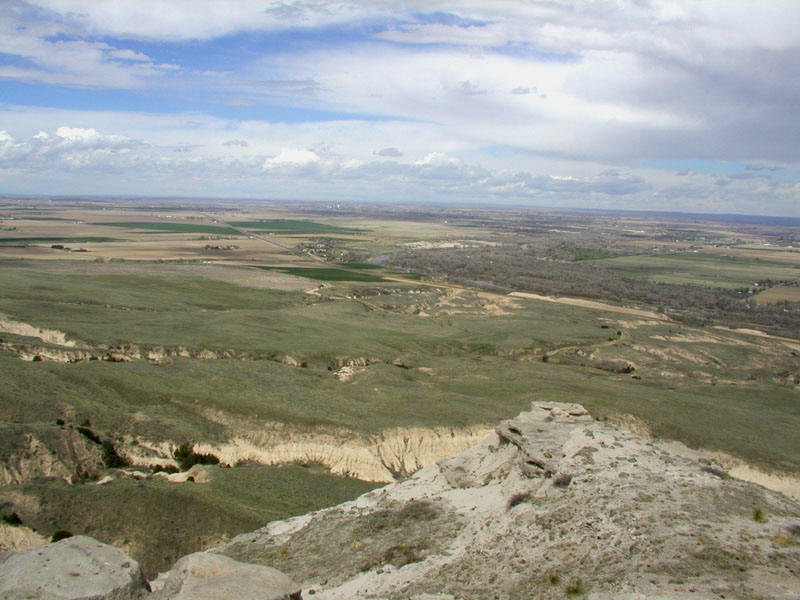 |
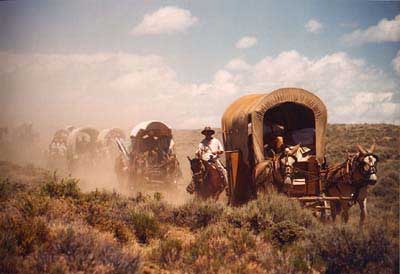
Life on the Trail: Most migrants traveled along the great overland trails and gathered to travel in groups by wagon led by hired guides.The main route west was along the Oregon trail which stretched about 2,000 miles where the migrants from there would move either north into Oregon or south into California. The migrants however, were put through a lot of hardships during their journies because of the difficult terrain and the slow pace. And although they were on the go, they were still able to recreate many of the patterns of American society such as the division of tasks among genders which allowed for organization and avoided conflict. |
11.1 Students analyze the significant events in the founding of the nation and its attempts to realize the philosophy of government described in the Declaration of Independence. |
|
|
| Examine the effects of the Civil War and Reconstruction and of the industrial revolution, including demographic shifts and the emergence in the late nineteenth century of the United States as a world power. |
Looking Westward| Expansion and War| The Sectional Debate| The Crisis of the 1850's| Lyceum