

Author:
Abramov
Sergey Stanislavovich, Cand.Sc.,
Node voltages calculation algorithm for an autonomous electric power system
Two-level algorithm developed to simulate non-symmetrical electromagnetic transients in 3-phase autonomous electric power systems. The algorithm should be suitable for systems with a varying structure.Introduction
This article has to do with electromagnetic and electromechanic transients simulation related to autonomous electric power systems. Unlike large power systems autonomous ones have some important features. One of them consists in changeable voltage values and frequencies related to system's nodes. When any transient process occurs motors and other loads affect these variables. The set of equations I have used in my Java program enables me to create a numerical integration algorithm that takes into account magnetic saturation and eddy currents arising within iron components of electric machines. Field distribution is simulated by quadrature formulae as per Prof. Dr B.V.Sidelnikov. At first I used the explicit Adams and Runge-Kutta non-iterative algorithms assuming the integration step to be constant during the whole process under study. I have determined this parameter experimentally to ensure a stable integration process. Adams method is more numerically stable in reference to simple electric circuits that do not require an algorithm solving stiff ordinary differential equations [3]. The stiffness is a ratio of the largest to the smallest time constant. This ratio can be on the order of 1000. To avoid numerical instability due to the stiffness and reduce the computational time it is possible to employ implicit multi step methods. The implicit Adams integration method enabled me to increase an integration step. So simulation process takes less time as compared to explicit algorithms despite the necessity of iterations. My program calculates node voltages in a three-phase electric system including AC generators, motors, static loads and transmission lines. I attempted to develop a method published in [1, 2]. Some papers present the so-called mixed equation set where the variables related to rotors of electric machines are presented with the aid of Park transformation while stator ones are described in terms of 3-phase axes of ordinates. I have also used this method.
To calculate transients in autonomous electric systems in phase axes of ordinates I designed Turbo Pascal and Java programs. To speed up the simulation process the Netbeans IDE with C++ module has been used. Below is a picture representing my program interface and 3 panels containing regime and motor parameters. One of my graphics illustrates induction motor (5 kWt) start and subsequent revers simulation results too.
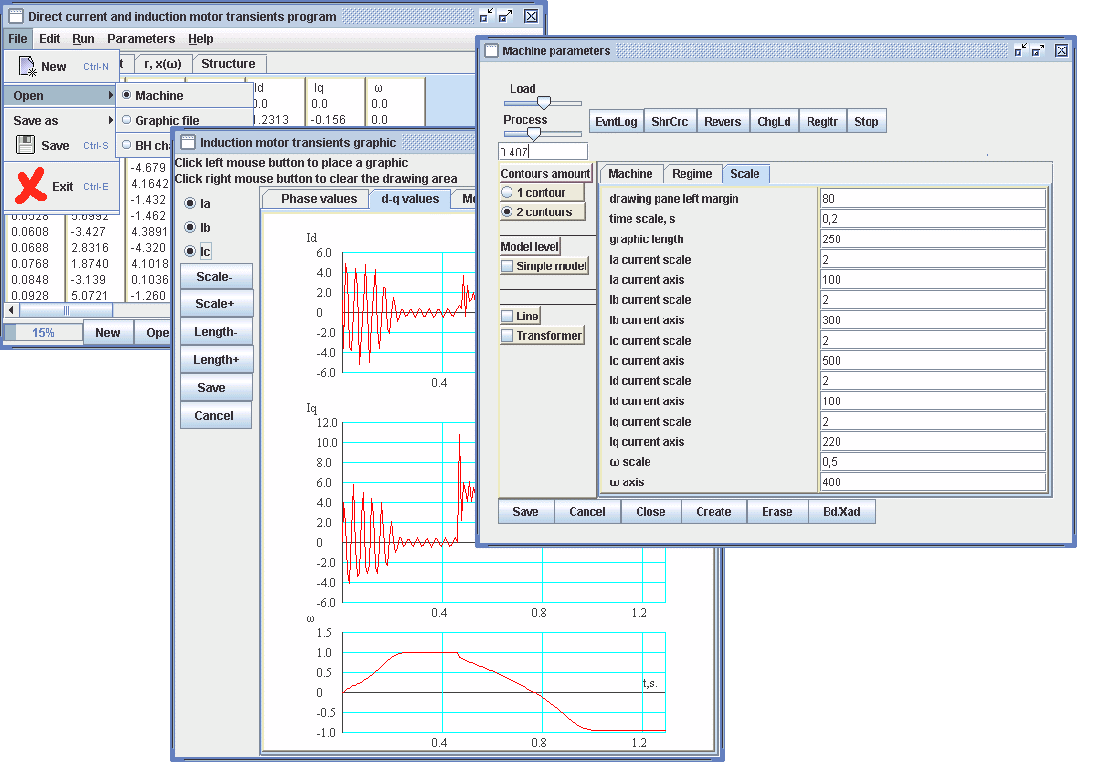
It should be noted that Java uses the so called "virtual machine" - JVM. It takes several seconds for my Turbo Pascal program to calculate a transient process in a simple power system but the corresponding Java program works much slower compared to a DOS version, if C++ module is not employed. Fortunately this module enabled me to calculate transients as fast as the Turbo Pascal program does. With the aid of the Netbeans IDE it is possible to create executable JAR - files. As I use Windows platform it is worth making executable EXE - files. They can be obtained with the aid of Excelsior JET software or some cheaper programs like Jar2Exe or Xenoage Java Exe Starter 2.0. I hope to improve my program to make it more flexible and capable of simulating autonomous power systems with a varying structure. I described electric machines as Java objects, each electric machine type is simulated by Java class so it is possible to add and remove machine models during the program execution.
To immediately start calculating transients in a variety of autonomous power systems you can employ commercial programs, e.g. PS-CAD. But these programs are very expensive. Those interested in free power system simulation software can join the European EMTP-ATP Users Group These open sourced programs have been developed for more than a decade. Still the software is only available for the members of this group. To join the group it's necessary to fill a form and send a hard copy to the address indicated on the web site. A lot of mathematical models of such power systems have already been developed so it seems senseless for me to make a software that can be regarded as their alternative. I am going to update my site taking into account its possible usage just as an educational program.
To simulate transients in an electric system it is necessary to describe its elements. When I calculated these processes I used a two-level model of the system developed in [4]. This method can be applied if it is desirable to calculate more precisely the characteristics related to a particular electric motor or generator while others can be described in a more simple form. E.g. if a short circuit occurs in the synchronous generator the detailed equation set is required to obtain currents and electromagnetic torques in this machine. This is also important if the short-circuited machine has been switched off, so the excitation current of a generator due to a control system influence can reach the value of 3 to 4 in p.u. and the magnetic circuit of this machine becomes saturated. The motors and other loads connected to these nodes should also be represented by detailed equations. They have to take into account all principal physical phenomena in electric machines. But generators and loads, connected to this nodes via long transmission lines hardly need a detailed model. Some loads can be described extremely simply if their influence on the most important system processes is weak.
Rather often AC machines are presented in the so-called Xad form. The assumptions and simplifications are summarised here:
-reactances Xad and Xaq are considered constant,
-variables related to the direct axis d and perpendicular one q do not affect each other;
-the distribution of a magnetomotive force through the pole pitch is sinusoidal due to the stator windings arrangement,
-flux leakage reactances do not depend on the currents. The latter assumption can be invalid under certain conditions (e.g. if stator currents are extremely high and the magnetic circuit is saturated, but this does not relate to a large number of regimes taking place in electric machines working in power systems).
These assumptions often work fine but sometimes it is desirable to obtain more precise transient characteristics of certain machines working in an autonomous electric power system. So it is worth using a detailed model for them. The AC machine model used in my program is derived from the equation set described in [5]. Some formulae describing saturated machine model are in this pdf-file . Prof. Sidelnikov created a more sophisticated model than that used in my algorithm but is seems too complicated to be employed in node voltage calculation. Besides internal physical processes in a machine which are described by a detailed model can be simulated after the calculation of the node voltages executed with the aid of a more simple model used in my program.
The transient process taking place in a simple power system when an induction motor starts is represented in Fig.1. Both models were used to calculate currents presented in d, q - form and the rotation speed. It should be noted that iron machine parts are not saturated in the course of this transient process. So these characteristics seem to be almost identical. But this is not always the case. When different regimes are simulated the magnetic saturation of iron components can take place. So the simple model usage may require the correction of the reactance Xad to obtain almost the same characteristics as those simulated by the detaled model. It is advisable to make the appropriate correction simulating different regimes. This algorithm enabled me to create mathematical models of power systems containing several machines. It is hardly worth creating autonomous power system model using detailed partial models for all their elements.
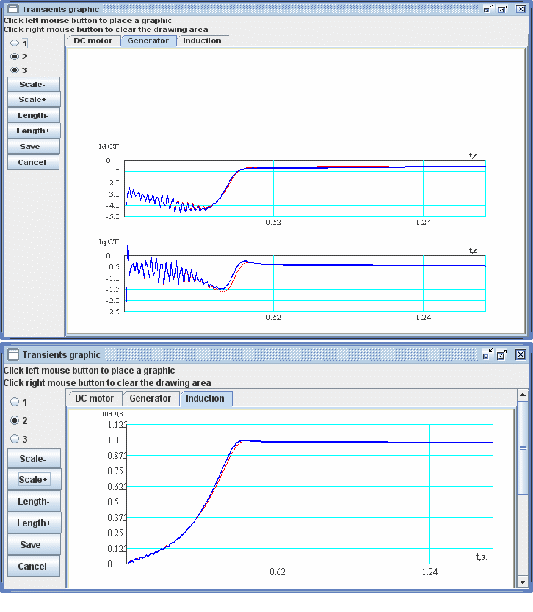
Fig.1 - ______________ - simplified model,
______________ - detailed model.
Conclusion
This is a brief overview of my two-level algorithm and a program. Originally I was going to distribute my programs free for non-commercial purposes. Still my copyright should be previously confirmed all the same as I don't want to be accused of anybody's intellectual property theft. Besides it's hardly probable I will be able to persuade my management to let me inspire this project. It would take me about several years to create any commercial grade program. What for? So I decided to only publicise scientific materials arising in the area in question. It doesn't require any downloadable program. What's more a lot of scientists can write programs by themselves. Some aspects of Java native methods usage with the aid of Netbeans C++ module and MinGW C++ compiler will be placed on my new web page. It is possible to unite Java's graphical interface and Fortran or C++ standard math functions. To my mind it's the only reason to use Java in scientific research, I have come to this idea after about three years of explorations.
Notes
My programs have been created by myself and don't concern any projects developed by the company I work in. You can also visit another my web page to read about a free energy research.
Reference list
1. Jasakov G.S. The model and algorithms for solving the equations of a self-contained power system of arbitrary structure// Electricity. 1991. Vol. №3 p.5- 12.
2. V.I. Finagin. Automatic formation of mathematical models for autonomous power systems.//Electricity. 1981. Vol. №7. p. 20-24.
3. Modern numerical methods for ordinary differential equations. Edited by G.Hall and J.M.Watt. Clarendon Press. Oxford. 1976.
4. S.S. Abramov. Development of a method of electric machine regimes analysis working in an autonomous power system with an electromechanic converter: Thesis. Saint Petersburg Technical University. 1995. 233 pages.
5. B.V. Sidelnikov. Saturated synchronous machines transients analysis with the aid computers: Theoretical and experimental research of powerful turbo generators and hydro generators. Leningrad, 1968, 308 pages.
6 V.F. Sivokobylenko, B.V. Sovpel. Calculation of equivalent AC machine parameters with the aid of transient and frequency characteristics; News of the Academy of Science of the USSR. Energetics and transport. 1976. Vol.№5. p.17-22.
Last modified: 12/05/2007