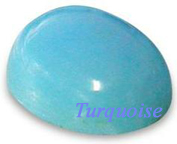
The name 'turquoise' means 'turkish stone' because the trade route that brought it to Europe used to come via Turkey.
Colors in turquoise range from sky blue (most desirable color) to blue green and apple green.
Shakespeare used this lore in "The Merchant of Venice'.
In it, Leah gave a turquoise ring to Shylock when he was a bachelor, hoping it would win his affections so he would ask her to marry him.
In Russia, the turquoise is popularly used in wedding rings.
It is considered by some as a love charm. When received as a gift, the turquoise symbolizes a pledge of affection.
Turquoise has many legends and lore.
It is said to hold the color of the atmosphere that surrounds the earth giving breath and life.
In Tibet, it is valued in the same way as jade is in China.
Turquoise was used to decorate the tombs of the Pharaohs as well as sword handles, bowls, costumes, seals and other ornamental objects of the Persians, Romans, Greeks, Aztecs, Mexicans, Chinese, and even Native Americans.
It was also worn as eyeliner and ground and swallowed for healing purposes.
The Apache lore holds that if a piece of turquoise were placed on the bow or rifle, it would cause accurate aim.
In Navajo legends, a piece of this gemstone, thrown into a river while praying to the rain god, would cause rain.
In the Zuni, Hopi and Pueblo Indian beliefs, Turquoise held secret healing energy and was the unifying power between the spirit of the air and the spirit of the earth.
Zircon
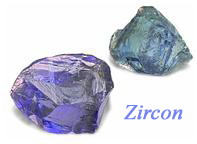
Another birthstone for December is the zircon. Its name is derived from the Arabic words "zar" and "gun", meaning "gold" and "color".
The gemstone is found in a wide range of colors, and possess great brilliance, fire and clarity.
Zircon, in its unchanged natural form appears colorless to pale yellow, or green.
During the Fourteenth century, zircon was popular as a safeguard against the Black Death, the great plague that wiped out one quarter of the population of Europe.
The stone was believed to possess healing powers. It was prescribed to insomniacs to induce sleep, used as an antidote against poison, and as an aid to digestion.
The legend of Zircon began when Hyacin, the Greek youth, was killed.
A blue hyacinth flower grew from the spilled blood.
The blue color of the zircon found in Greece matched the blue of the flower.
Pliny, the elder, started this legend by his written comparison of colors.
Zircon rival diamonds in brilliance and fire, and are the heaviest transparent stone known.
The popular colors, white golden brown, and blue are produced by heating the natural brown or yellow stone.
It was used by many of the ancient civilizations as an amulet.
As legend holds, a person who wears a blue zircon, "the Sailors and Travelers Stone," would be guaranteed a warm welcome everywhere, as well as be guarded from being hit by lightning, the plague, wounds and injuries.
Because of its brilliance, it was said to provide good sleep, give great prudence and common sense.
Therefore, it meant financial success.