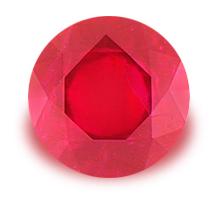
Ruby is from the Latin "ruber" meaning red. In Sanskrit it was called "ratnaraj" meaning "king of precious stones".
The most desired and expensive color of ruby is the deep blood red shade called, "pigeon red," because of its exact dark resemblance to that of pigeon blood.
Legends & Lore
In the Orient, rubies were once believed to contain the spark of life - "a deep drop of the heart's blood of Mother Earth", according to ancient Eastern legends.
Ancient Orientals believed that the ruby was self-luminous.
They called it "glowing stone" or "lamp stone."
It's said that an Emperor of China once used a large ruby to light his chamber, where it glowed as bright as day.
Brahmans - Hindu priests of the highest caste - believed that the homes of the gods were lit by enormous emeralds and rubies.
Later, Greek legends told the story of a female stork, who repaid the kindness of Heraclea by bringing her a brilliant ruby - a ruby so bright that it illuminated Heraclea's room at night.
During medieval times, it was believed that the ruby held the power to warn its owner of coming misfortunes, illness or death, by turning darker in color.
It is said that Catherine of Aragon, first wife of King Henry VIII, predicted her downfall in seeing the darkening of her ruby.
Ruby is said to open one's heart to love.
According to ancient lore, a Ruby is capable of reconciling lovers' quarrels.
Ruby engagement rings are given to express passion and promise of their heart. Ledgend has it that a ruby instills health, wealth, wisdom, and success in love.
Rubies were also associated with mythical creatures like the Dragon.
In China and Europe, in the 10th century, dragons and snakes were carved in their surfaces.
Many believed rubies possessed an inner flame which burned eternally.
HIstory
The ruby is among the most highly prized of gemstones.
Transparent rubies of large sizes are even rarer than diamonds.
As a result, rubies' value increases with size more than any other gemstone.
Because of their rarity, there are very few famous large rubies.
In Marco Polo's 13th century books of his travels, Marco Polo relates the tale of a magnificent gemstone - believed to be a ruby nine inches long and as thick as a man's arm - belonging to the King of Ceylon.
Kublai Khan, the Emperor of China offered an entire city in exchange for the enormous stone, to which the King of Ceylon replied that he would never part with his prize for all the treasures of the world.
The name ruby which is derived from the Latin 'ruber', meaning red, was once used to describe all red stones, including red spinel, red tourmaline and red garnet.
Many famous rubies in history turned out not to be rubies after all. For example, the famed Timur ruby - given to Queen Victoria in 1851 - was later found to be ruby spinel.
Meanings & Symbol
* Meaning : Passion & Power, Affection and Majesty, Chastity, Glory, Contentment
Today, it is a symbol for nobility. success, devotion and integrity.
Rubby & Sapphire
Ancient Hindus, Burmese and Ceylonese regarded sapphires as unripe rubies, believing that if they buried the sapphire in the ground, it would mature to a rich red ruby.
Along with its close relative, the sapphire, the ruby is a form of the mineral corundum, which is normally drab and grey in color.
Red gemstone corundum is called ruby.
All other gemstone corundum colors - orange, yellow, brown, green, blue, purple, violet, black, and colorless - are called sapphires.