



The NeXT Step
Jobs sold over $20 million of his Apple stock, spent days bicycling along the beach, feeling sad and lost, toured Paris, and journeyed on to Italy. It was not until late August that he began to catch his breath. Then Jobs thought back on his experience at Apple. Though he is not an engineer, he felt his greatest talent had been spearheading development of new products. Jobs also recalled with special pride that he had helped introduce personal computers into education. To collect his thoughts one day, he took up pen and paper and began to write down the things that were important to him. Along with the development of the Macintosh, he listed three educational projects he had launched: Kids Can't Wait, Apple Education Foundation, and the Apple University Consortium.

Inspiration came at the beginning of September 1985 when he had lunch with Paul Berg, a Nobel laureate in biochemistry at Standford University. Paul Berg explained to Jobs the time consuming trial and error experiments carried out to extract DNA. Jobs asked whether Berg had ever thought of speeding up these experiments by simulating them on a computer. Berg said most universities did not have the necessary computers and software. "That's when I started to really think about this stuff and get my wheels turning again," says Jobs.
On September 12, 1985 Steve rose in the board meeting and said in a flay, unemotional voice, "I've been thinking a lot and it's time for me to get on with my life. It's obvious that I've got to do something. I'm thirty years old." Offering to resign as chairman, Steve said he intended to leave the company to start a new venture to address the higher education market. The company Jobs envisioned would have sales reaching $50 million annually in a few years and would not be competitive with Apple, only complementary, and that he would take with him only a handful of personnel. John Sculley said, "all of us want you to reconsider your decision to resign from the board. Apple would be interested in buying 10 percent of your new company." Jobs told the board he would think about it and tell them his decision the upcoming Thursday.
That Thursday Jobs went into Sculley's office and handed him a piece of paper with all five employees that would leave with him. The employee's were Rich Page, an Apple Fellow and one of the company's most import engineering designers, Daniel Lewin, the marketing manager for higher education business, Bud Tribble, the manager of software engineering for Macintosh, Susan Barnes, Senior controller for US. sales and marketing, and George Crow, an engineering manager with vast Macintosh experience. Together, they knew Apple's internal schedules, costs, focus of NeXT products, schedule of when Apple would introduce them, how they would be used, and which individuals and universities Apple would work with to ensure their success. The board authorised Sculley to begin litigation on the basis that Steve allegedly made plans for the new company while serving as Apple's chairman, and that Steve falsely represented his company and intentions to the board.
A Software Company
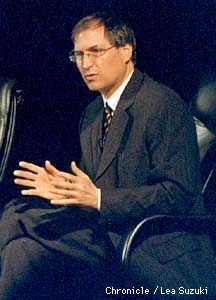
After leaving Apple, Jobs' new revolutionary ideas were not in hardware but in software of the computer industry. In 1989 Jobs tried to do it all over again with a new company called NeXT. He planned to build the NeXT generation of personal computers that would put Apple to shame. It did not happen. After eight long years of struggle and after running through some $250 million, NeXT closed down its hardware division in 1993. Jobs realised that he was not going to revolutionize the hardware. He turned his attention to the software side of the computer industry.
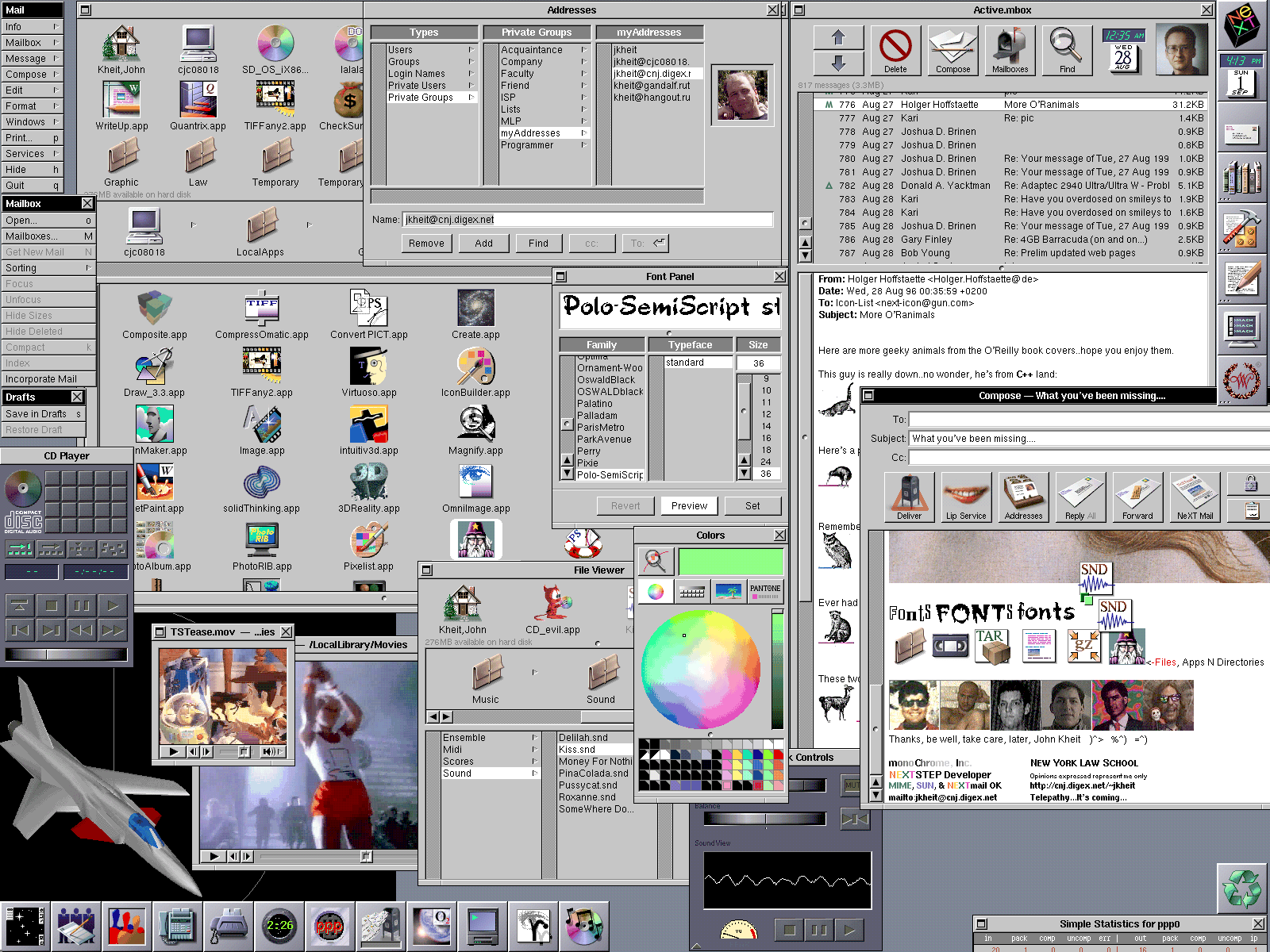
In 1994, Jobs feels there is a lot of money in developing an object-oriented industry that would fix the problems companies have in developing software. The corporate developers are going to fuel the object revolution because they know they have a giant problem that needs to be solved in software development, and PC makers are doing less to serve the needs of software developers. Jobs said, "Our primary mission is to establish NeXTStep as a leading operating system in the Nineties." Now, Jobs invisions NeXTStep will revolutionize the computer industry by its operating system software which incorporates a hot technology. It's called object-oriented programming (OOP), and OOP lets programmers write software in a fraction of the usual time. Jobs feels OOP is the solution to corporations problems of wasting money to develop software because OOP serves as a blue print to develop programs like blue prints for constructing a building. Jobs thinks the OOP paradigm will have a great effect on the production of software like the effect the industrial revolution had on manufactured goods. "In my 20 years in the industry, I have never seen a revolution as profound as this. You can build software literally five to ten times faster, and that software is more reliable, easier to maintain, and more powerful," says Jobs.
Jobs feels software programs have gotten bigger, more complicated, and much more expensive to produce. Object-oriented programming changes that by allowing gigantic, complex programs to be assembled like Tinker toys. Programmers will use pre-assembled chunks of code to build 80 percent of their program thus saving an enormous amount of time and money.
The criticism Jobs received from building the NeXT computer was that he failed in trying to build a second computer empire. Jobs's goal was to produce a NeXT computer for $3,000 that would land on the desk of every college student. In designing the NeXT computer, he ignored the demands of the computer market. Even his own experts were saying: "Keep in touch with the intended customers and avoid the pitfall of anerobic isolation; do not assume that the customers will pay any price to secure the latest computer technology; ease the way for customers to adopt a new standard by providing software and hardware bridges that help connect older machines to the new ones." According to developers, he disregarded every one of these lessons when he launched NeXT computer.
In mid 1989, after long delays which Jobs was never blamed for, NeXT finally introduced a $7,000 monochrome system. The system had no floppy disk, virtually no useful software applications, and a slow magneto-optical disk. When the NeXT computer was introduced, the academic world and corporate America rejected it. In the end, only about 50,000 NeXT machines were ever built, and in February 1993 Jobs announced that NeXT would stop producing hardware and focus all its energy on the NeXTStep operating system. The operating system was promised to run on a wide variety of platforms.
Jobs recurited an Englishman, Peter van Cuylenburg, age forty-four as his number two person in NeXT to help promote the NeXT computer and organise the company's management. The company's management had decimated. In the past few months virtually all of NeXT's vice presidents had quit. Van Cuylenburg said the quitting of vice's presidents was due to his own toughness. He said, "I've put pressure on the company, and not everyone was willing or able to accept it. NeXT had too many vice presidents when I arrived, so Jobs and I decided to eliminate some."
Jobs and Cuylenburg planned on releasing NeXT software to run on other companies computers by the fall of 1993. NeXT did release a version of NeXTStep's operating system for PC's equipped with Intel's 486 microprocessor. Still, the market did not fully accept NeXT's operating system over OS/2 or Microsoft DOS.
NeXT had also talked with Hewlett-Packard, Sun, and others about licensing NeXTStep to run on their machines. But these companies thought it was a ridiculous idea, because NeXT is trying to acrimoniously compete against them in hardware. Cuylenburg admits that the scenario makes sense only if NeXT's hardware business is small enough that the major players do not see NeXT's computers as a threat.
Jobs feels NeXT is moving slowly but surely to being a software
company that makes great reference hardware. That is NeXT will have
a machine that provides a benchmark of quality. The NeXT operating
system will be in a three-way race for the object-oriented operating system
of the Nineties against Microsoft's Cairo project and Apple's and IBM's
joint venture.
 |
|
|
Considering that object-oriented software has become the key to NeXT's future, it is ironic the Jobs committed the company to it almost by accident. When NeXT introduced its first machine, the Cube, in 1988, it was incompatible with existing computers. These computers had virtually no software to run on them. Jobs urgently needed outside software developers to write programs for the Cube. He found the basis for his operating system in Carnegie Mellon University software called Mach, which happened to use object-oriented programming. Jobs' goal was not to ease programmers' lives; he just wanted to get some programs written and shrink-wrapped pronto so he could sell his NeXT computers.
NeXT squeezed its way into the field of being a good platform for companies to build object oriented programming through a review done by CKS Partners. CKS Partners is a San Francisco advertising agency founded by a bunch of old Apple colleagues. Jobs NeXT advertising agency needed help in promoting the NeXT, because it boasted about the computers hardware disk storage and processing chip technology, but gave no compelling reason for businesses to buy a NeXTStation. Jobs called on his old friends at CKS Partners to help his advertising agency out. CKS conducted focus groups of Fortune 500 managers in charge of information systems. They can up with the report there was little perception in the marketplace about NeXT. But important information came from a number of hard-core information systems geeks. They had discovered NeXT made it much easier and faster for companies' in-house programmers to customize software to handle important parts of their businesses. Rather than start from scratch, programmers using object oriented programming can do much of the job by looking in a library of preexisting software modules.
This was a good report to have about the qualities and benefits of using a NeXT computer, because if companies where to read analysist report on NeXT computers in a computer magazine. The companies could reduce the time in developing software packages by having a preexisting library full of code all ready written to handle specific operations. And NeXTStep provides an easy platform to create libraries, maintain, and integrate the code in a object oriented programing environment. The companies would see a solution to the problem of spending to much time and money in building software applications. Software developers could reduce their time in finding errors and maintaining its software, because object oriented design allows a nice encapsulated structure, information hiding, and communication between modules through messages.
A company O'Connor & Associates, a Chicago options and futures firm, claims its engineers can write a complex trading program in three months with NeXTStep versus over two years on a Sun workstation. Corporate mangers who ventured into using NeXT computers told NeXT, "You guys have one of the best products ever, but you do not even know it and you're not trying to sell it to us." Jobs recalls himself, "Companies came to us and said, "You're idiots, you just do not get it." Now that NeXT knew companies in the real world could solve problems faster with NeXT computers. NeXT needed to advertise better how their computer's performance and benefits could make companies more productive. So NeXT went to compare their system against their number one competitor Sun computer. The Company commissioned a study by management consultants Booz Allen & Hamilton that showed that corporate programmers worked two to nine times faster on NeXT machines, than on Suns and others. When Sun World magazine gave its highest rating not to a Sun machine but to the NeXTStation Turbo machine, a NeXT advertisement proclaimed:
NeXT CAST SHADOW OVER SUN.

From the review reports the company's sales have gone up, but NeXT has been forced to turn to its Japanese partner for cash infusions. Canon originally invested $100 million in 1989 and added another $10 million to $20 million in 1991 before extending that $55 million credit line last July in 1992. Canon holds an 18% equity stake Industry analysts say that the Japanese are increasingly scrutinizing their investment. The heat is on for NeXT to start producing high marginal returns from selling their NeXT products.
Jobs thinks NeXT can survive as a software company when he attacks his old enemy Apple and IBM. He does not think the Apple-IBM linkup will work: "Apple has a thousand software engineers, who have realized that Taligent is their enemy." If apple adopts IBM's Taligent software, Jobs explains their out of a job. Instead, he argued, if Apple will stick with its System 8, under development in-house, leaving IBM as Taligent's primary advocate in the marketplace. This would leave IBM in a bad position. Jobs admits that Microsoft has "market power" and sees Cairo as his main competitor.
Jobs feels his NeXT machines are going to be in high demand, because once businesses figure out how to use object oriented programming to solve most of their design problems. Business are going to buy NeXT computers to run the object oriented platform, because the businesses have money and will pay big money for things that will save them money or give them new capabilities.
Jobs thinks the advantages of NeXTStep software compared to its rival Microsoft is its ability to design programs in an object oriented design. Jobs perceives Microsoft Windows as a bad development environment. And Microsoft does not have any interest in making it better, because the fact that it's really hard to develop applications in Windows plays to Microsoft's advantage. Microsoft developed their software so companies cannot have small teams of programmers writing word processors and spreadsheets, because it might upset their competitive advantage. Jobs states that NeXTStep will become the preferred platform for businesses to develop software. Therefore NeXT software will out compete Microsoft in programming languages used to develop applications.
Jobs thinks object oriented programming will allow small company's to build libraries containing already built coded modules. These libraries will allow programmers to incorporate pre-existing modules to perform specific operations in their code. This type of programming technique will reduce time a programmer has to spend on writing code. Therefore less time spent on a project the company saves money. Since the library code has already been tested, programmers using the pre-existing code in their programs have fewer errors. Less errors to fix in a program means less time spent on the program which saves the company money. Jobs says NeXT software will literally let three people in a small business out perform what 200 people at Microsoft can do. Corporate America has a need to find a solution to their problems. Jobs feels NeXT software can save companies a lot of much money or make them a lot much money. If companies do not presently invest into object oriented programming, their developing technique will cost them large amounts of money. Later, when they try to re-organized their software system they fuel the object revolution.
Jobs believes Microsoft has not transformed itself into an agent for
improving things or a company that will lead the NeXT revolution in software
development. Jobs has become very concerned because he sees Microsoft competing
very fiercely to put a lot of companies out of business. This is hurting
innovation in the computer industry. Jobs feels the computer industry needs
an alternative to Microsoft's software in computer systems.
Text in the History pages is used courtesy of this
web site


 Neon Open SignsNeon Signsand Neon Signs