


Pixar Letter From Steve Jobs
---------------------------------------------------------------------------------------------------------------
From Steve Jobs
Chairman and Chief Executive Officer
June 1998
Dear Shareholders,
I have just returned to my study from our family room, where we have been watching this year's Academy Awards show. Pixar's new short film Geri's Game just won the Oscar for Best Animated Short Film, and our entire family went bananas. This is Pixar's third Oscar (our first was for Tin Toy, our second for Toy Story) and I expect everyone at the company will be walking on air tomorrow. It's nice to be recognized for one's hard work, and I'm sure it will give us even more encouragement as we work to complete our second animated feature, A Bug's Life.
As I wrote to you a year ago, our mission is to build Pixar into a great feature animation studio. No one other than Disney has been able to do this in over sixty years (though many have tried), because it is really, really hard. And Pixar is making it even harder by trying to do it in the new medium of computer animation, which Pixar itself is pioneering.
Nonetheless, we are now closer than ever. Last year I reported that Pixar had just entered into a landmark five picture deal with Disney redefining our successful partnership with much more favorable economics and branding for Pixar. A year later, I am pleased to report that the partnership is working remarkably well, and that A Bug's Life, Pixar's first picture under this new deal, will be released on schedule this November and promises to be an absolutely stunning film.
Just as important, Pixar is now poised to take its next major leap forward by cranking up our output in an effort to release one animated feature a year over the next three years. This will be equal to Disney's recent feature animation output, and is unprecedented for any other studio. If we can turn out three great pictures in the next three years (which will not be easy), we will achieve our goal of becoming the second great feature animation studio well ahead of schedule. We're going for it.
THE PAST YEAR
Although we didn't release a feature film in 1997, we continued to reap the economic benefits of Toy Story's long running success. And we were busy working on our three upcoming features and finishing our short film, Geri's Game. It was a very productive year. Let me recap some of the highlights:
* We earned $22.2 million, compared to $25.3 million in
1996 and
$1.6 million in 1995. The results were better
than we expected.
Our revenues came mostly from sales of Toy
Story videos and
merchandise, reflecting the enduring popularity
of Woody and
Buzz and demonstrating the potential of successful
animated
features to create some of the most valuable
franchises in the
entertainment industry (which Toy Story 2
will build upon).
* Pixar ended the year with cash and short term investments
of
$176 million, up from $161 million a year
earlier. This
increase came from our operations and Disney's
$15 million
purchase of stock and warrants, minus more
than $44 million we
re-invested back into our business: $17.8
million to purchase
property and equipment (mainly lots of new
computers, and land
for our new studio facility) and $27.1 million
to fund our 50%
share of the costs to make our films under
the new Disney
partnership.
* We added 100 talented employees, making our studio 400
strong.
In many ways, these are the most important
decisions we make.
Just as medical science is now lending credence
to the old
saying "you are what you eat," we strongly
believe that "you
are who you hire." Our size has doubled in
the last two years,
and we are now close to having the talent
in place to meet what
promises to be a very demanding production
schedule over the
next several years.
* As I mentioned, our partnership with Disney is working
remarkably well. I have never seen a partnership
where both
teams work together so effectively and enjoy
it so much. We
continue to draw upon their best talent to
mentor us, and we
are thrilled with both the quality and quantity
of the
marketing they are planning for A Bug's Life.
* We have again been honored with Academy Awards this time
an
Oscar for Geri's Game (Best Animated Short
Film) and four
awards for Scientific and Technical Achievement.
Geri's Game,
Pixar's sixth animated short, is about an
elderly gentleman who
plays chess alone in the park. Our congratulations
to Director
Jan Pinkava, Producer Karen Dufilho, and the
entire Geri's Game
crew. This is a real feather in our cap, and
we'd like to share
it with you so we've enclosed a videotape
for your personal
viewing. We hope you like it as much as we
(and the Academy)
do. Congratulations are also due Pixar's Tom
Duff, Eben Ostby,
Tom Porter and Bill Reeves, who each received
Academy Awards
for Scientific and Technical Achievement,
the industry's top
honor for technology that advances the art
of film making. Pixar
employees have won an impressive eighteen
such awards.
* We dramatically expanded our computer infrastructure,
adding
the latest server, storage, networking and
backup systems. Our
RenderFarm now uses over 1,000 of Sun's fastest
processors; we
have 5 terabytes (a terabyte is 1,000 gigabytes)
of disk
storage to hold our production data; and data
now races through
our studio over a gigabit network. All our
work is backed up
nightly, and copies are moved off site, just
in case. It's one
of the most impressive computer facilities
around.
* We designed a new studio facility for Pixar to house
our
talented band of creative and technical artists
and to provide
a working environment more accommodating to
our specialized
needs. We have purchased 16 acres of land
in nearby Emeryville,
California, and expect to break ground this
summer on a new
200,000 square foot building that will hold
our entire studio
and give us some room to grow. We hope to
move in early in the
year 2000.
* Finally, it's been a very busy year for me personally.
Last
summer I was asked to help renew Apple Computer.
It was a
request I could not turn away, coming from
the company I
co-founded over 20 years ago. Though Apple
consumed most of my
energies during the second half of last year,
Pixar's strong
senior management team didn't miss a beat.
I'm able to be at
Pixar much more these days.
A PICTURE A YEAR
Like a year ago, the big news about Pixar's future came just after we closed the books on the year. Pixar and Disney announced in February that Toy Story 2, the sequel to Pixar's 1995 blockbuster, will become a theatrical picture scheduled for release during the 1999 holiday season. This means Pixar now has an animated feature slated for release each year during the coming three years A Bug's Life in 1998, Toy Story 2 in 1999, and a still secret picture in development for the year 2000 (Pixar and Disney hope to "green light" this picture for production by the end of this year). We will most likely take a break in 2001, and plan to resume releasing pictures in 2002 and beyond. Releasing a feature film a year is the "Holy Grail" of animation studios, and Pixar is poised to become the second studio in history to achieve it.
We have tried to depict our journey as a studio in the filmstrip above.
You can see Pixar growing from a newcomer releasing its first picture in
1995,
through a two year adolescence in 1996, 1997 while we were developing
our next films and doubling the size of our staff, then emerging in 1998
as a studio planning to release a feature a year in the coming three years.
Though many hurdles remain, we are confident that we can increase our output.
However, higher output alone won't matter much if the pictures are not
great. So let me tell you more about our next two films.
A BUG'S LIFE
A Bug's Life brings Pixar's storytelling and three dimensional computer animation to the extraordinary world of insects. It's Pixar's second feature film, and the first of our five pictures under the new Disney partnership. We've been working on A Bug's Life for over three years now, and it will be released this November. A Bug's Life is directed by Pixar's Academy Award winner John Lasseter and co-directed by Toy Story veteran Andrew Stanton. The film features a great voice cast, including Dave Foley, Julia Louis-Dreyfus and Kevin Spacey, and will feature an original score by Grammy Award winner Randy Newman.
A Bug's Life features Pixar's contemporary brand of comic sensibility, and is full of the heart and humor for all ages that we believe characterizes the best in family entertainment. We call A Bug's Life an "epic of miniature proportions," which is fitting because it has turned out to be a project of near epic challenges and rewards. Let me give you a few examples:
* A Bug's Life has over a dozen major characters, compared
to
less than half that many in Toy Story, and
each one of them is
far more complex than Toy Story's most complex
characters,
Woody and Buzz. It was truly a task of epic
proportions for our
story, art and modeling teams to create all
of these wonderful
characters. The computer models for these
characters are the
most sophisticated we have ever built, and
incorporate our new
"subdivision surface" technology (which we
developed to create
Geri's Game). In the hands of our talented
animators, the
result is far more subtle and lifelike expressions
than ever
before possible in animation.
* A Bug's Life takes place mostly outdoors, under a luminous
canopy of vegetation. To create this compelling
world, we had
to invent entirely new methods to achieve
more delicate and
sophisticated lighting. In addition, the free
flowing organic
shapes in this outdoor environment posed a
much tougher
challenge than Toy Story's mostly indoor,
rectangular settings.
Our creative and technical artists came through
brilliantly,
and the results are breathtaking.
* As the complexity of our scenes increases, our animators
cannot
animate every element in each scene and still
finish the film
in an allowable time frame. So in A Bug's
Life we are adding
elements with autonomous behaviors such as
ants that know how
to perform by themselves in a crowd (we have
crowd scenes with
hundreds of ants) and blades of grass that
know how to bend by
themselves in the wind (ok, computer wind).
The overall effect
is that A Bug's Life feels more "alive" and
believable. And our
animators remain free to concentrate on bringing
their
characters to life.
A Bug's Life is being produced in the windscreen format used by epics like The Sound of Music and Star Wars. This format has 27% more screen space to fill, so it's rarely used for animation. On the wide screen A Bug's Life looks, well...epic. A Bug's Life will also be the first complete film to use lasers to transfer the digital information from computers onto the actual film. Unfortunately, no one sells a suitable laser film recorder, so we designed and built our own (luckily, we have some of the world's leading photoscience experts here at Pixar). The image quality on the film is a cut above anything else we have seen. Combined with the windscreen format, the viewing experience is spectacular.
We are creating A Bug's Life with the newest and most advanced versions of Pixar's proprietary animation software. The complexity of A Bug's Life also demands much more computer power, so we are using almost ten times as much to make A Bug's Life as we used to make Toy Story. As I mentioned, our RenderFarms, as we call them, are really quite impressive with over 1,000 of Sun's fastest processors working 24 hours a day, 7 days a week, to transform the data created by our creative and technical artists into the detailed three-dimensional imagery of A Bug's Life.
When A Bug's Life premiers this November, audiences will know that Pixar
created the film. As I wrote last year, branding was one of our top concerns
in negotiating our new Disney partnership. The images to the left depict
how A Bug's Life will be branded the film itself, both in theaters and
on home video, will display the top credit, while merchandise will be labeled
with the bottom ÒleafÓ logo. We should see lots of these
logos starting in November when the release of A Bug's Life will be accompanied
by the sort of marketing blitz that only Disney can muster. Disney's marketing
team is already in full motion, and their promotion of A Bug's Life should
be as good as it gets.
TOY STORY 2
We are delighted that Woody and Buzz will be returning to the big screen in Toy Story 2, Pixar's third animated feature, scheduled for release during the 1999 holiday season. Toy Story 2 is being directed by Toy Story veterans Ash Brannon and Colin Brady, and Toy Story's Oscar winning director John Lasseter is executive producer. Tom Hanks, Tim Allen and the entire voice cast of Toy Story will be reprising their roles for the sequel, and they will be joined by some memorable new characters.
Toy Story 2 began life as a direct to home video sequel. Let me tell you why. After the success of Toy Story, it was clear that audiences wanted to see more of Woody and Buzz on the big screen. But most of the team that created and produced Toy Story were already working on our next feature, A Bug's Life. Even with a handful of Toy Story veterans in key positions, we thought it would be almost impossible to recruit a second crew as talented and experienced as the original Toy Story one. So we decided to make a sequel that would be measured by a gentler yardstick--a direct to home video sequel. This was our plan when I reported to you last year. But we were wrong. We underestimated Pixar's gravitational pull--it has become one of the hottest places to work in our industry and by the fall we had pulled together an incredible team to make Toy Story 2. With a world class crew in place, the only remaining question was "Is the story good enough?" That question was answered when Pixar and Disney viewed the complete story on "reels" last November. The decision was clear and unanimous: to expand Toy Story 2 into a full theatrical feature for release during the 1999 holiday season.
Per the new Disney agreement, Toy Story 2 will now be treated under the same terms as our other theatrical releases, except that it will not count as one of the pictures in our five picture deal. This is because when we negotiated the new agreement, we acceded to Disney's position of wanting five original casts of characters for their theme parks, which sequels do not provide. The fact that we were so easily able to accommodate the major change from a direct to video to a theatrical sequel speaks to the depth, scope and enduring nature of this important agreement, as well as to the close working relationship between Pixar and Disney.
GERI'S GAME
It felt great when Pixar won its third Oscar for Geri's Game. But Pixar's biggest "win" comes from the talent and technology we developed in the process of making it. Being on the crew of a Pixar short film is a terrific and much sought after opportunity. First time director (and now first time Oscar winner) Jan Pinkava was able to work closely with VP Creative John Lasseter to hone Geri's story, and producer Karen Dufilho was mentored by VP Production Sarah McArthur every step of the way. Our studio's incredible wealth of talent and resources was brought home to me when I watched Geri's Game director Jan Pinkava bound up onto the stage to accept his Oscar. I bet that he, in turn, will one day be mentoring another Pixar first time director.
Pixar continues to move further ahead as the leader in computer animation. For Geri's Game, we developed a new technology called subdivision surfaces to create more lifelike skin and cloth. This is an important area for Pixar to master, since future films will feature humans as main characters. A Bug's Life and Toy Story 2 have already incorporated this technology into their computer models (it works for non-human characters too). As a studio, we are investing over $8 million annually in research, plus tens of millions more in our production teams to develop the technology required to produce each picture. We believe that Pixar is investing more in core technology than any of our potential competitors. We try to protect our research investments with patents whenever possible, and to date Pixar has been granted 9 patents in the U.S. alone, with 11 more U.S. patents pending.
Like any serious studio, Pixar does not just make films, it also develops talent. We started Pixar University two years ago to provide a three-month course for all incoming animators and technical directors. As we reach full staffing for the near term, the mission of Pixar University has shifted more to continuing education. Over 100 of our employees--25% of Pixar--now spend at least two hours a week taking formal classes in story, drawing, composition, color, lighting, mathematics, programming and other areas related to the craft of making computer animated films. They are honing their particular skills, as well as learning new ones. We have technical directors who find the time to take story classes, while story people are taking courses in programming. Ed Catmull, our Chief Technical Officer, is taking a course on improvisation.
LOOKING FORWARD
The five of us pictured above are Pixar's executive team. We are committed to making Pixar the second great animation studio. More than anything, this means protecting Pixar's unique collaborative environment and ensuring that when one of our creative or technical geniuses has a brilliant spark, it will ignite into a flame. Judging by the innovation and artistry happening at Pixar these days, we're going in the right direction.
Stepping up to a picture a year, while difficult, is helping us provide the variety and opportunity that Pixar needs to offer its talent as we become a world class studio. And releasing films more frequently will also help us moderate revenue and earnings troughs like the one we are in this year (Toy Story revenues have mostly run their course, and we will not begin earning our 50% share of the profits from A Bug's Life until the second half of next year). As I reported to you last year, we anticipate a possible earnings loss for this year, with earnings rebounding next year if A Bug's Life is as successful as we hope it will be.
The coming three years promise to be a magical time for Pixar. It will also be one of the most challenging (they usually go together, don't they). We are working on three features at once, each in a different stage of development or production. They all promise to be very, very good. As we attempt to release a film a year over the next three years, we may encounter unforeseen delays and not quite get a film out every twelve months. But as long as we keep making wonderful films with original stories, lots of heart, memorable characters, and Pixar's own brand of contemporary humor we believe that audiences of all ages will judge us a success, and Pixar will prosper.
Here goes...
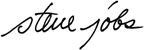
Steve Jobs
Chairman and Chief Executive Officer
-------------------------------------------------------------------------------
© 1998 Pixar Animation Studios,
All Rights Reserved.

