FORBES CULTURAL PLAN: a community initiative by the Forbes Arts & Culture Working Group to develop a new vision for the Shire of Forbes, NSW
|
What is the Forbes Arts & Culture Working Group? NSW State Gov's Cultural Planning Guidelines (pdf download)
|
FORBES ARTS & CULTURE WORKING GROUP MEETING, 16 MAY 2005 @ FORBES TOWN HALL ATTENDANCE: Yvonne Collits, Forbes Railway Arts & Tourist Centre; Denise Sheridan-Smith, SOPHIA women’s group; Sue-Anne Nixon, Forbes Town Band, and school teacher; Carmen Dundon, St Laurence’s School; Sian Dyce, Forbes Progress & Development; Len Reade, Forbes Urban Landcare; Graham Falconer, Shire Councillor; Bronwyn Clark, Forbes Library; Anne McLennan, Forbes Library; Patrick Driver, Friends of Lake Forbes; Merrill Findlay; and Watson, the Forbes Library Cat.
APOLOGIES: Alister Lockhart, Mandy McMahon, Mary Laksito, Chelsea Ridley, Richard Barwick, Peter Cripps, Jo Erskine, Ron Penny. ADOPTION OF THE MINUTES OF THE LAST MEETING
GENERAL BUSINESS This meeting was chaired by Denise Sheridan-Smith who especially welcomed newcomers Yvonne Collits, Sue-Anne Nixon, Len Reade, Patrick Driver, Anne McLennan, Bronwyn Clark and Watson, the Forbes Library Cat, to the working group. In introducing himself Patrick Driver noted that there was a lot happening under the surface in Forbes and that many of the Shire’s cultural riches were not apparent to outsiders or visitors. Much more could be done with these, he said. As a representative of Friends of Lake Forbes Patrick stressed the cultural significance of this body of water and its importance in nurturing a sense of place. He also acknowledged the contribution the Urban Landcare Group had made to the lake’s aesthetic appeal and its ecological health with their urban wetland. COMMUNITY PROFILE: Merrill distributed copies of the 2001 Community Profile of the Shire based on the 2001 Census, which Richard Barwick made available through Council. The profile showed that the total population for the Shire at the 2001 Census was 9,707. A very large majority of the population was of Anglo-Celtic descent while 509 people were of indigenous descent, and 341 were born overseas, nominating Canada, China, Egypt, Fiji, France, German, Greece, Ireland, Italy, Lebanon, Malaysia, Malta, Netherlands, New Zealand, Philippines, Poland, South Africa, Sri Lanka, United Kingdom, United States of America, Vietnam and elsewhere as their places of birth. The working group agreed that all these groups needed to be consulted across the full spectrum of ages if our data collection for the cultural planning process was to be statistically credible. We agreed that we would seek to obtain responses from at least 10% of each ethnic and age group.
PROPOSED QUESTIONNAIRE: In follow-up from the decision made at the meeting of 19 April to seek Council support for the distribution of a questionnaire, Sian Dyce presented her draft of a form that could be sent to all households. She explained that she had tried to get around the confusion many people still felt with the word ‘culture’ by posing very simple questions about people’s ‘way of life’ and how this might be improved. Yvonne said she would like the word ‘heritage’ included, and Denise admitted that she still had problems with the word ‘culture’ which for many people meant ‘high art’ activities like opera. Sian pointed out that we were saddled with the name Arts & Culture Working Group and that we just had to be up front with that. Sue Anne commented that she was here because the article in the Advocate brought her along, and suggested that we could educate people about ‘culture’ and ‘cultural planning’ with more articles in newspaper. She added that ‘culture’ and ‘heritage’ also had many Aboriginal connotations because of people’s great interest in indigenous culture. We discussed the wording and distribution of the proposed questionnaire extensively, and agreed that it should include a box in which people could nominate their ethnic background etc, since we also needed that data. Graham, Marg and Sian all wanted to include something that explained why we required the ‘cultural’ information, and suggested the addition of words such as ‘Help us develop Forbes’. Sian will work on this for the next draft. Several people were keen that we have our own logo but we deferred discussion about this for another time. Patrick was concerned that people might respond to the questionnaire by nominating things that were ‘in opposition’ to this working group’s agenda: that they might think football was the most important thing in their lives, for example. Marg suggested other locals might feel the same about netball. The meeting agreed that since football and netball were very significant parts of the Shire’s culture it would be surprising if they weren’t mentioned, and that we just had to live with it! Merrill commented that in the working group’s early days she visited most of the pubs in town where footballers and other sportspeople traditionally gather and in none of them did people say that sport was all there is to life! Many pub-clients were also great raconteurs or story-tellers, poets, bush-balladeers, comedians, singers and musicians, for example, and participated in many other creative activities in their lives.( One publican even admitted to being a rather good ‘bull-shit artist’!) We also discussed different ways of consulting people, including phone interviews, ‘conversation couches’ in the streets, and asking organisations to get members to fill the questionnaires in at meetings. We agreed that the initial draft of the questionnaire developed by Merrill could be used in face-to-face or telephone consultations. DISTRIBUTION OF THE QUESTIONNAIRE: Marg and others insisted that all people in the Shire should begiven an opportunity to contribute their ideas, and that letterboxing all households was the fairest and most reliable way of doing this, even though the return-rate might not be very high. She reminded us that letterboxing would not cover rural households,so we would probably have to mail forms out to country people. Sue-Anne said she could distribute material to all schools in the Shire through her teaching work, and suggested that we could also put the survey in the pew slips in all the churches. Patrick offered to leave some on the counter at his office, and we expressed the hope that the same could be done in other government offices. Bronwyn reported that around 200 people came through the Library each day and that she’d be happy to distribute questionnaires there. Marg asked if we could also distribute material through the Advocate. Graham was keen that organisations be asked to get members to fill the forms in, and suggested we send forms and a formal letter to each of the service organisations asking them to do this. The meeting agreed to this. COLLECTING THE QUESTIONNAIRES: Bronwyn asked a very practical question about a return-by date and place. She suggested a drop box in the supermarkets, the library, the Advocate office, the shire council, and at the clubs and schools to make the process easy for people. Sian said she’d add these details to the next draft of her form.
CLARIFICATION OF THE STATUS OF THE WORKING GROUP: Merrill advised that she had sought clarification in writing from Council’s General Manager Chris Devitt because it was her understanding that the working group was independent of Council, but was to be resourced by Council. Chris responded by email on April 27, 2005 as follows:
FUTURE OF THE WORKING GROUP: Interim chair, Merrill Findlay, advised the working group that she would not be available for most of the rest of the year and that she would like to stand down. Her resignation was not accepted. Instead the next meeting was set so she would be able to attend! The meeting informally agreed, however, that the term ‘convener’ would be more appropriate than ‘Chairperson’, and that it was pleasantly democratic for people to take it turns to chair the actual meetings. So – we are looking for a new convener to replace Merrill as soon as possible! All nominations will be very gratefully accepted! LESSONS LEARNED: The convener had hoped that we could start the SWOT analysis as discussed at the last meeting. This didn’t happen, in part because we spent so much time talking about other issues. We agreed that future meetings should be conducted so that all agenda items are covered, and that meetings should end promptly at 7 pm. But as Graham Falconer commented, we are all still learning and it is a good thing that new people are able to contribute and develop their meeting skills as we proceed. Graham offered to chair the next meeting on Thursday 9 June ‘if necessary’. The
meeting closed after 7 pm.
|
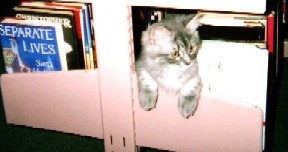 Left:
One of the attendees at the May meeting of the Working Group, Watson
The
Left:
One of the attendees at the May meeting of the Working Group, Watson
The 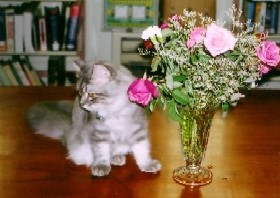 Cat
Culture: Watson The
Cat
Culture: Watson The Forbes
Arts & Culture Working Group 2005:
For more information please contact [email protected]
Site created 2 May 2005, last revised 26 May 2005