 |
Characters
|
|
 Macbeth:
He begins the play as an ambitious general in the King's army. At
this point he is a noble and kind-hearted gentleman who does envision a
prosperous future for himself but restrains himself from taking any extrenuous
actions for attaining these visions. It is at his meeting with the
three witches that his inhibitions towards vile action begin to change.
He begins to question whether it would be possible to attain more power.
It is here that Macbeth begins to cross the line between ambition and greed.
Any reservations that Macbeth had toward killing King Duncan to obtain
power were destroyed by his even greedier wife. It is at this point
at which he kills Duncan.
Macbeth:
He begins the play as an ambitious general in the King's army. At
this point he is a noble and kind-hearted gentleman who does envision a
prosperous future for himself but restrains himself from taking any extrenuous
actions for attaining these visions. It is at his meeting with the
three witches that his inhibitions towards vile action begin to change.
He begins to question whether it would be possible to attain more power.
It is here that Macbeth begins to cross the line between ambition and greed.
Any reservations that Macbeth had toward killing King Duncan to obtain
power were destroyed by his even greedier wife. It is at this point
at which he kills Duncan.
After being crowned King, he begins to need to commit more murder in order
to keep his hold on power. As the play progresses, his greed worsens
as he kills both people that are even remotely a threat to his power, and
people who were his friends. This greed leads to the circumstances
which end in his death.
Lady
Macbeth: She is the greediest of all the characters in the play.
She goes to every length possible in order to achieve her goal: make her
husband King of Scotland. Her quote (1.7.54-59) "I have given suck,
and know/ How tender 'tis to love the babe that milks me:/ I would, while
it was smiling in my face,/ Have pluck'd my nipple from his boneless gums,/
And dash'd the brains out, had I so sworn as you/ Have done to this." shows
the lengths with which she would go in order to see that her husband become
king. Her greed, in part, causes the situation to slip out of her
control into a murderous rampage. This causes her to go insane and
commit suicide.
 Macduff:
He is the play's foil to Macbeth. He is not ambitious or greedy.
Throughout the entire play, he is always considering someone or something
other than himself. He begins the play with leaving the scene of
King Duncan's murder in order to ensure that his family is safe, and ends
the play with ignoring his personal feelings to save his family for the
good of Scotland.
Macduff:
He is the play's foil to Macbeth. He is not ambitious or greedy.
Throughout the entire play, he is always considering someone or something
other than himself. He begins the play with leaving the scene of
King Duncan's murder in order to ensure that his family is safe, and ends
the play with ignoring his personal feelings to save his family for the
good of Scotland.
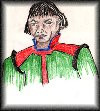 Banquo:
Like Macbeth, Banquo begins the play as an ambitious warrior. He
also hears good prophecies from the witches. However, unlike Macbeth
Banquo does not become obsessed with greed. He decides that it is
wrong to take violent measures in order to achieve his ambitions.
He believes in fate and is willing to let events take their own course
as opposed to taking matters into his own hands. It is this lack
of greed that helps lead to his death.
Banquo:
Like Macbeth, Banquo begins the play as an ambitious warrior. He
also hears good prophecies from the witches. However, unlike Macbeth
Banquo does not become obsessed with greed. He decides that it is
wrong to take violent measures in order to achieve his ambitions.
He believes in fate and is willing to let events take their own course
as opposed to taking matters into his own hands. It is this lack
of greed that helps lead to his death.
 Malcolm:
He ends the play as King of Scotland. He is, in respect to ambition
and greed, equal to Macduff. He ignores his ambitions during the
play and runs from King Duncan's death. He returns in the end in
order to rid Scotland of the problems that Macbeth has caused.
Malcolm:
He ends the play as King of Scotland. He is, in respect to ambition
and greed, equal to Macduff. He ignores his ambitions during the
play and runs from King Duncan's death. He returns in the end in
order to rid Scotland of the problems that Macbeth has caused.
(copyright) 1999 BeeSing Inc.


