Produced by: Sega AM Division
Genre: 3D Fighting
Players: Two
Virtual On is a game that continues to divide gamers. Many feel that it's too complicated, too hard, too annoying. Others believe that it is the most technical two player game ever, and has more depth than any other game in the arcades. By the end of this review, I'm hoping you'll be able to see where I stand on the subject.
People often talk about "hardcore" gamers. Well, Virtual On: Oratorio Tangram (VOOT from now on) is a "hardcore" game, and no mistake. The gameplay revolves around two giant robots battling in an enclosed arena. The arcade game made use of twin joysticks, giving the impression of controlling a huge mech. Via a combination of joystick postions and button presses, the player could make the mech do almost anything - in terms of control methods, it was perfection. Unfortunately, the DC pad does not offer this twin stick setup (it's a shame that Sega didn't copy the Sony Dual Shock - the twin sticks on that would have been perfect for VOOT). Therefore, the DC conversion of VOOT gets off to a bad start straight away. You simply can't perform as well with the DC pad. VOOT relies on the player being about to pull of several moves in quick succession almost without even thinking. In the arcade, this was possible - but on the DC it's very, very difficult. There are so many button presses to remember, and what was merely a slight joystick movement in the arcades is now a massive pad/button combination on the DC. The only solution to this is the DC Twin Stick joystick, released (in Japan) at the same time as the game. Needless to say, it costs a packet and the chances of seeing one in the West are slim. I've not never managed to have a go on the DC version of the Twin Stick, but I did get my hands on the Saturn version - and it improved the game dramatically.
It's a crying shame that VOOT is crippled by it's control method because this really is one of the best two player games ever made. Watching two expert VOOT players battle it out is a sight to behold - at times, it's like a dance, a ballet of death and destruction. It's easily up there with likes of Virtua Fighter 3 and Tekken 3 when it comes to depth. There are literally hundreds of different moves to pull off, depending on what "state" your mech happens to be in - running, dashing, crouching, jumping, etc. Considering these are supposed to be towering hulks of metal, they sure move swiftly.
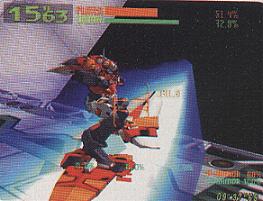
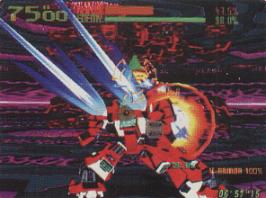
The mech designs themselves really stand out. The person responsible is Hajime Katoki, of Gundam fame. The graphics are nothing short of stunning, showcasing the DC's substantal visual muscle to great effect. As far as I can make out, this is arcade perfect, and it more than makes up for the utter disappointment I felt after loading up the Saturn version a few years back, and seeing Sega's poor 32-bit warhorse struggle to replicate the original VO. The only criticism you can level at VOOT's graphics are the explosions and weapon fire - they look very weak, and destory the impression that you've got an arsenal that could level an entire city at your fingertips. Aside from that, the presentation is what we've come to expect from Sega - clean, attractive and eye catching.
Tactics play a big part in VOOT's gameplay. If you simply pound the fire buttons, you'll be dead in next to no time. Several factors need to be taken into account when in battle - your weapons take time to recharge once fired (recharge time depends on the weapon's power, range, etc). Jumping allows you to avoid enemy fire, but once your mech is at the apex of it's jump, it becomes vulnerable. "Turbo dashing" can also be used to avoid damage, but this also incurs a recharge time. Timing is the key here - you have to constantly be aware of what your opponent is doing, and you react in a split second to make a successful attack. I won't even go on to mention dash cancelling, jump cancelling, lob shots...if this seems too complicated for you now, don't even bother to read on. This game is as complex as they come, and then some. It's also very, very hard. Even on the easiest setting, the CPU controlled opponent will display an impressive level of AI, dodging your attacks and flinging attack upon attack in your direction. You really can't sit back for a second with VOOT - you must always be on the move, planning your next attack and on the look out for an opening in which you can strike.
It really pains me to say this, but I can't recommend VOOT without the Twin Stick controller. The game was designed to be played with this stick, and the standard DC joypad is just not equal to the task. This doesn't matter so much when playing against a human opponent, as both of you have to struggle with the DC pad, so it evens things out, but when playing against the computer, you often find yourself cursing the lack of complete control as your foe runs rings around your mech. I've heard from other DC owners that they get on with the standard pad fine, and that it's just a matter of getting used to it. They're probably right. However, I've wasted a good portion of my life (and life savings, for that matter) playing VOOT the way it was meant to be played - with the Twin Sticks. If this game came complete with the sticks, I'd give it a five right away. However, due to the fact that VOOT may never be released in the West, the chances of getting both the game and the dedicated controller at a resonable price is very slim indeed. If you're willing to get to grips with a clumsy control method, then a whole world of video game bliss awaits you with VOOT - however, I'll stick to playing the game at my local arcade, until I can find one of those damn Twin Sticks...
3 1/2 out of 5
UPDATE: Since this review was written, VOOT has been released in the US, not by Sega, but by Activision.