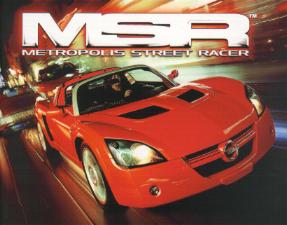

Produced by: Bizarre Creations
Genre: Driving
Players: Two, split screen
The Dreamcast certainly isn't short of racing games. In the last few months alone we've seen Sega GT, Ferrari 355 Challenge and Test Drive: Le Mans join the likes of Sega Rally 2, Speed Freaks, Wacky Races, Tokyo Extreme Racer, and F1 World GP. With so many racing titles available it goes without saying that new additions need to be pretty special to stand out from the crowd. Of course not every title makes the grade - for every gem there's five stinkers. Thankfully, MSR is the former. It was supposed to be a launch title, which makes it over a year late. However, when you get a game this good, the wait becomes irrelevant. British codeshop Bizarre Creations, the team responsible for the early installments of Sony's Formula One franchise, have crafted a game that is worth waiting years for.
Graphical quality seems to be the first thing people look at when they're judging a racing game, so I might as well start the praise there. MSR features gorgeous car models and complex trackside detail, as well as clean, crisp textures and vibrant colors. The cars shine and sparkle like they've just been waxed, with light bouncing off every curve and bump of the bodywork. The frame rate is also exceptional, ensuring that the action is always smooth and fast (although it does drop slightly when playing in split-screen two-player mode, but this is to be expected). It's not just the cars that look beautiful - the streets you race around are rich in detail and set new standards in the genre. In terms of visuals, you really can't fault MSR and it just goes to show that the Dreamcast is more than capable of producing graphics that rival anything currently seen on any other machine. While we're on the subject of tracks, many of you will have no doubt heard the hype surrounding the "real" replications of streets and cities in MSR. The development team spent months taking photographs and researching layout plans of London, San Francisco and Tokyo. The result is that MSR features the actual roads and landmarks of these cities - if it's there in real life, it's there in MSR. An impressive achievement, but you'll only really feel the benefit if you've actually visited these places. Otherwise, they don't look any different from any other track. Still, it's a nice touch and one that Bizarre should be applauded for. Being able to say "I've been there!" when you pass a famous landmark is quite cool.
Although there are only three cities there are around 250 different tracks. Each city is split into different sections and these sections are split further by the addition of barriers on streets, creating new routes. This means you could race in the same city any number of times but the layout of the track will be different. It makes a refreshing change from the usual "mirror" courses we see so much in racing games today. This method of sectioning off parts of the circuit is much more effective in making the most of the tracks and areas the programmers have at their disposal.
The actual structure of the game is radically different from other driving games. It's not about winning races and buying cars with your prize money - in MSR you have to earn both your car and progression through the game by driving better than you have before. To advance you need to acquire "Kudos" points. These are awarded for driving style - powersliding, neat cornering, tight overtaking and the sort. Points are deducted when you clip walls and hit other cars, so the emphasis is on getting that perfect lap. Once you've gained enough Kudos, extra tracks and challenges open up, and once you've met the requirements of a chapter, another car is unlocked. You then have to take on a challenge to earn ownership of that car. The game is divided up into 25 chapters which feature around ten races each. This system encourages you to improve on your performance in races - coming first doesn't mean you'll advance. You have to win with style to get anywhere in this game. This has the obvious effect of giving MSR tremendous replay value - you'll find yourself racing on the same stage again and again seeing just how many powerslides you can squeeze in and just how close you can take the corners. This structure is refreshingly different from the "win, buy, win" system found in so many other titles.
In terms of control, MSR is again faultless. Never before has the DC analogue control felt so...precise. To begin with you'll find that cornering is rather difficult when just using the brakes alone. Once you discover the handbrake, the game really opens up. Ridge Racer style powerslides are possible so long as you don't hold down the handbrake too long, and once you become comfortable with sliding your machine around hairpin corners, the Kudos points pile up thick and fast. There's nothing quite like the feeling of pulling off a perfect powerdrift, and all the best racing games harness this "rush". MSR gives you the chance to execute some of the most thrilling powerslides you'll ever encounter, but you won't get away with Ridge Racer tactics here - a fine balance must be struck or you'll end up running out of time or spinning out completely. MSR finds the perfect middle ground between the simulation feel of Gran Turismo and the arcade elements of titles like Daytona, Ridge Racer and Sega Rally.
Few would argue that GT revolutionized the racing genre. However, one of the less welcome aspects (in my opinion, anyway) was the insane amount of cars featured in the game. The massive number meant that you never really experienced each one properly and you'd end up spending more time tuning up the car up than you'd spend actually racing it. Thankfully, MSR has the perfect balance. There's roughly 50 cars in the game and each handles differently. You can't get under the bonnet, like in GT (but that was another aspect I found rather dull) but you don't really need to - the cars are optimized for each event. Also, it's not just a case of moving from one car to the next. Some of the challenges later on require a slower, more grippy machine so you need to keep a varied garage of cars (you can only have three garage slots to start off with, but this soon rises to six) to cater for every event. This means you have more incentive to utilize every car to its fullest potential. After all, MSR isn't about who's fastest - it's about who's the best.
Music is also an important ingredient to a racing game. Bizarre have "borrowed" the soundtrack system found in Grand Theft Auto. Each city has several different radio stations that can be accessed via a sub menu while racing. For example, San Fran has rock, country and jazz stations. These stations have their own DJ who introduces each piece of music. However, the neatest touch is the ability to change (or "seek") each station as you race, or turn the radio off altogether and play a track from the in-game CD player. This is a novel approach but it's let down by the rather dull choice of music. The selection of tracks is dire at best, and more often than not I found myself turning the music off altogether. However, the variety on show means that there's bound to be one that everyone will like, and I can't really judge the music based on my personal taste. Whatever your opinion of the music, you can always turn it off so it doesn't detract from the game.
It's very hard to fault MSR. You could say that the lack of an in-depth car tuning option means you won't be as "involved" as you are in GT. I have no doubt that some will mark the game down because of this. Others will be annoyed that MSR doesn't try to challenge for GT's "Most cars in a game" award. However, I really couldn't care less about these things. MSR offers one of the riveting driving experiences I've played, and the structure of the game is a definite improvement over recent racers. The emphasis is on bettering yourself, not trying to fill your garage up with hundreds of cars you'll never drive. In a crowded genre, MSR stands head and shoulders above the competition. It may have taken its time, but it was certainty worth the wait. Essential.
5 out of 5

