
Produced by: Sega/Smilebit
Genre: Skating/Tagging
Players: One
So here it is - the game that stole the show at the last E3, Sega's great white hope, the title that will make the Dreamcast the "must have" system this fall...does it live up to the hype? Well...
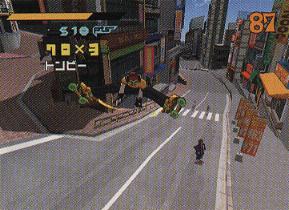
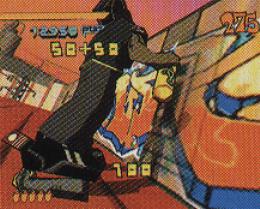
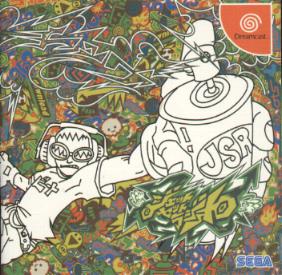
The graphics are excellent. This really is one very attractive and eye catching game, no doubt about that. The innovative "cel-shading" technique is used to very good effect here, and each character looks like they've been lifted right out of a cartoon and placed in a full 3D world. The recent DC racer Wacky Races employs a similar technique, but it is put to far more impressive use here. Every character is beautifully rendered and animated, each location is breathtaking in design and every menu screen looks suitably "funky". In terms of visual style, JSR has it all. No problems there then.
Sonically, things are also very good. The cool visuals are accompanied by an equally "hip" DJ soundtrack. Several of the tracks are Japanese pop/rock, but most are made up of mixed samples and beats. It's one of the best original videogame scores I've ever heard. However, there are rumors that Sega plan to replace it with more "Western" tunes when it's released over here as Jet "Grind" Radio. If this turns out to be true, it'll be a big shame.
The gameplay is simple yet addictive. The basic premise of the game involves "tagging" locations around a city (this graffiti aspect has gotten Sega into trouble with the Keep America Beautiful organization). You must first conquer the city's three main rival gangs by entering their turf and painting over their tags, thus marking the territory as your own. After you've succeeded in this task, a new enemy appears...but I'll let you find that out for yourself. You can only tag in set locations (where there is a red or green arrow) and although this may seem restrictive at first, it makes sense from a gameplay point of view. If you were able to tag anywhere, it would be very hard to create a coherent game structure. Tags range from simple (which require one button press) to large (which require a button press and several stick movements). Cans of spray paint are required before you can actually tag a location, and the larger tags need more cans, giving the game a "resource management" feel. There's more to it than that of course - you can also pull off "zany" stunts which result in a points bonus. The "grind" aspect has been borrowed from Tony Hawks Pro Skater, but this is a much more basic concept. There's no multiple button presses and pad movements for this - to perform a stunt you just have to jump off a grinding surface and make sure you're traveling at the right speed. The simple nature of this control method means it's more instantly enjoyable than Tony Hawks, but obviously there is less depth.
You're not unhindered in your tagging and stunt work, of course - the police aren't happy about you messing up their fair city and will stop at nothing in their attempt to stop you. At one point they even bring in the military, and you find yourself dodging homing missiles and tank shells as you try to get that final can of spray paint. Unfortunately, you can't fight back. This is one of the problems I have with this otherwise stunning title. There's nothing more frustrating that being pounded into submission by police units as you attempt to finish a tag, and not being able to do a thing about it. Sega could have included a way of temporally stunning the police, or even placed some weapons for you to utilize. As it stands, the police are just too fast, powerful and accurate, and most of the time all you can do is run away and hope they've gone when you return. There are also issues with the control method. In cramped, small spaces (and given the detail in the locations, there are quite a few) it becomes a struggle to control your character, and the often erratic camera AI doesn't help matters much. Sega did think to include a separate camera centering button - for some strange reason, they decided to make it the same button as the "tag" button - meaning you sometimes start a tag by mistake when all you wanted to do was see where the hell you were going. Quite why Sega didn't make use of the other buttons on offer is beyond me.
However, these criticisms do tend to pale into insignificance once you get stuck in. The gameplay is engrossing while it lasts, and the whole experience is one every gamer should try. The game is a little on the short side, and it's more than likely that you'll be looking at the "End" screen in under three days, but JSR has the same "pick up and play" feel that Crazy Taxi has, and just skating around the city performing elaborate stunts is fun enough. Also, there are several extra tag pictures spread around the city, and once collected you can use these tags in the main game, as well as create your own using the tag editor.
Overall, this is another worthy title from Sega. It may not quite live up to the hype, but it still provides some solid single player entertainment. If Sega can keep producing games of this standard, hopefully the gaming public will start to take notice.
4 out of 5