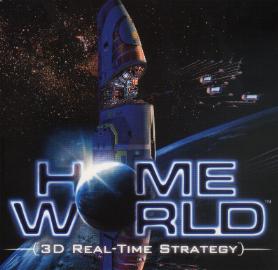

Produced by: Relic
Genre: Real Time Strategy
Players: Eight (in multiplayer)
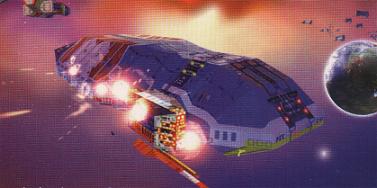
The history of the "Real Time Strategy" game is a long one, but lacking in real innovation. The first RTS is largely agreed to be Herzog Zwei, released on the Genesis/MegaDrive way back in 1989. It only allowed you to build units (not actual buildings) and you couldn't actually give your units orders "on the fly" (you only actually controlled one unit, a transforming robot/plane - this idea was later copied by Cavedog in Total Annihilation) but the key building blocks were there. The next advancement was Dune 2 on the PC. This game has served as the blueprint for all modern RTS titles, and although Command And Conquer improved the formula, it didn't really offer anything new or groundbreaking. Where could the RTS go from here? That's the question developers Relic chose to answer with Homeworld, the first true 3D RTS game. You're not just functioning on one plane here - action happens all around you. There are no flat surfaces to built on - you're in space.
The plot is a real stunner. None of your "kill the evil Russians" C&C rubbish here - this is real epic sci-fi plot, and it lends the game a real movie-like feel. You play a race of people living on the desert planet Kharak. An ancient stone tablet is discovered which tells the story of your people's exile to this barren world. A mothership is built and the course is set for your people to return to their rightful home - but there are forces in your way, of course. As you edge closer and closer to you home, new foes are revealed and the reason for your exile becomes more clear. This story is linked by stunning hand drawn, comicbook style cutscenes. The game starts with the launch of the mothership, and the opening cutscene plays out to a stirring vocal version of "Adagio For Strings" by Samuel Barber. It's epic stuff, and as the mothership moves away from the docking platform, a voice crackles in on the radio - "what a beautiful sight". It's little touches like this, and an incredible attention to detail that makes a "good" game "great". Homeworld is full of these neat little touches.
The gameplay will be familiar to those of you who've played any RTS game in the past five or so years. You mine/gather resources, you built an army, you defeat the enemy. The real twist here is the 3D element. You no longer control your units on one set 2D plane - you control them in full 3D. Attacks can come from any direction. Your units can engage enemy units coming from any angle. Because you're no longer just moving along one set 2D level, the control system also works in "3D". Once you have targeted a unit, you can zoom in and out (using a mouse wheel, if you have one) and spin round that unit to view it from any direction you please. Movement, mining and attacking are all controlled via a unit sub menu, but some actions can be accessed with hot keys. As is the way with everything new and different, it takes a while to get used to the control method, but once you've mastered it to a fair degree it soon becomes second nature.
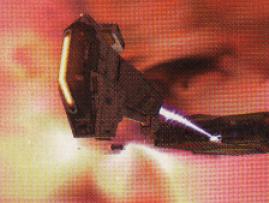
The wealth of units on offer is impressive. Your mothership is your "base" or "construction yard". Once this is destroyed, it's game over. You have your basic fighting units, such as Scouts, Interceptors, Defenders, Bombers and Multi Gun Corvettes, and then you have your heavy units such as Assault Frigates, Ion Frigates and Destroyers. It's best to get a good mix of the two - the light attack craft may not be able to take down a capital ship, but they will be able to out-fly it, provide support and take out other smaller ships. The larger vessels will have trouble taking out smaller craft as they are slower and their guns take longer to aim. Of course, there are other units, such as the Harvester (which mines asteroids and dust clouds), the Research ship (which allows you develop new technology and weapons) and the Carrier (which effectively doubles as other construction ship and docking bay for light fighters). There's more than enough craft on offer here to keep any RTS fan content. This gives the player a wide range of options when it comes to tackling the missions at hand.
There are sixteen single player missions to fight through, and they will provide a good few weeks of solid play. However, for those of you who crave human combat, there's the multiplayer option. Up to eight people can be involved at once, but I'd stick with two or three - it's chaos enough being attacked from two angles, let alone eight.
There are some negative points to Homeworld, though. At times, the screen can get very crowed, and this not only results in mild slowdown but it also makes it hard to see what's actually going on, and marshaling your forces becomes annoyingly awkward. Thankfully, these moments are few and far between, and if you put together a solid battle plan you sometimes don't need to give out any orders once your units move in. The multiplayer mode is a nice addition but it just doesn't offer enough scope - you've got the basic game and nothing else - it's just you against the other players and the last one standing wins. This is fun for a while, but it leaves you wanting something with more variety (like the actual single player missions, for example). However, this can only be regarded as a minor criticism, and Homeworld is a single player game at heart.
For those of you who feel that the RTS genre has stood still for far too long, this is a game you must play. Homeworld is the first game of this type that I've played in almost five years that has really impressed me. No doubt many imitators will follow, just as they did when Westwood released Command and Conquer. If you count yourself as a RTS fan, then Homeworld is essential.
5 out of 5