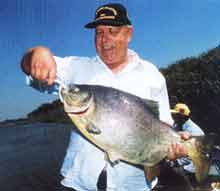
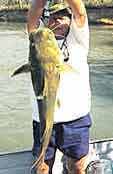
Pacus
They are the specie
most found in pictures albums. Besides the pleasure to
capture them, they possess a meat of select flavor. They
can be fished in the flooded fields under trees and under
water bushes. Related to baits, small fruits or pieces of
larger fruits are used, balls done with wheat flour and
some types of industrialized baits. When the connection
between the river and the fields is interrupted, the best
is to seek them in great camalotes (aquatic plants). The
throws must be done to the middle of the river, so that
the current takes charge of accommodating the bait below
or close to the thickets of the aquatic vegetation. The
fishing with crab however, is the most common practiced,
because that mollusk is one of the favorite food of the
diet of this specie. |
|
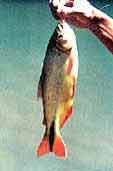
Piraputangas
The fishing of this
specie is something indescribable and unimaginable
because, despite of rarely cross the 40 centimeters of
length, and something around 4 kilos of weight, when
stabbing, they transform in a respectable opponent. They
run and give spectacular jumps, what provokes a lot of
anxiety on whom that has them in the tip of the line. They
like clean and very oxygenated water, and can be found
under the trees of the river and in flooded fields. |
|
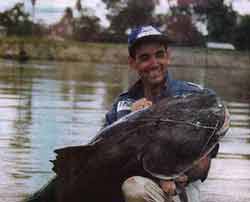
Jaús
The biggest and
largest fish of region, they can easily weight over 100
kilos and measure more than 1,5 meter. Its fishing is more
productive when the river is full, because their habitats
are the deep wells, where they keep awaiting passing small
fishes that serve them as food. With low river, even for
the difficulty of finding such atmospheres, the fishing of
this specie is committed, limiting to rare captures. The
most efficient baits are the minhocuçu, the pirambóia and
fish of small load, which should be baited whole and
alive. They should be fished in the afternoon ends and in
the first hours of the day in the wells of the river,
which can be easily identified due to the water movement
that are formed in the surface. |
|
next page |
|