

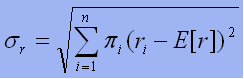
The risk of an asset is related to the potential gap between its actual, real return r and the estimated average return E[r]. It is measured by:
Intro to Finance
Learn online
>Basic concepts
>Corporate finance
>Other materials
Financial careers
>Banking
>Management
>Real estate
>Insurance
Goodies!
Ask Financious
Useful links
About us

Consider asset a and asset b, then the covariance of these two securities is given by:
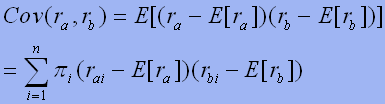
Now if Cov(ra,rb) is negative, then it is probable that rb<E[rb] when ra>E[ra].
Next section: The portfolio theory Go back