| Brine Shrimp |
| Home ] Hatchery [Gallery P1 [ Gallery P2 [ Water Quality [ Equipment [ Breeding [ Hatching Eggs [ Raising Fry [ Foods [ Brine Shrimp [Trouble Shooting [FAQ [Special Projects [ Sources&Links] |
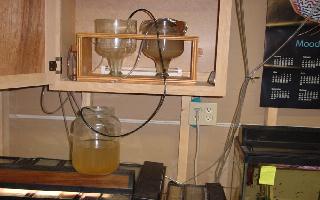
| The ability to hatch and harvest brine shrimp (bbs) is very important in raising fry. It is the first food that you should offer to your free swimming fry. It is the food that will sustain them for at least the first 3 or 4 weeks of their lives. Most angelfish breeders will agree that there is not a better food to feed your fry than live brine shrimp. Freshly hatched brine shrimp should be fed to your fry a minimum of twice a day. Three or 4 times a day is even better. After feeding on bbs your fry will show an orange color in their bellies. As they grow your fry will just simply devour them. It is their absolute favorite food. There is nothing that will make your young fry grow any faster or provide more nutrition than bbs. The recipe for hatching bbs eggs contains 6 ingredients. A hatching container, water, salt, light, eggs and aeration. Water right out of the tap can be used with no dechlorinator added. The temperature should be 78' to 80'. Next add salt to a specific gravity of 1.018. Next put a light source near the hatching conainer. Add the bbs eggs and aeration and you will have live bbs in 24 hours or less. I will go into greater detail. The preffered hatching container is narrow at the bottom and wide at the top. It can be made of plastic or glass and should be clear in color. In the picture on the right you can see I use a homemade set up. I cut the bottoms off of 1-gal wine jugs and built a stand to hold them. An easier container is a plastic liter soda bottle with the bottom cut off. It is important to clean the container between batches in hot water to prevent any bacteria from developing. When I first started hatching bbs, I used aquarium salt purchased from the local fish store. This cost about $1.50 to $2.00 per pound. I then swiched to marine salt which I thought was cheaper. I finally started using Morton's water softening salt in 80 lb. bags for about $6.00. As long as the salt is 99% pure non ionized salt it should work very well for you. I go through more than 1 lb. per week so you can see the obvious savings. I feel that it is very important to measure the specific gravity with each batch of bbs eggs you start. Eggs won't hatch at specific gravities of less than 1.017. At specific gravities above 1.020 the hatched bbs tend to stay near the top of the water because of the extra bouyancy the salt adds making it more difficult to harvest. I like to harvest the bbs when they sink closer to the bottom of the hatching container. I keep the specific gravity between 1.017 and 1.019 with 1.018 being optimum. The anount of bbs eggs to be added to the amount of water should not exceed 1 teaspoon per quart of water. When I mix batches it is usually 2 teaspoons per 3 quarts of salt water. This produces an acceptable hatch out rate for me. In order for bbs eggs to hatch they require a certain amount of light. It is not known at which stage of hatching the light is necessary. I hatch my bbs in a cabinet that contains an 8 inch florescent light that is on 24 hrs a day. This light also helps to keep the temperature at 78' in the enclosed cabinet. My hatching time for bbs is 18 hrs. Cooler temperatues and less light take longer depending on the temperature and the amount of light. Aeration is required to keep the eggs floating in mid stream and the agitation of the bubbles on the eggs makes it easier for hatching to take place. A medium flow of bubbles is all that is required. Too much and the eggs will start sticking to the top of the hatching container and too little will alow them to settle on the bottom. There are different grades of bbs and different sources to buy them from. Local fish stores carry them but usually only sell them in small quantities at high prices. I usually buy mine on line from brine shrimp direct in 1 lb quantities. They offer several hatchout rates and I usually purchase 90% hatchout grade A eggs. They are much more reasonable than the local fish stores. Make sure you keep any excess eggs in the refrigerator in an airtight container. Moisture is the biggest enemy of bbs eggs. While it is important to have a good hatchout rate, it is more important to have a good harvest rate. Keeping the specific gravity between 1.017 and 1.019 allows the bbs to settle on the botton after the airstone has been removed. I find it much easier to syphon 3/4" off of the bottom of the hatching container than the top. I also find it easier to harvest the whole batch at one time and place it in another container to feed throughout the day than harvest a couple of times a day in the hope that more eggs will hatch. I prefer to keep as many unhatched eggs and shells away from the fry as possible. Even though the egg shells don't seem to hurt the fry they clog up the sponge filters and are basically a nuisance. If you would like to test your harvesting skills, simply syphon as many bbs into another container as possible without getting any egg shells into it. Then pour 1 pint of fresh water back into your hatching container. Let it settle and then syphon it again into a brine shrimp net to be used for immediate feeding. You will be surprised at how many feedings you are not harvesting. Bbs should not be fed after 24 hrs of being hatched. I suggest you feed the excess to your next smallest fry or refrigerate them. If you decide to refrigerate them, you can only feed them for another 24 hrs before they lose all of their nutritional value and start to die. |
| Hatching BBS Eggs |
 |
| Hatching container |
| Salt |
| Water |
| Light and Temperature |
| Aeration |
| BBS Eggs |
| Harvesting Hints |