| The Mechanical Doll |
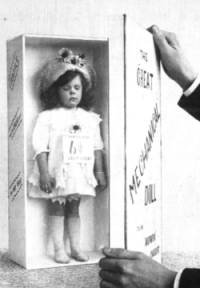
| This "doll" was called "The Great Mechanical Doll" from "Auwin, Cardiff" and sold for a supposedly cheap price. She is dressed in an summery Edwardian bonnet and a white summer dress. She is 18 inches tall. Looking remarkably human, the question is, could she have been a little girl rather than a doll? Was the Great Mechanical Doll a variety act? Did the hands holding the box belong to a stage "Svengali"? The Fragile...handle with GREAT care...Do NOT drop - warnings on the side of the box seem to confirm the contents were much more valuable than a paste doll. After consulting the Theatre Museum, London, they in turn advised us to consult the Westminster Reference Library in the hope of sheding some light on the subject. Unfortunatley, though the library has an excellent section on variety acts and music hall, there was no information on The Great Mechanical Doll, or on Auwin. After writing to the Music Hall Society based in the Passmore Edwards Museum at Stratford we recieved a dismissive telephone call. Why on earth was it thought that this was a little girl, rather than a doll? A search through a few Western Mail business directories for "Auwin" between 1910 and 1930 came up blank, the next task was to rummage through old Western Mails looking for adverts and reports of promising variety acts. |
| In fact, it appears that in the early years of the century, acts by miniatures - small singing children or dwarves - were quite common. There were also acts that must have mimicked mechanical actions. The Western Mail of 1911 mentions "Solbrig`s Automaton", also advertised was "Lady Little - The Doll Lady". |
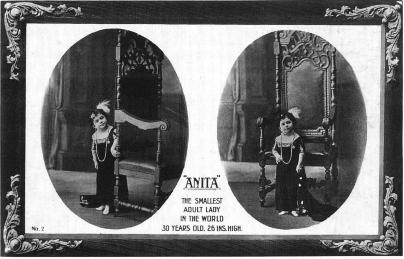
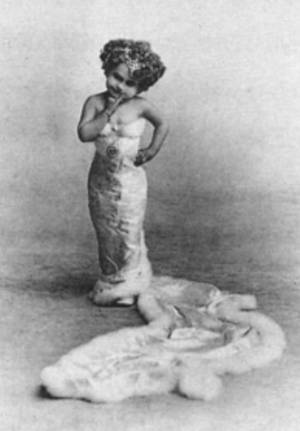
| On June 3 1911, the Western Mail advertised, "See Dainty, Charming Anita - The Living Doll - The Tiniest Woman That Ever Lived". She was 26 years old and 26 inches high. She held "receptions" daily, from 2pm to 10pm in a "specially appointed" hall, at 25 Queen Street. Admission for adults was 6d, 3d for children. An article about Anita appeared in the Western Mail on June 3, entitled "Venus in Miniature". Her soirees were "thronged with people". She was "perfectly proportioned" although, "Those who have not had the pleasure of meeting the lady, are apt to imagine that she is peculiarly formed". Lady Little possessed a "bewitching smile" and was often to be seen in jewellery worth upward of �2000, including a diamond watch given to her by Mikado of Japan and a gold and diamond watch presented by Lord Kitchener. She was the "smallest adult the world had ever known", and attended by her brother, "a stalwart Hungarian four times her height". Bill Barrett, who writes for the Cardiff Post could not identify the Great Mechanical Doll, but kindly put an item about her into the newspaper. Days later, a Mrs Marjorie Williamson wrote, "Dear Mr Butler, I was very interested to see your letter in the Cardiff Post enquiring about "The Great Mechanical doll". I am the little girl who was the doll. As it turns out, The Great Mechanical Doll was never a variety act. Her father, Augustus Winter, a professional photographer who traded under the name of "Auwin, at 30 Crwys Rd, Cardiff, took the photographs when she was 3 years of age, in 1913, and would never have allowed that to happen, actually he had been approached by film companies having seen his work with Marjorie. Auwin turned them down flat. The perspective of the photograph was explained by the fact that Auwin would take two photographs and subsequently superimpose one upon the other. Once, her father photographed a cracked egg, and then superimposed the infant Marjorie emerging from it, this became a regular Easter theme, at the time. And the box in the picture of the mechanical doll? This was in fact a drawer tipped onto its side. |
| Auwin, used these photographs to advertise his capabilities in the shop window. Mrs Williamson remembers customers being attracted to the shop to buy the postcards that were subsequently made, or to have some made, similar to the originals. Both Marjorie and her older sister acted as model`s in other photographs which were used for advertising such things as jam, soap and the White Rose Laundry. The indoor shots were taken with the help of magnesium flare. As a child model, Marjorie thought nothing of it, and called it gunpowder. She remembers First World War soldiers coming into the studio for a photograph and then running back out into the street, scared of the noise the gunpowder made...These poor men, who had come back as hero`s had probably had enough of frightening flashes for one lifetime. Though, there was one soldier, who had come back as a National Hero, who did not run away. Sergeant Major Frederick Barter from Daniel Street, Cardiff, was awarded the VC for his bravery at the battle of Festubert in May 1915. He was the only Cardiff man to win a VC in World War I. With eight men he had attacked german positions, severed 14 enemy mine leads with his clippers, peppered fleeing Germans with grenades and captured three enemy officers and 102 men, thus securing 500 yards of trench for the Allies. Barter told the Western Mail that it was, "All in a days work". Barter was given a tremendous welcome in Cardiff, when he returned, being met and escorted by the Lord Mayor from the railway station. A crowd mobbed his house and skinned his nose when one over-zealous fan threw a box of chocolates to him. During his leave, Barter visited his old school in Cryws road, which is probably then, that he went into Auwin`s studio. He was presented with a bouquet to hold just before the photograph was taken. Feeling that it would not look right for him to be holding the flowers, he suggested that Marjorie might join him. The result was a picture of Barter with Marjorie in his arms. Barter died in a nursing home in 1953. Marjories own photograph of herself and Barter is entitled "Comrades In Arms". Marjorie remembers the days of living over the shop, with kind memories. When she was not helping her father in the studio, she was out the back playing with the chickens. Her father went off to War during WWI, his skills no doubt much in demand by the RAF. Sadly he died while in service, of meningitis, a disease not unknown in the crowded camp conditions. Marjorie`s mother bravely took over the running of the business. |
 |
 |
 |
 |
 |
 |