| The USS Chatinouka |
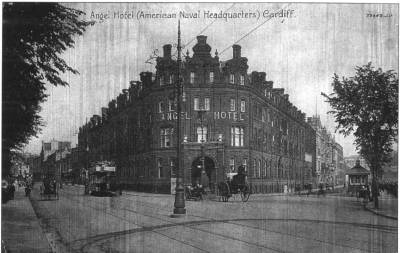
| The Angel Hotel was built on the same site as the Cardiff Arms Hotel, from which, the now gone, Cardiff Arms Park derived its name. After the demolition of the original hotel, the Angel was opened on July 7 1883, and has since played a central role to the city. It was designed by Charles James Jackson and built by his father, James Edwin Jackson. The number of guests that entered and left through the Angel`s door, especially to and from the railway stations, afforded a good trade fo the cab drivers. If you look carefully to the left of the hotel in the picture, you can see the tram ticket office. The local studies section of the Central Library, was able to shed some light on the use of the Angel. The hotel was used as a US Naval Headquarters between the years of 1918 and 1919 and later became the Welsh Regimental Headquarters of the Ministery of Pensions between 1922 and 1924, then again becoming an hotel once more. Whilst the Angel was under US Naval rule, it was styled the "USS Chatinouka". Amused staff at the Angel, expressed surprise that their hotel had once, technically been a ship! It was the Office of Naval History of the US Navy at the Washington Navy Yard, that was able to solve the puzzle of the location of the HQ in Cardiff. Near the end of 1917, General Pershing`s American Exhibitionary Force ran into difficulties, regarding their supplies, there were American ships arriving in France with only 50% of their cargo space taken up. The urgent demand, was for American manpower at the front, but the supply lines were inadequate. Desperate pleas were made to the US Navy to release Navy colliers to haul coal between Cardiff and the French ports of Le Havre, Brest, Cherbourg and the Bay of Biscay. The first US Navy ship to perform this duty was the USS Bath, carrying 3309 tons of coal from Cardiff, on the 5 October 1917. According to records, the ships that the Army ran, the "Army coal trade", had a slow turnabout at the French end. In October 1918, the average turnabout was 30 days, the aim of assigning the operation to the US Navy was to cut the turnabouts down to 18 days. There is more than a hint that the US Navy knew what they were doing and the US Army was inefficient. In July 1918, 19 ships operated by the US Army were assigned to the US Navy, other ships were also commandeered, 76000 tons of Swedish "time-charters", for one. By November 1918, 65 ships were involved in this emergency coal trade. The Cardiff HQ, was established October 1 1918, headed by Rear Admiral Phillip Andrews. The official purpose of the base was to expedite repairs and to report the arrival and departure of vessels. Other substations, were set up in Barry on 11 October, Swansea on 15 October and Newport in November. Some thought was put to setting up another substation in Penarth. In all, there were 1758 US Naval Officers involved in operation "Afloat and Ashore", enlisted US personnel numbered 4101 in November 1918. Between September and December 1918, 464.000 tons of Welsh coal were transported to France. Eight of these small vessels were sunk and one was badly damaged by enemy action. The Cardiff base was eventually wound up after the US soldiers in the AEF were returned home. While the Americans were around, they contributed to the shipping and coal boom in Cardiff. Their departure marked the beginning of the end of coal export from Cardiff. |
 |
 |
 |
 |