| Airships Over Cardiff |
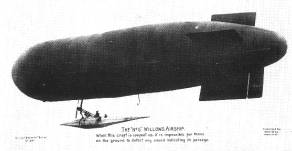
| The caption reads: THE "No5" WILLOWS AIRSHIP. When this craft is a 100 feet up, it is impossible for those on the ground to detect any sound indicating its passage. |
| E.T Willows, the daring Cardiff born airship pioneer from the early 1900`s, was at one time the leading private sector pioneer of airships in the world. Willows was born in 11 Newport Road in July 1886, and later was to move to Dumfries place along with his family. His father, Joseph, was a dentist and his son began training to follow in his footsteps. The lure of airships proved too great though and E.T abandoned dentistry. His father supported his sons ambitions, which at the time must have seemed way out of the league of a young trainee dentist. In August 1905 at the age of nineteen, Willows flew for the first time in his new airship, named for him - Willows I. The flight was eighty five minutes long and the airship had not been tested before, this also being her first flight. A Colonel Capper from the War Office claimed that the government`s own airship the Nulli Secundus, which was built in 1907, came a poor second to Willows I and the later model, Ia. Willows later experiemnted with Willows II around the skies of Cardiff. She was 86ft in length and carried 21.000 cu.ft of gas, which made her twice the size of Willows I. The airship had swivel propellers which made use of the principle of dynamic lift. Using the propellers, Willows was able to make the airship rise or fall at slopes of 1 in 7 or 1 in 8. She could climb at a rate of 1000fet a minute. Later, Willows, undertook an historic flight from Cardiff to London, starting out on August 6 1910. In doing so, he became the first man to cross the Bristol Channel in a powered aircraft. Willows flew at night, perhaps he felt it was easier to manoeuvre the craft in the cool night air. Pressing on, Willows attempted to get his bearings by the glittering lights of the towns below, he dropped close to the ground, hailing people using a megaphone to ask directions, close on a dozen times. The "directors" on the ground must have been startled to see this huge balloon coming towards them, shouting for directions. Running out of fuel, Willows drifted over Crystal Palace, eventually landing at Lee, near Mottingham, therefore accomplishing the record for cross-country flight in Britain. Cardiff City passed a congratulatory resolution, but no money was offered in support of their favourite man of the hour. The Lord Mayor indicated that there ratepayers money would not be expended on any Willows venture. Undaunted by this, Willows set himself the goal of a non-stop flight from London to Paris. Coming in at 120ft long and carrying 32.000 cu.ft of gas, Willows III was his biggest airship yet. She could rise 6.500 ft in 12 minutes. Her first flight was on October 29, over the Japan-British Exhibition at White City, London(the white city, being so named because of the white plasterboard palaces created for a series of annual exhibitions starting in 1908). Williows renamed this airship the "City of Cardiff"and took off for France from Wormwood Scrubs on November 4 at 3.25pm. As he lifted off, his audience included Asquith, Churchill and Lloyd--George. Willows ran into thick fog at 3.000ft. The charts were dropped by mistake and the engine had to stop more than once because of mechanical defects. Eventually, a slack envelope forced him down, nose first at Corbehem, near Douai. This had been the first cross-channel crossing by airship at night. Fortunately, the airship was not badly damaged, though bureaucracy loomed in the shape of French customs, demanding �30 for import duty on the gas in the airship. Urgent representations by the Aero Club of France, eventually resulted in Willows being given a month to leave or pay up. Several mishaps later, including adverse weather conditions and Willows finally made it to Paris on December 28. On New Years Eve, he triumphantly circled the Eiffel Tower. Willows was a big hit, even offering trips to the stout hearted for 200 francs a go. Willows left France before Customs could stick him with the duty. On his return to Britain, Willows moved his operations to Birmingham and began work on Willows IV. This airship was to be smaller and more streamlined than Willows III, with a length of 110ft and a capacity of 20.000 cu.ft. The War Office sent a Lt. CM Waterlow of the RFC to give it a going over. He reported that it was good for training but had, "no conceivable use for military or naval purposes". On this unpromising basis Willows IV was bought by the Navy for the sun of �1.050, and in 1912, Willows IV became His Majesty`s Naval Airship No 2. During her first test, Willows IV reached the speed of 50mph. The money came in good stead for Willows who suffered perpetual money troubles. It did not, however stop Willows from setting up again with the help of his indulgent father, and began a flying school (flying spherical balloons) operating from the Welsh Harp at Hendon. He also began the construction of his most ambitious airship yet - Willows V. She was 130ft long and had a capacity of 50.000 cu.ft - four times as big as Willows I. She could carry four people and could travel at up to 38mph. In February 1914, Willows V, flew over central London, circling St Pauls Cathedral and paying respects to the Houses of Parliaments and Buckingham Palace. The fate of Willows V, is still a mystery to this day. When the first World War broke out, Willows was commissioned by the Admirality to build his sixth airship - the SS2. This time the ship was 140ft long and had a huge capacity 70.000 cu.ft. Unfortunatley, she had problems of being inadequately gas tight, and did not match up to the Admiralty`s requirements. The SS2 was struck off the active list. The SS1 was built out of the envelope of Willows IV with the fuselage of an aeroplane hung beneath. The SS1 struck telegraph wires on May 7 1915, and was wrecked in 1917. Willows was called to advise the services on kite balloons( similar to the barrage balloons of WWII). Willows was able to make significant improvements in days and enormously strengthened British defences against German air raids. Willows returned to Cardiff in the last years of the war to manufacture kite balloons in a building made of wood and iron on Westgate Street, between the Arms Park and the County Court Offices. The building had previously been a roller-skating rink. The Government contracted for 83 balloons, and at the height of his success, Willows employed 150 staff. After the war, in 1919, Willows piloted a massive 80.000 cu.ft balloon at a Red Cross fete in Cardiff and a brave Miss, Elsa Spencer parachuted down from 2.200ft to land in the River Taff. The following day, Elsa Spencer had another dramatic splashdown in the Roath Basin in Cardiff Docks. In 1924, Willows flew a captive balloon at a military tournament at Wembley. In August 1926, Willows flew another captive balloon at Kempston, Bedford. Giving rides at two shillings a go. The net covering the balloon, tore away and the basket carrying Willows plummeted to the ground, breaking Willows neck and killing him as well as four passengers. Willows was proud of his home city. Indeed, if he had had his way Cardiff would have been a major beneficiary. On August 13 1910, he was reported as saying, "My great desire is to get Cardiff fixed upon the Government for the airship base for the rest of England. I see no reason why Cardiff should not ere long become one of the most important ports of the air". The Western Mail newspaper wrote in 1910, "It is the not uncommon lot of a man of genius to recieve scant honour in his own city. Such is the fate of Mr E.T Willows." It still is. The father of British Airways is buried in the family grave in Cathays Cemetary. |
 |
 |
 |
 |