By Nicole Alexander, Yasmin Akhtar, Samir Kakodar, Jon Meyer, Mehak Sethi and Lauren Sprieser
Photo Illustrations by Joey Armario
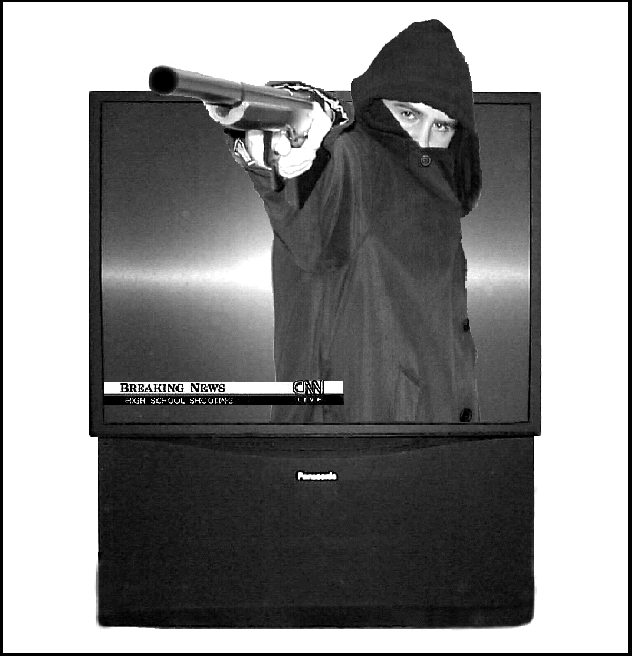
The names are ominous. Paducah. Columbine. Santee. All are American cities, surprisingly like Hinsdale. All were quiet, suburban areas dominated by middle- to upper- class white families, who thought they were immune to the violence traditionally associated with city life. All are home to public high schools. And all of them have buried the victims of a school-shooting.
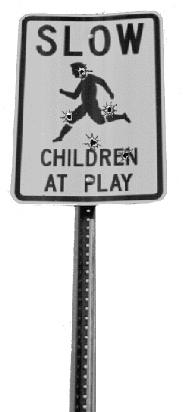
Over the past three years, school shootings have become far more publicized by the media and feared by students, teachers, and faculty across the nation.
Yet despite these frightening occurrences, most students at Hinsdale Central say that they feel safe at school. Should they be worried? Could the stress of living and working in such an active environment lead to a violent explosion? Should the school be putting even more security measures into place? Exactly how safe is our school?
SCARED STUDENTS?
Despite the many high profile school shootings which have occurred in the past several years, most students at Central do not seem concerned about the possibility of such an incident happening here.
"I feel safe," said Bryant Shockey, sophomore. "We live in such a safe area, I can't imagine anything like Columbine happening here."
The majority of Shockey's peers tend to agree. Despite the parallels between Central and other schools which have been the targets of school violence [see box, page17], most students do not feel they are at danger while in the class room.
"Some kids are nervous," said Jackie Schram, senior. Schram, however, feels that she is perfectly safe at school and does not worry about the possibility of violence occurring at Central. "It could happen, but I don't stay up nights thinking about it," said Schram.
Even students who acknowledge the chance of an armed attack here say they still feel `safe' on school grounds. "Our school could be a target for school violence, because we live in a rich community and have lax security," said Nick Lunon, junior. "But I don't think that our school necessarily fosters violent behavior."
Teachers also tend to feel that they are safe in the school. "I don't think that there's any chance that [an act of violence] would happen here. We just don't live in that kind of area," said Chris Korfist, Social Studies dept.
Mike McMahon, social worker, believes that the level of student comfort in the school is directly related to the atmosphere of the school. "Students can feel that their voices can be heard [here], the school does a good job of providing activities that can help assimilate students into the high school atmosphere," said Mr. McMahon. He does, however, recognize that there is room for improving the support system provided to troubled students.

"We need to somehow reach out to those students [who would be prone to violent behavior] to help them develop their interests and develop them personally. There's less talking going on and more violence," said Mr. McMahon. "We need to start talking."
Central principal, James Ferguson, agrees. "Our school is very safe; we've taken measures to try and ensure that kind of safety," said Dr. Ferguson. "But there's nothing to stop someone-- student, teacher or anyone--from bringing a gun to school and using it."
STRESS AND STRAIN
In many past school shootings, the aggressors have been characterized as students who were often bullied or teased by their peers, and that this constant alienation led to their attacks. Even students who feel safe at school acknowledge that the taunting and teasing that goes on in the hallways, classrooms, and cafeteria at Central could have the potential to push someone over the edge.
"Everything that was going on at Columbine is happening here," said Chris Lauer, senior. "Unfortunately, it took a tragedy to stop it there. [Social problems] have the potential to get to the point of violence."
For most students, the stereotype of a school shooter is the "outcast" who has been driven to his/her actions through constant abuse and ridicule. Nick Lunon, junior, describes the gun-wielding student as "not necessarily someone who dresses in black, but someone who is an outcast, does not have enough family support, and is harassed by kids at school."
"The kids at Columbine were pushed over the edge," said Stassia Sullivan, junior. "That scared me because those guys weren't very different from us."
Many people agree that the amount of stress, at home and at school, could lead to a potentially deadly situation. "If a student is physically intimidated, feels disconnected, and does not have a proper support system at home or at school, the anger can build up and can cause drastic last resorts," said Mr. McMahon.
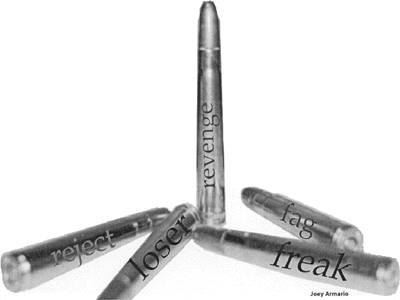
Parents of students here are also concerned about the relationship between bullying and possible violent behavior. "I don't worry particularly about violence around here; I think the school is aware of potential problems, and they have security measures in mind. The only thing that makes me somewhat concerned is the amount of bullying which goes on. It isn't taken seriously, especially in elementary schools," said David Christian, father of Hilary Christian, junior.
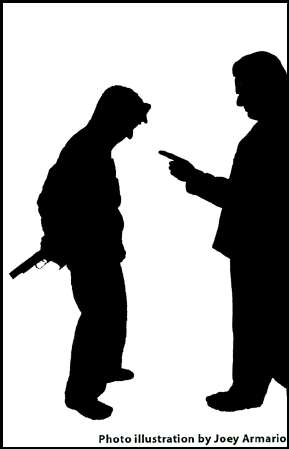
"We spend 40 hours a week in this building," said Mr. McMahon. "When [a student] spends those 40 hours with no friends, being harassed or physically intimidated and getting hurt, he'll eventually fight back. It's like backing an animal into a corner."
SECURITY MEASURES
Despite the students lack of concern about violent activity on campus, Central administration has been taking measures since Columbine to increase safety around the school. In the past years, the school has taken such measures as having a full time police officer in school, maintaining a closed campus, and employing several full time hall monitors to watch the hallways during the day.
The administration has also formed the Safety Task Force, a committee whose purpose is to implement new means of protection around the school.
However, Dean Michael Leverence, a member of the committee, is quick to acknowledge that a school can never be 100 percent safe. "Schools are so public and have so many doors. You can't lock down the whole school."
One of the most often criticized means of school security is the closed campus, which means that all external doors are kept locked during school day with the exception of the front door, which a hall monitor always watches. Some students see this policy as being unfair to students, who must often walk to the front door to enter during the day, and not a successful means of securing the school.
Dr. Ferguson said the closed campus policy "was designed not to keep students and teachers in, but rather to keep others out." However, according to Dr. Ferguson, simply locking doors during the day is not enough to completely prevent a shooting or other violent crime.
"How open is this building at night, with sporting events and activities?" said Brent Johnston, Physical Education dept. "How easy would it be to keep a door ajar and sneak in something?"
Many teachers, students and parents have proposed the idea of placing metal detectors or security cameras throughout the school. The idea of installing such devices was brought up among the Safety Task Force. "Early on we discussed installing cameras in parking lots and the commons, but we decided against it," said Dr. Ferguson. "They'd cause a disruption. There's no need."
Mr. Leverence saw some potential benefit to their installation. "Security cameras could give us the ability to know where to send hall monitors at different times. They could also be a deterrent," he said. "It's like when you put a marked squad car on the highway, one would tend not to speed or drive recklessly."
Many students are openly against the idea of enhanced security measures. "Adding security measures would just make more people angry at the school for being restrictive," said Shockey. The issue of personal freedom plays into staff opinions as well. "As citizens in a free society, we're always examining what the government or school does to make sure we are keeping our rights," said Dr. Ferguson. "Why take away students' rights and freedoms in place of safety?"
Dr. Ferguson believes metal detectors or enhanced security wouldn't matter. "If someone wanted to start shooting here, a metal detector wouldn't make them think twice," he said. "They'd barge right through it blazing. In ten minutes, it'd be all over."
WHAT WE CAN DO
According to Mr. Leverence, the level of responsibility in regards to student safety has to extend beyond metal detectors and locked doors. "The only way to stop a shooter is if he or she tells someone before hand," said Police Liaison officer Mark Keller. In this situation, communication is key. "Kids need to take threats seriously," said Mr. Johnston. "They need to have zero tolerance, because there's no such thing as joking about this subject anymore."
Students, too, acknowledge their apathy toward such threats. "We don't take threats seriously," said Sullivan. "You can never tell if someone's just messing around or if they're serious."
Mr. Johnston compares the situation at schools across the country to that of airports. The Federal Aviation Administration (FAA) has adopted a policy of arresting and questioning anyone who even jests about committing a violent crime or carrying a weapon on board any flight. Mr. Johnston suggests that school staff and administration need to adopt a similar policy. "Kids have the unique position where they hear what's going on," he said. "They're in the pipeline, and need to take responsibility for their school."
"You ask the question, `what's going to stop a shooter from getting in?'" said Mr. Leverence. "The question should be, `How can we stop someone from wanting to bring a gun to school?'"
One of the answers to that question, according to Mr. McMahon, is student inclusion. Being welcomed in the high school environment is crucial to success in the educational process. "After we make sure our physical needs are met - food, water, shelter, etc. - our next priority is getting a sense of belonging or affiliation," said Mr. McMahon.
Violent students, according to Mr. McMahon, are usually disconnected from the school community. To increase this connection, there are many programs students can attend, including Ambassadors, Peer Mentorship and Peer Leadership. These three programs are part of the Student Assistance Program, and were designed to work with students in need by pairing them with other students.
Additional programs like Operation Snowball and Students Against Destructive Decisions, or the 60 other school sponsored clubs and organizations can promote a healthy connection to the school, according to Mr. McMahon.
"In reality, any school is a potential Columbine," said Schram.
|
Getting a gun
Although only one of the many weapons that pose a threat to students, guns are one of the most feared and are becoming increasingly common. Gun control laws are creating controversy, but the debate over their implementation in Illinois is at a standstill. Currently, the Illinois State Police regulates the process of owning a firearm.
To own a firearm in Illinois, one must first obtain a Firearms Owner's Identification Card (FOID). To be eligible for a FOID, the applicant must:
- have never been convicted of any
type of felony
- not be a narcotics addict
- not be mentally retarded
- be a US citizen
- not be subject to an existing order of
protection prohibiting the possession of
a firearm
- not have been hospitalized for a men-
tal condition in the past five years.
- have not been convicted within the
past five years of battery, assault, aggra
vated assault, violation of an order or
protection, domestic battery, or similar
offenses within given lengths of time
- be over 21
If under 21, the applicant must have the written consent of his guardian. In such case, the guardian must be eligible for a FOID, and the applicant must never have been convicted of a misdemeanor or found to be a delinquent.
There are also several specific laws regarding youth and guns. It is against the law for anyone under age 18 to possess a handgun or concealable firearm.
A person under 21 is not required to have a FOID in order to possess a firearm or ammunition as long as he is under the immediate control of a parent, guardian or other adult who has a valid FOID.
It is unlawful, with few exceptions, for anyone - youth or adult - to possess a gun or ammunition on the grounds or buildings of a school. Exceptions can be made if they are in a firearm training course, parade, hunting or target shooting on school range, or if the student has the consent of school authorities. Firearms on school property for these reasons must be transported, unloaded and enclosed in a suitable case, box or transportation package.
|
 [ main ]