
 |
 |
 |
 |
 |
 |
|
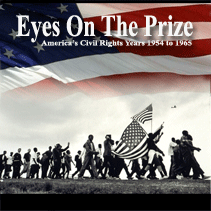
See the award-winning PBS documentary series EYES ON THE PRIZE right here in Fauquier starting in February 4, 2006. The Afro-American Historical Association of Fauquier County, along with the Fauquier Branch of the NAACP, the Fauquier Library, and the Sunday Supper Club will host showings of the 14 episodes of EYES ON THE PRIZE. EYES ON THE PRIZE is the most comprehensive television documentary ever produced on the American Civil Rights Movement. It focuses on the events, issues, triumphs and tragedies of ordinary people as they tested their power to effect change in America during a period termed “the Second American Revolution”. The episodes will be shown on fourteen consecutive Saturdays, beginning February 4, 2006 at the AAHA’s headquarters in The Plains, Virginia. ( driving directions ). |
Upcoming Showings
FEBRUARY 4, 2006
Awakenings – 1954-1956
This program concentrates on the period from 1954 to 1956, highlighting the events that began the modern black freedom struggle. Prior to 1954, racism was rationalized under a "separate but equal" doctrine. It was during this time that existing organizations, local leaders and ordinary citizens became involved in the black freedom struggle. The lynching in Mississippi of 14-year-old Emmett Till led to a trial that caught the attention of the national news media. The personal courage of Rosa Parks triggered the 1955-1956 Montgomery, AL, bus boycott.
FEBRUARY 11, 2006
Fighting Back – 1957-1962
Public schools became a battlefield when blacks rejected the notion of "separate but equal" education. This episode explores the critical 1954 Supreme Court BROWN vs. BOARD OF EDUCATION OF TOPEKA decision; the story of nine black teenagers who integrated Little Rock's Central High School in 1957; and James Meredith's enrollment at the University of Mississippi in 1962. The program identifies the national organizations involved in the struggle to integrate schools and how they affected the freedom struggle.
FEBRUARY 18, 2006
Ain’t Scared of Your Jails – 1960-1961
In 1960, large numbers of college students and young people began to get involved in the black freedom struggle. The focus of black protest changed from legal battles to personal and group challenges against racial inequities. This program focuses on four related stories: the lunch counter sit-ins of 1960; the formation of the Student Nonviolent Coordinating Committee (SNCC); the impact of the movement on the 1960 presidential campaign; and the freedom rides of 1961.
FEBRUARY 25, 2006
No Easy Walk - 1961-1963
In Albany, GA, the Reverend Martin Luther King, Jr.'s, strategy of nonviolence was tested by Police Chief Laurie Pritchett. In Birmingham, AL, schoolchildren filled the city's jails after they marched against Bull Connor's fire hoses. In the nation's capital, marchers captured national and international attention. This program places the civil rights phenomenon in a broad historical context, describing the growing commitment of activists to nonviolent tactics. In the period between 1962 and 1966, the civil rights struggle became a "mass movement."
MARCH 4, 2006
Mississippi: Is this America? - 1962-1964
In 1961, Mississippi became a testing ground for constitutional principles as the civil rights movement concentrated its energies on the right to vote in this state. This program focuses on the extraordinary personal risks faced by ordinary citizens as they assumed responsibility for social change, particularly in the 1962-1964 voting rights campaign. By 1964, conflicts between movement leaders and liberals became apparent as the newly formed Mississippi Freedom Democratic Party challenged the Democratic Party Convention in Atlantic City.
MARCH 11, 2006
Bridge to Freedom - 1965
Ten years after Rosa Parks refused to give up her bus seat to a white man and 11 years after the decree that "separate but equal" was unconstitutional, millions had joined the fight, and thousands of blacks and whites came together to march 50 miles for freedom in Selma, AL. This program highlights this historic march as the last great gathering of the Southern-based movement and provides an opportunity to examine the gains made by the civil rights protests.
MARCH 18, 2006
The Time Has Come - 1964-1966
In the South and the urban North, leaders emerged who helped transform the civil rights movement into a boarder struggle for human rights. Their message was direct: “The Time Has Come.”
This urgency was best articulated by Malcolm X, who exhorted African Americans to build on self-respect, self-reliance, and independent Black institutions. The Student Nonviolent Coordinating Committee (SNCC) responded to Malcolm’s call by launching an independent political party in Alabama, using the symbol of a black panther to counter the existing Democratic Party’s white rooster. Maclolm X’s influence also reverberated in the call for “Black Power,” raised by SNCC chairman Stokely Carmichael during a march through Mississippi.
MARCH 25, 2006
Two Societies - 1965-1968
“Two Societies” reveals the division that existed between African Americans and Whites in America’s cities, where African Americans had gained little from the southern freedom movement by the late ‘60’s. In Chicago, one of the most segregated cities I the country, we see the southern civil rights movement’s attempt to bring the nonviolent movement north. Dr. King and his Southern Christian Leadership Conference (SCLC) lead protest marches through White suburbs, where its nonviolent methods were sorely tested.
In Detroit, tensions exploded during the summer of ’67, and more than 100 cities shared the pain of racial violence. A presidential commission warned that America had become “two societies, separate and unequal.”
APRIL 1, 2006
Power - 1966-1968
Solutions to the problems of inequality were as diverse as America itself. Communities mobilized for change in strikingly different ways, but their ultimate goal was the same power.
In Cleveland Ohio, Carl Stokes sought power through the ballot box, and became the first Black mayor of a major city. In the streets of Oakland, California, where tensions were high between the community and the police, activist formed the Black Panther Party for Self-Defense to advocate community empowerment and social programs, and to monitor the police, and in Brooklyn, NY, African American and Latino residents elected an interracial governing board to control their children’s education. Their two-year experiment was buffeted by teacher strikes and battles for power, but out of the struggle came an organized community of parent-activist.
APRIL 8, 2006
The Promised Land - 1967-1968
The escalating Vietnam War further divided America, and the government’s war on poverty began to suffer. Martin Luther King, Jr. spoke out against the war, facing a firestorm of anger from across the nation. King and his SCLC joined others in the movement seeking to expand the struggle for civil rights to include economic equality. SCLC organized a multiracial Poor People’s March to Washington, D.C. to force government response. They also joined a peaceful protest in support of striking Memphis sanitation workers, which was shattered when an assassin’s bullet took King’s life. A hundred cities exploded in riots, and the murder of Robert Kennedy shortly after only added to the darkness. The Promised Land now seemed more difficult to reach, but eh legacy of the 1960’s activism provided a foundation for future action.
APRIL 22, 2006
Ain’t Gonna Shuffle No More - 1964-1972
At the pinnacle of his success, the young boxer Cassius Clay announced his conversion to the Muslim faith and became Muhammad Ali. He embodied the spirit of resistance to the war in Vietnam by refusing army service, sacrificing his heavyweight title and fighting for his principles up to the Supreme Court. At Howard University, the nation’s premier Black institution, many students felt that the school was too slow in developing course with an African American perspective. When angry students took over the university administration building Black Political Convention in Gary, Indiana, 8,000 African American ratified a sweeping agenda, setting the stage for unprecedented Black political participation.
APRIL 29, 2006
A Nation of Law - 1968-1971
The Black Panther Party… Fred Hampton…Attica…These names equaled controversy in the America of law and order promised by President Nixon. Urban rebellion and campus unrest had brought cycles of protest and reprisals, leaving many wondering if America was in fact “a nation of law”
For some, the Black Panther Party’s vow of self-defense “by any means necessary” evoked the memory of Malcolm X and overshadowed the Party’s community service activities. FBI Director J. Edgar Hoover declared the Panthers the United State’s numbers one threat to internal security. With the help of an FBI informant, police raided the apartment of Illinois Party Chairman Fred Hampton, killing him and another Panther leader. The law and order crackdown also had troopers and guards stormed the prison after an inmate rebellion. Thirty-nine people were killed, all by gunfire from government weapons.
MAY 6, 2006
The Keys to the Kingdom - 1974-1980
Busing…Maynard Jackson…Affirmative Action…from South Boston to Atlanta, American sought remedies for the problems of discrimination.
In Boston, the issue was busing. White parents reacted violently to court-ordered busing, and Black parents steeled children for their role in this next civil rights battle. For both Blacks and Whites busing proved an unpopular means of integrating schools, but, in the words of one Black parent, “There was no turning back.” Undoing the wrongs of past discrimination proved equally complex in the workplace. Though fifty percent of Atlanta was African American, less than one percent of city contracts were awarded to Africa American firms. Following his election as Atlanta’s persistently high poverty rate showed the limits of what local government could accomplish. Affirmative action faced its first crucial test in the Supreme Court when a White man sued a University on grounds of “reverse decimations.”
MAY 13, 2006
Back to the Movement - 1979-Mid-80’s
The powerlessness that was felt in many Black communities in the third decade of the civil rights movement provoked both rage and activism. In Miami’s Overtown section, a young Black salesman died after being beaten by police for a traffic violation, and the officers were acquitted by an all white jury. Overtown exploded in the worst riot in a decade.
In Chicago, the first female mayor gained publicity by moving into Cabrini Green a predominantly Black housing project. But in the eyes of many African Americans, Jane Byrne did little to handle the problems of Chicago’s inner city. Despite severe opposing, the Black community mobilized a grassroots campaign to elect U.S. Congressman Harold Washington to serve as Chicago’s first Black mayor. Their success became a symbol for hope and a model for change.