



|
|
|
|
|
|---|
Carnival's roots go back to the ancient Romans and Greeks who celebrated the rites of Spring. In the Middle Ages, when the Catholic Church tried to suppress all pagan ideas, it failed when it came to this celebration. The Church incorporated the rite into its own calendar as a period of thanksgiving. The nations of Europe, especially France, Spain, and Portugal, gave thanks by throwing parties, wearing masks, and dancing in the streets. During the last four decades of the 18th century, new art appeared (especially in Rio de Janeiro) in which religious themes were no longer predominant. Works with temporal themes, such as portraits of exalted personages, became part of Rio's artistic production.At the beginning of the 19th century there was a process of "Europeanization" with the coming of the Portuguese Court to Brazil as the result of the invasion of Portugal by Napoleon Bonaparte's troops. Dom João VI, the refugee Portuguese monarch, encouraged Rio de Janeiro's intellectual activity, founding cultural institutions such as the Royal Press and the National Library. In addition, he brought a group of French masters to Brazil to establish an Academy of Arts and Crafts after the style of European art academies and to implement the neoclassic style in the "modernization" plan for the royal capital of Rio de Janeiro. Artists such as the Taunay brothers, architect Auguste Grandjean de Montigny (1776-1850), and painter Jean-Baptiste Debret (1768-1848) were part of the group. Debret, the most important of the French artists, systematically documented landscapes, people, and rural and urban customs. Schools of music existed in Bahia in the early 17th century and religious music was played in churches throughout the colony. As with other art forms, musical activity intensified with the arrival of the Royal Family in 1808. King João VI, a music lover, sent to Europe for the composer Marcos Portugal, and for Sigismund von Neukomm, an Austrian pianist, a pupil of Haydn. Local musicians also attracted the King's attention, such as José Maurício Nunes Garcia (1767-1830) who was a notable improviser on the organ and clavichord. João VI appointed him Inspector to the Royal Chapel, a body which had more than 100 instrumentalists and singers, many of whom were foreigners.
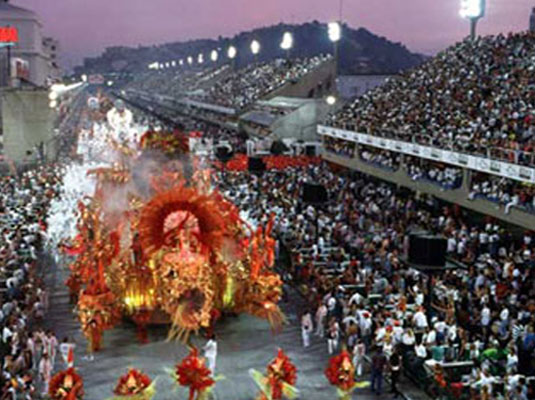
(Carnival in Brazil) |
|---|