|
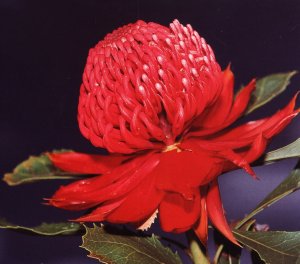
Waratah (Telopea)
Wet and Dry These forests fall into two categories, wet and dry sclerophyll. Wet sclerophyll Forests are typically dominated by tall, quite close growing eucalypts such as Mountain Ash (Eucalyptus regnans), the tallest flowering plant on earth. (Along with Eucalyptus diversicolor, the Karri of Australia's south-west, it is also the tallest hardwood species in the world.) The canopy is dense but not light-excluding so that an understorey, usually a profusion of tree-ferns and softer-leafed trees and shrubs, is able to flourish. Growing in areas of lower rainfall and soil nutrients, the trees in dry sclerophyll forests are smaller. They are predominantly Eucalypts, such as Messmate Stringybark, Brown Stringybark, Spotted Gum or Jarrah in the south-west, and Angophoras, growing up to 30 metres in height. These may be interspersed with still smaller species of Casuarina, Banksia, Callistemon, Hakea, Grevillea, Melaleuca and Telopea. Better known as Waratahs, Telopea are found in areas of New South Wales where they have adapted to exploit chemicals released by the breakdown of sand-stone otherwise poor in nutrients. Dry sclerophyll forest is also more open, allowing light to penetrate and promote the growth of a scrubby understorey which at ground level, might include bracken ferns, grass trees and cycads.
[page 1, 2, 3, 4, 5, 6, 7, 8, ]webmistress What does that mean? set design©Kids4ME2004 Music - The Forest Speaks
|