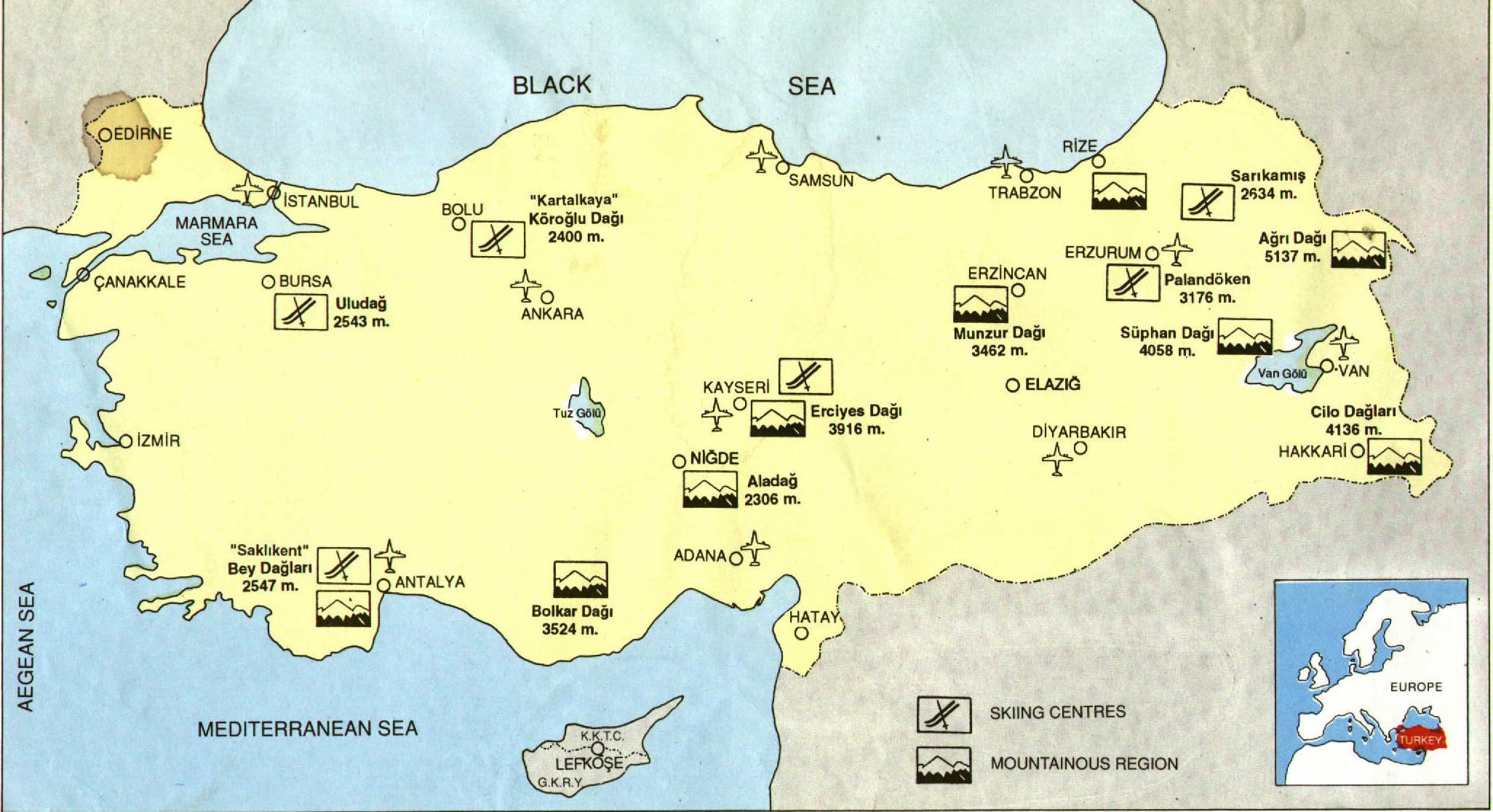
| A glance at a topographical
map of Turkey immediately reveals that this is a country of mountains.
Rising in all four directions, mountains encircle the peninsula of
Anatolia. A part of the Alpine-Himalayan mountain range, Turkey has
mountainous regions of different geological formations. The North
Anatolian range skids the Mediterranean shore.
Turkey’s magnificent mountains and forests are mostly
undeveloped, existing as wonderful natural preserves for an extraordinary
variety of wildlife, flora and fauna. Two of Turkey’s most famous peaks
are volcanoes, both inactive, Mt. Erciyes in Kayseri in Central Anatolia
(3917 m) and Mt. Agri (Mt. Ararat 5137 m) in the East. Other well-known
mountain ranges are the Rize-Kaçkar (3932 m) in the Eastern Black Sea
region, Nigde-Aladag (3756 m) in the Central Taurus range, and the Cilo
and Sat mountains (4136 m) near Hakkari in the Eastern Taurus.
The mountainous nature of the country has influenced its
cultural evolution. For centuries, nomads and semi-nomadic peoples have
migrated annually to the fresh pastures of the higher elevations in the
summer. These alpine meadows, called yayla, still represent a firm tie to
traditional culture. |
|
For climbers and those
interested in mountain geography, Turkey offers a wealth of exploration.
Glaciers, volcanoes, and peculiar geological formations such as karsts,
prove irresistible to researchers and students of geology. The challenging
terrain offers great opportunities for aficionados of outdoor sports who
find interesting experiences on the mountains of Eastern, Central and
Southern Turkey. A list of resources to aid an expedition, at whatever
level, is to be found below.
Mt.Agrı (Ararat)
Mt.Cilo
The
Toros Mountains
The
Kackar Mountains
Mt. Erciyes
|