 |
|||||||||||||
     |
|||||||||||||
 |
 |
||||||||||||
   |
World News
A hit on "The Late Show With David Letterman," on which he appeared 10 times, and "The Howard Stern Show," Hedberg once was dubbed "the next Seinfeld" by Time magazine. But TV-series fame eluded him because his unique style of mumbled one-liners didn't lend itself to the sitcom format. Hedberg delivered absurdist, random observations in a spacy staccato. His long, dirty blond hair harkened to the image of a 1970s stoner. Jokes about Hedberg's drug use were a staple of his act. He took a hiatus from performing for several months after a May 2003 arrest in Austin, Texas, for felony possession of heroin. Born in St. Paul, Hedberg rose through the ranks at Minneapolis' Acme Comedy Co. and caught his big break through a Comedy Central special. His rambling, non-sequitur style often drew comparisons to Steven Wright, but Hedberg disagreed. "If I made potato chips and put them in a can, people would say I was ripping off Pringles," he said. "But what if I put them in a bag?" Hedberg had two popular comedy CDs, "Strategic Grill Locations" and "Mitch All Together." He acted in the movie "Almost Famous" smoking fake pot with Peter Frampton and appeared on Fox's hit series "That '70s Show." Hedberg is survived by his wife, comedian Lynn Shawcroft, his father and mother, Arne and Mary Hedberg of St. Paul, and sisters Wendy Brown of Woodbury and Angie Anderson of South St. Paul. [Associated Press, 4-1-05] Top
of Page Back to Main News
Page Home
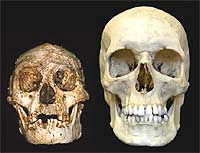
The original skeleton, a female, stood at just 1 meter (3.3 feet) tall, weighed about 25 kilograms (55 pounds), and was around 30 years old at the time of her death 18,000 years ago. The skeleton was found in the same sediment deposits on Flores that have also been found to contain stone tools and the bones of dwarf elephants, giant rodents, and Komodo dragons, lizards that can grow to 10 feet (3 meters) and that still live today. Homo floresienses has been described as one of the most spectacular discoveries in paleoanthropology in half a century�and the most extreme human ever discovered. The species inhabited Flores as recently as 13,000 years ago, which means it would have lived at the same time as modern humans, scientists say. "To find that as recently as perhaps 13,000 years ago, there was another upright, bipedal�although small-brained�creature walking the planet at the same time as modern humans is as exciting as it was unexpected," said Peter Brown, a paleoanthropologist at the University of New England in New South Wales, Australia. The researchers estimate that the tiny people lived on Flores from about 95,000 years ago until at least 13,000 years ago. The scientists base their theory on charred bones and stone tools found on the island. The blades, perforators, points, and other cutting and chopping utensils were apparently used to hunt big game. The discovery shows that the genus Homo is more varied and more flexible in its ability to adapt than previously thought. (The genus Homo also includes modern humans, Homo erectus, Homo habilis, and Neandertals�all of which are marked by relatively large braincases, erect posture, opposable thumbs, and the ability to make tools.) "Homo floresiensis is an addition to the short list of other human species that lived at the same time as modern humans. I think people will be surprised to learn that not so long ago, we were not alone," said Brown. [National Geographic News, 10-27-04] Click here to learn more at National Geographic online. |
||||||||||||
  |
|||||||||||||
|
home about me news gallery links contact me sitemap �2006 All Rights Reserved. |
|||||||||||||
 |
 |
||||||||||||