


First
Act:
Case Blue(5)
During September, the combats transformed the city in a hell for the soldiers from both sides. A German General wondered if Stalingrad was converter in a new Verdun. Hitler always had wanted to avoid that his troops had a long combats into of towns, Although, Hitler guaranteed in a discourse, that nobody throw the German army from the positions in Volga River. For many people, these words were an omen: Never could to leave the battle, whichever it was the consequences.
(pag 5 of 5)
On September 24, Hitler dismissed the general Halder at the head of the General Staff and is changed for the general Jodl. Halder couldn't tolerate in any more time Hitler's interferences, who to his opinion weren't doing any more that to obstruct his task. And Hitler wasn't admitting any type of critique. The critiques to the performance of the VI Army of Paulus were increased, this critique was based from it was the biggest formation of the German army with near 300.000 men. Nevertheless, Paulus was using eight divisions inside the city and other eleven divisions were defending a front of approximately 210 km from the north of the city up to the south, only a division was staying in reserve.
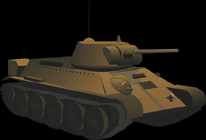
Chuikov was planning to fragment the German massive assaults, using the buildings remains as strengthened forts occupied with infantry with guns antitank; these had to turn aside to the attackers for channels where the tanks T-34 and antitank units would wait for them camouflaged among the rubbles. Paulus's headquarters knew that was not time to lose with the winter coming closer and there began to be prepared to conquer the industrial north of the city.
On September 27, the assault began with a concentrated bombardment, while in land two panzer divisions and five infantry divisions were advancing (Map, situation b). The Mamaev Kurgan's top was conquered, the Russian counterattack managed to make move back to the Germans though not to reconquer the top. The German advance was slow but sure during the following days, the general Chuikov was starting doubting that they could be kept in the western shore because everything was depending on the reinforcements that were coming from another shore. But for the Germans the things were not being OK either. The men were very tired and the morality was getting off due to strong loss and the resistance, almost suicidal, of the enemy. During October the front would become stable to "blood and fire" (Map, situation c).
The German Staff were terrified before the waste of lives from Chuikov, but they were admitting that it was wasting to his troops. Chuikov's troops were exhausted and without ammunitions, but it wasn't an obstacle for that Stalin will order, through Eremenko, to recover the zone occupied by the Germans. Nevertheless, for Chuikov the only possibility of resisting was based on the massive bombardments of the situated artillery to another side of the river, and of the provisioning material and men supported across the piers.
Stalingrad since 24 of September to 19 of november.
During the months of October and November, the situation into the city was turn impossible for both sides. The Volga frozen process, made more desperate the support of soviet troops. The Germans weren't better, the time was running out, the temperatures went on turn down and the Hitler's obsession for conquer the city changed to Paulus into a caricature from himself. At middle of November, the 42 per 100 of the battalions of the VI Army could be considered "out of combat".
On Monday, the 14th of October, Paulus threw a new frontal assault against Stalingrad; the target was this time the factories of the north (Map, situation d). Chuikov used his principal armoured force, 84th Tank Brigade, opposite to the principal assault. The Germans throw everything what they had: the batteries of artillery, the Stukas bombardment in chain and the self-propelled cannons of assault. The Soviet soldiers hold with an incredible efficiency; nevertheless, it was impossible to be able to bear the force in the central point of the assault. On the following day the Germans were assuring to control most of the factory of tractors though the front was blurred, there was fought body to body and Soviet troops had stayed isolated.
On October 19 the distraction counter-offensives were organized from the front of the Don towards the northeast by 64th Army towards the south because relieved the German pressure on 62th Army for some days. Though the German falls were enormous, 62th Army had remained reduced to a few heads of bridge isolated ones of others in the western side of the Volga.
In Stalingrad's rear the principal worry of the Germans, it was to support the lines of defence and to face the poll's assaults. But soon these worries were replaced with the preparation of a good winters barracks and they set to work to the Russian prisoners and to the hiwis (Soviet soldiers who had gone over to the Germans). On November 9, the temperature down to 18 º under zero, the Volga began to give up being to sail; the winter had come to Stalingrad.
During the first days of November, the German pressure was kept with assault constant of small scale though it continued being fierce. On November 11, it began the Paulus's final assault. Groups newly organized were thrown against the redoubts that were staying, the buildings key were conquered and reconquered by both sides, staying finally in Soviet hands. The night of November 11, 62th Army threw to the assault to attenuate the German pressure but they were stopped by the German bombardments. The assault was so terrific that some Soviet battalions were totally annihilated, though the rest continued resisting with the Volga to his back (Map, situation e).
On November 19, the Germans understood that Stalingrad had turned into a great fodder. It was beginning the Operation Uranus.

