
“What we do in life echoes in eternity.”
 ————————————————————
 Proximo, GLADIATOR
I
long to get back to a place
I’ve come to love. I miss the place. I miss the people.The weather
was fine although gray clouds were looming over the horizon. The
road was worse than it used to be. “No wonder people don’t
come this way,” said one of my travel companions. I smiled
and said to myself, “Exactly the place I wanted to be.” On
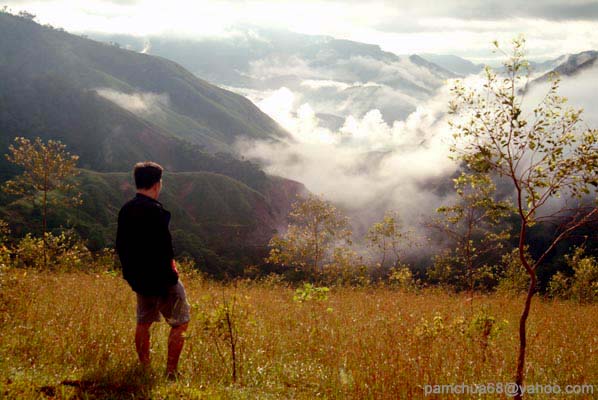
our way up the mountain, the landscape would transform from rice
fields into forested ravines then to pine covered hills. That unmistakable
mountain scent was in the air.I was deep in my thoughts. The memories
of our last visit were frozen in my mind like a fond memory of a child
at play.
The morning was so peaceful, cold, and inspiring yet anxiety was present,
deep in my gut. Much had happened since the last two years we’d
visited this land of theBugkalots (declared as millennium tribe by GMA,
for what reason I don’t know) in themountainous region of Nueva
Vizcaya.A few months back, a malaria outbreak had claimed the lives of
16 people and for weeks the area was declared under a state of calamity.
After the outbreak, came reports of tribesmen exchanging narra logs for
guns. Being a warrior is deeply imbedded in Bugkalot culture and is evident
in theirLong history of violence. There were reports of headhunting practices
during the late 70’s. The practice was long gone now since the Bugkalot
community learned to embrace Christian values. I can attest to how deeply
religious these people are. Then there was a distressing report from
the Inquirer news team about endangered animals caught by Bugkalot hunters,
such as Wild boars and deer, being rampantly sold along the highway. Most
of the meat hanging by the road, fresh and bloodied, as it turned out,
were not the real wild boar meat as what the sellers claim, but that of
a native pig. To the untrained eye and guillible buyers, they won’t
trace the difference.
Two days before our scheduled trip, I had read disturbing news that violence
nearly erupted between the DENR personnel and the Bugkalots when
the former tried to confiscate narra lumbers as evidence against violation
of “the right to harvest limited volumes of forest products as covered
by the certificate of ancestral domain claim program.”I am starting
to believe that our trip was more like a fool’s errand. “We
do not have enough. How can we earn for our family?” one tribe member
told me later in one of our conversations. Lack of job opportunities
has forced many Bugkalots to engage in illegal logging in the watershed
area ofCasecnan. Most of them were lured by the demand of
businessmen involved in selling lumber in the lowlands to support their
families. How can the government protect its forest and watershed and
not protect the interest of people? Can the Bugkalots live harmoniously
with their environment the way their ancestors did, before the onslaught
of modernization? These and morewere the questions that popped up in my
mind on our way to our destination.After almost 12 hours on the road we
finally arrived in that miniature Shangri-la that is Brgy. Lipuga. But
the rain that would soon become a storm caught up with us. We found comfort
in our chosen sanctuary, an elementary school, which, ironically, was
nearly destroyed by a landslide.
As if sensing our torpor, a bunch of Bugkalot urchins trooped
to the school to give us entertainment. The boys danced the traditional
Bugkalot warrior dance with matching fake wooden swords and their faces
filled with dignified conviction. The girls, on the other hand, sangand
danced the “Spaghetting Pababa.” They are too young to realize
the conflict around them, too young to grasp the effect of their
old culture being influenced by the new. Soon after, they guided us to
the nearby waterfall that echoed from a distance. These children,
with the hope and promise of education, can become the future leaders
of their community, and safeguard their diminishing culture and resources.
My visit only strengthened my faith with the Bugkalot people. It made
me see things in a different perspective. It made me realize one thing
I already know: that like us, they also need to survive. Are we to judge
them based on isolated cases of misdeeds and unfounded reports which
do notrepresent the whole community?We plan to get back. Not to play savior
or redeemer to these people but to find ways to help them cope with their
worsening predicament. The only way we know how, eco-tourism. The beauty
of the Bugkalot ancestral domain is comparable to Baguio minus the
houses and pollution. There are plenty of natural wonders in store for
adventurers: waterfalls, mountaintops, caves, pristine rivers, and the
warm hospitality of the people. Tourism may not be much, but done properly,
it could bring livelihood to the Bugkalot and fund the preservation of
their priceless resources.
Like the river wild that runs through the Bugkalot land like veins that
supports life, hope springs eternal.
(written by Noel Galang)