


Northeast Alabama is blessed with good farming soil because of its position at the foothills of the Appalachian Mountains. Therefore, in the early 1900's, it's no suprise that industry spread to this part of Alabama in the form of cotton mills. They were an excellent business for this area because of the abundance of cotton as well as cheap labor. I've obtained information from books, libraries and websites about these mills, but the majority (and probably best) information I've obtained from older members of my own family that worked at these mills for years and years. The memories are what will make the history of the mills. The goal of this page is to provide information of these mills and the people that worked in them.
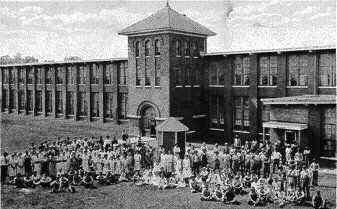
My great great grandmother Carlisle starting working at a mill at age 13. (about 1910) My great aunt Vera began working at a mill when she was 16 or 17. By the 1916 the first national child labor law had been passed (the Keating-Owen act, which made it illegal for childred under 14 to work and for children under 16 to work in mines...obtained from www.sparacus.schoolnet.co.uk/USAkeatinga.htm.) This law, however, was branded "unconstitutional" in 1918. Other laws were passed in the early 20's, however often these laws were not strictly enforced and many times a child had to offer no proof of birthdate to an employer. My aunt Hazie, who began working at a mill at 13 or 14, said that the adults worked 10 hours a day, and the children under 16 worked eight, and had to attend school for two hours also.
Why work at a mill?
Mills tended to locate themselves frequently in small, rural towns where there was usually a lack of education. A mill job, though very hard work, didn't take a lot of education. People worked at mills because there were no other jobs. My aunt Vera said, "The incentive to work was that if you wasn't there, somebody else would be. And that wouldn't be your job no more." This is why some reform in the South took so long, because people were hesitant to do anything that might risk
their livelihood. A mill job, unlike farming, was a reliable (if not very small) paycheck. Many women especially worked in mills during war times because it gave them a sense that they were helping the troops abroad.
From a 1930 Census Bureau, Manufacturing of textiles was the second leading employer of women and men. (Next to Agriculture.)
So what were the jobs/pay?
My great greatgrandmother Carlisle in the 1910's made $.15 an hour.
My great great grandfather White made $.45 an hour in the 20's-30's
My great aunt Vera made $.75 an hour in the late 30's, early 40's
The three main jobs seemed to be spinner, doffer, or working in the "card room"
My great great grandfather worked in the "card room." This is where the big loads of cotton were brought in (usually about 350-450 lbs.) and the seeds were removed. Working in the card room meant that you were in charge of a big piece of machinery which extracted the cotton seeds, so this meant loading the cotton and unloading it.
A doffer came in contact with the most crude cotton thread. This thread was thick (about the size of a man's thumb) A doffer had to unload the thread from the machinery and wind it around these large wooden spools. My great great grandmother White did this job, typically considered a man's job because of the heavy lifting involved.
A spinner was involved in the final product. The would take the "doffin" yarn and load/unload it in machines to make it smaller into usable threads. Often spinners were involved in the making of thread to cloth and they dying of the threads.
Most mills were like assembly lines in that one product was passed from one room to the next.
A mill typically had a main boss, a boss for each shift, and overseers for each of the jobs.
How did people dress for work in a mill?
There wasn't a dress code in most mills; people usually just wore what they had at home. Women wore dresses in the early part of the 20th century but later opted for overalls and pants because there was less fabric to get caught in the machinery. My great grandfather said, "You'd see em comin' out those mills, their clothes would be soakin' wet from the sweat. It was a hard, hard job."
What about African-American workers in the Mill?
My great aunt Hazie worked in the Avondale Mills in Pell City. She said that black people worked in one section of the mill. (segregated) She said that they mostly did janatorial work, and probably were paid less.
Some mills that my family worked in were the Avondale Mills (Pell City and Sylacauga), the Blue Springs Mill in Oxford, The Buck Creek Mill in Thompson, the Blue Mountain Mill in Anniston, and the Linen and Thread mill in Anniston. ---more--->