
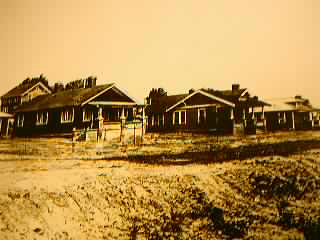
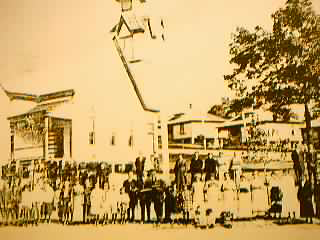
"Blue Mountain: Ajoining Anniston, on the Northwest, this is a model textile city of 1,134 people, with its own school system and water supply from Anniston lines. One of the largest net and twine plants is located there."
written for The Anniston Star
December 19, 1944
By: Nonnie Booth
"This old document here was the beginning of it all," recalled Judge J. J. Willett, handing over a legal looking paper, yellow with age and dated May 29, 1896. It proved to be a contract between the citizens of Anniston and the American Net & Twine Company. This company contracted to build a twine mill to cost not less that $100,000. To look at that plant at Blue Mountain today valued at about four or five Million dollars, and realize its small beginnings, is to see real progress. The committee that pushed this project and signed the contract were: W.W. Stringfellow, J.C. Sproull, H. Atkinson, M.B. Wellborn, W.H. McKleroy, James Lapsley and T.G. Bush.
Station Steeped in History
Blue Mountain Station, nestling at the foot of Blue Mountain, has quite a history of its own and was up and coming before Anniston got its start. Many people remember the old Hudson Stage Inn on the hill above the mill, recently torn down and replaced by a modern house. There in the old days the Washington to New Orleans stages stopped to change horses or for the guests to get refreshments or spend the night. Old settlers said that two or three miles out of Blue Mountain the stage driver would blow his horn and by the time he arrived at the Inn the fresh horses were ready and waiting to be harnessed to the stage.
The stage traveled over a plank road. This was a big improvement over the dirt road which was liable to get very muddle at times and bog the stage down. Trees in this section were plentiful and cheap and the plan road not at all uncomfortable. On this type of road horses could make twelve or fifteen miles an hour, but had to be changed about every twenty-five miles.
The Alabama and Tennessee Rivers Railroad planned to build a railroad from Selma to Guntersville, but by the time the War Between the States, had completed it only from Selma to Blue Mountain. All such building ceased during the war and when it was resumed it was decided to build the road on to Rome and Dalton instead of to Guntersville. And it was then called the Selma, Rome, and Dalton Railroad.
A Training Camp
But back to 1861 and the beginning of the war, Blue Mountain was selected as a place for a Confederate training camp. Raw recruites from South Alabama, South Mississippi and Louisiana were assembled and trained here. There were usually six or seven thousand in training at a time and when they were ready to join General Lee in Virgina or General Joe Johnson in Georgia and Tennessee, they marched from Blue Mountain to Rome (that part of the railroad was not built then and from there could ride to their regiments.
Beginning with that early Confederate Camp Anniston has consistently been a training center for our fighting forces. In the Spanish-American War, Camp Shipp was located on Union Hill and Ft. McClellan has trained soldiers for both World Wars.
After the War Between the States the Camp at Blue Mountain was abandoned and there was nothing left but a water tank. The American Net and Twine Company, a corporation of Boston, Mass., soon saw the advantages of its proximity to the railroads and started negotiations to build there. As a result we have a splendid mill close by the lovely village of Blue Mountain. ----More history--->