
Anniston Star July 2, 1986
by Mark Fuller-assoc editor
Blue Mountain today is a quiet town of about 264 residents, the majority of whom have retired from Blue Mountain Industries--the present name of the cotton mill that has operated and been vitually the only employer in the town since 1897. In the early days, Blue Mountain was simply a mill village, in which the company owned all the houses in the town and rented them to workers. In 1940, Blue Mountain became an incorporated town and began electing a mayor and five city council members.
The mill continued to own the houses until 1959, when Indian Head Yarn Company bought the mill from the Linen Thread Company. Indian Head put the houses up for sale and gave the tenants first option to buy, and most of them chose to do so, with financing through the company. Indian Head also gave the church, school, and sewage disposal plant to the city at this time.
The Model City of the New South
by Grace Gates
In 1896 Anniston secured a $250,000 branch of the American Net and Twine Company. The firm was organized in Massachusetts in 1842 to make candlewicks. When oil replaced candles they switched to lampwicks. According to the story, the two partners were walking along the Boston docks one day when they overheard two fishermen discussing the high price an scarcity of twine for nets. The owners went into the business and became one of the largest such organizations in the world, winning gold medals at fairs in London and Paris.
The Anniston plant was called "Gold Medal" briefly. By February, 1897, the mill building, warehouse, and fifteen cottages on a nearby hillside were completed under the supervision of Charles M. Noble. The boilers and engines were in place, and five cars of machinery had arrived by then. Work began in July, 1897. The mill was so successful that in 1898 the capacity was doubled. So many orders were on hand that the mill ran day and nignt.
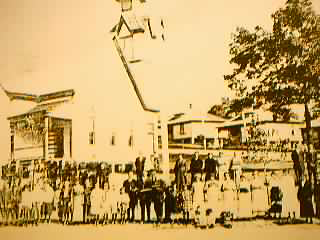
The Anniston Star
by Pat Guy- Star Staff Writer
November 2, 1969
The American Net and Twine Co. build a mill on land that is now known as Blue Mountain in 1897. The Linen Thread Co. bought the mill in 1916 and operated the mill until it was purchased by Indian Head Yarn and Thread Co. in 1959.
As a company town, rules were strict for the residents of the 125 mill-owned houses. A longtime employee recalled that "when the company owned the town they looked after the welfare of all the houses and had an inspector that checked everything, housekeeping and all, and if you didn't meet specifications you didn't stay very long." A list of company rules was posted in the kitchen of every house, he said, and it included prohibition of alcohol.
Richard Moyer, the last company mayor of the town (from 1937-1963), said the rules didn't keep people from wanting to move into the houses. "People were fighting for houses. We always had a long list of applicants," said Moyer. And who wouldn't fight to be in a house where all utilities were paid and rent 25 cents a room, when Indian head sold the houses the average price of the wood frame houses was $3,500. The company handled most of the town operations in those days, Moyer recalls. "When anything had to be done, the company did it," he said. "We kept it in good condition. It was a costly thing to do."
In addition to providing housing for the mill employees, Linen Thread Co. built a disposal plant for the town, provided a church and community center and hired its own policemen.
*The full text of the articles by Mark Fuller and Pat Guy may be found in the files in the Alabama Room, at the Anniston Public Library.