 |
 |
 |
| EMERGENCY ASSESSMENT |
| AND |
| FIRST-AID |
 |
| EMERGENCY ASSESSMENT |
| INITIAL ASSESSMENT/EARLY ACCESS AND CPR Whenever an injury occurs, survey the area first and then the examiner must be able to control the situation and make sure that the patient is in a very minimal position for any additional harm. Do not allow anyone to move the patient, not until a thorough assessment is made. While performing the initial assessment, the examiner must keep in mind that there are three major situations which can threaten the state of the patient: A-irway obstruction, B-reathing difficulties and C-ardiac arrest. Early Signs of Heart Attack -prolonged compression pain or discomfort in the center of the chest behind the breastbone. -pain may radiate to the shoulder,neck,arm or jaw usually on the left side. -may be accompanied by sweating, nausea, vomiting and shortness of breath. Early Signs of Resipiratory Failure -unable to speak, breath or cough -Cyanotic or bluish coloration of the skin and lips -clutches neck(universal distress signal) While the examiner is waiting for additional assistance, he or she can immediately begin to check for any abnormal or arrested breathing/pulse, internal or external bleding and shock, But do remember to survey the scene first to see if it is safe and get some idea of what happened. Then begin doing a primary survey by checking for unresponsiveness. To check for unresponsiveness -Tap or gently shake the patient and ask "Are you OK?" -If the patient is unconscious, examiner shouts "Help!" -Then proceed to CPR What is CPR? CPR stands for Cardio-Pulmonary Resuscitation. It is a life saving technique performed on a person who is not breathing(repiratory arrest) and whose heart stopped beating(cardiac arrest). This procedure involves a combination of rescue breathing and chest compression. It should be done before defibrillation and advanced cardiac life support can restore normal heart and lung function. CPR-BAsic Life support can be performed by both lay persons (for out-of-hospital situations) and medical personnel. How does CPR work? All the living cells (those little thingy who makes up our body) of our body need a steady supply of oxygen to keep us alive. CPR works because you can breathe air into the victim's lungs to provide oxygen into the blood. Then, when you press on the chest, you move oxygen-carrying blood through the body When will you do CPR? CPR must be started as soon as possible afte the heart stops beating or breathing either stops or is ineffective. Any delay in starting CPR reduces the chances of survival. In addition, the brain cells begin to die after four to six minutes without oxygen. |
|
|
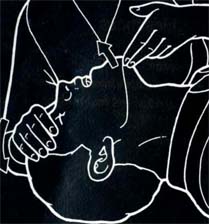
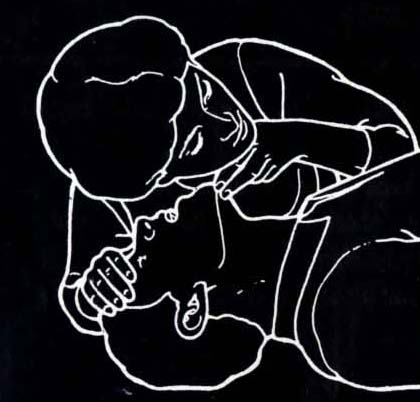
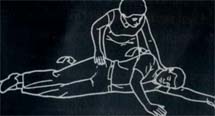
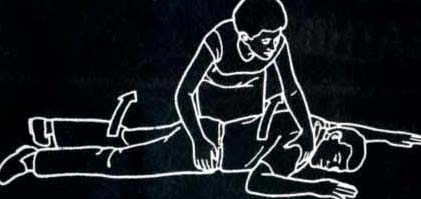
| After determining unconsciousness, the examiner must evaluate the condition of the body's two most vital systems-the respiratory system and the circulatory system. This is done by checking the ABC's. A-irway: Does the victim have an open airway (air passage that B-reathing: Is the victim breathing? C-irculation: Is the victim's heart stop beating (does the victim have a Is the victim bleeding severely? A-irway -------------------- Open the Airway: use the headtilt/chin lift method -Place one hand on patient's forehead -Place fingers of other hand under bony part of the lower jaw near chin -Tilt head and lift jaw-avoid closing patient's mouth Check for breathlesness -Maintain open airway -Place your ear over patient's mouth and nose -Look at the chest, listen and feel for breathing for 3 to 5 seconds -patient may either be: breathing or not breathing If the patient is breathing: Maintain open airway and position the patient -Roll patient onto back, if necessary -Kneel facing the patient, midway between patient's hips and shoulders -Lean over patient and place one hand on patient's shoulders and the other hand on patient's hips -Roll patient towards you as a single unit; as you roll patient, move your hand from shoulder to support back of the head and neck -Place patient's arm nearest you alongside patient's body |
| allows the victim to breathe)? |
| pulse? |
 |
 |
 |
 |