
Checking the Gauge
Checking the gauge of your knitting is an important step to take before beginning your project, yet a step that many knitters omit to their sorrow when their project ends up the wrong size. The gauge is simply how many stitches fit in an inch measured across the width and across the length of your knitting. You knit a small sample, called a swatch, using the needle size and yarn specified for the pattern and then compare your results to the numbers of stitches per inch given in the pattern. If your swatch is significantly larger or smaller than it should be to match the gauge, you will need to use different size needles than given in the pattern to match the gauge.
Why this happens is because everyone knits a little bit differently. Some people pull the yarn more firmly and make smaller stitches than average while others pull it more loosely and make larger stitches, even when using the same size needles and yarn. To compensate for this, knitting needles come in a range of sizes so that the first knitter can use larger needles to make her stitches larger while the second knitter can use smaller needles to make her stitches smaller.
Let's look at a specific example. Suppose a sweater pattern says that the gauge should be 20 stitches per 4 inches and 26 rows per 4 inches for stockinette stitch and size 7 needles. To check your gauge, you need to use size 7 needles and the yarn specified for the sweater, cast on 20 stitches, and knit 26 rows in stockinette stitch. Then lay your swatch down and gently flatten it without stretching it. Use a ruler to measure the width and length of the swatch. If it is 4 inches wide and 4 inches high, you have matched the gauge and can use size 7 needles for your project.
If it is too large, you will need to try size 6 needles and knit another swatch. If it matches, use size 6 needles. If not, try size 5 needles. It is more important to match the stitches per inch across the width than across the length because you can often compensate for a slight difference in gauge along the length by adding or omitting rows, but an error in the width will affect every row you knit. Similarly, if the swatch is too small, try larger size needles until you match the gauge as closely as possible.
Here is a set of swatches knitted for this gauge using size 5, 6, and 7 needles in stockinette stitch with the same worsted weight yarn.
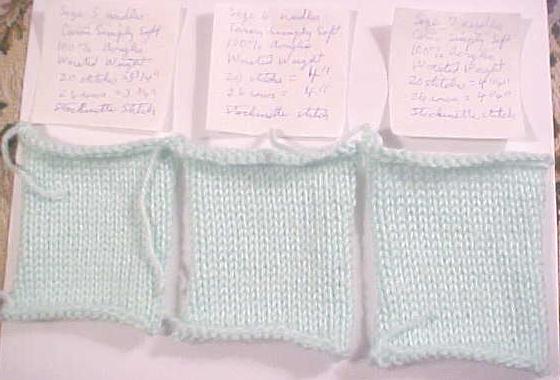
The size 5 swatch measured 3 3/4 inches by 3 3/4 inches. The size 6 swatch measured 4 inches by 4 inches. The size 7 swatch measured 4 1/4 inch by 4 1/4 inch. I would need to use size 6 needles to match the gauge. If I used size 7 needles, my knitted pieces would be too large.
For example, if the instructions said to cast on 100 stitches to begin a sweater front, the designer meant for the piece to be 20 inches wide. You figure this from the gauge by noting that 20 stitches should be 4 inches wide, so 100 stitches should be 20 inches wide. If I used size 7 needles knitting 20 stitches per 4 1/4 inches, my sweater front would be 21 1/4 inches wide.
I would have a similar error in the sweater back, so the sweater would be about 2 1/2 inches larger around than it should be. That is about a size bigger than I intended. If the difference in gauge is even larger, the error is even greater when multiplied by the greater number of stitches in the actual piece. You can get into real trouble with adult size projects or projects on fine needles needing lots of stitches for the width. Always take the time to check the gauge before investing the time into knitting the project!
For projects which specify more than one size of needles, you need to choose the size for all the needles based on the gauge. You will often see sweater patterns which call for two sizes when the sweater has ribbing at the edges. Here is a picture of the size 6 stockinette swatch and a classic 1 x 1 ribbing swatch knitted on size 6 needles.

If the pattern said size 5 and size 7 needles, the instructions will say to knit the rib on the smaller needles for a specified length, then switch to the larger needles to continue with stockinette stitch. If you look closely at the rib swatch on the right, you will notice that the stitches look larger than the stitches of the stockinette swatch on the left. That is why a size or two smaller needles are specified for the rib, so that the stitches will look the same size in both patterns. The stretchy rib swatch will pull in to look narrower than the stockinette, so don't worry about the difference in width since the stockinette stitch will gently stretch the rib out in the actual sweater piece. It really is knit with the same 20 stitches across.
So, since I would need size 6 needles to match the gauge for the stockinette stitch instead of size 7, I need to use size 4 needles for the rib instead of size 5. You can knit a swatch in rib stitch to check its appearance. If the pattern calls for more needles, find out what they are for and match the appropriate size. If it calls for a size 5 circular needle to knit a turtleneck in rib stitch without a seam, use size 4 to match the other ribbing.
You also need to check the gauge if you use a different yarn than specified in the pattern. Yarns come in different thicknesses and twists and so may knit into a different sized swatch. You can often substitute a pretty new yarn in a pattern if you choose an appropriate needle size. Do consider how similar a knit fabric it will produce, though. A thick yarn may knit a stiffer fabric that won't flow softly like the original lighter yarn specified in the pattern, and a lighter yarn may produce a limp fabric that won't give the same appearance as a heavier one. One trick you can try is to use two strands of a lighter yarn together to give more body if you can't get the same weight yarn in the color and style of the lighter yarn Get a ball or two of the yarn and experiment before getting enough for the whole sweater.
You also need to check the gauge if you want to use a different knitting stitch. It's fun to design your own unique sweater with your choices in yarn and stitch patterns, but it is up to you to make sure the gauge will make the size sweater you intend. Also, some stitches like cables may call for adding additional stitches instead of changing the needle size to compensate for the way the cable draws in because it is a raised pattern. Experiment with test swatches to see what happens for your choices and try to match the gauge as closely as possible. A published pattern has already had the number of stitches carefully worked out to fit the sweater around the shoulders, armholes, and bustline, so avoid changing the number of stitches there if possible unless you want to change the style and fit of the sweater as well.
Tip: If you tend to knit a bit larger than the gauge, buy extra skeins of yarn to be sure you have enough to finish the project. Yarns that are on sale or are not "no dye lot" ("no dye lot" yarns are the same color from batch to batch; some yarns may vary in color and will have a number indicating which dye lot batch they came from on the skein paper band) may be difficult to match if the store sells out their stock before you discover that you need another skein. Some stores will allow you to return unused skein for a refund, but check before you buy the yarn under this assumption. Crafters who used just a little yarn and then returned the skein have caused some stores to refuse to take yarn back.
Tip: It is a good idea to buy more yarn than the pattern calls for if you aren't sure if you will have enough to finish the project. A pattern gives an estimate only and not a guarantee. If it tells how many ounces of each yarn are needed and you will have at least an ounce more than that when you buy the skeins, you are usually pretty safe as long as you match the gauge carefully. If it tells you how many skeins of a given weight or yardage, you can't be sure how much of the skein will be left when you finish. Watch for patterns which give several sizes but the number of skeins is the same for two adjacent sizes. The larger size may use most of the skein and you might run out if you knit loosely.
Tip: Skeins that you can't return can be used in other projects. There are many patterns available using small amounts or a mix of yarns for just this purpose. Match the care instructions for the different yarns so that you will have compatible yarns and know how to care for the project if it needs cleaning.
You now are ready to try our second project, The Boa Scarf. When you are ready for the next lesson, click on the link for Increases and Decreases.
Last update: December 31, 2003