Welcome to Venous disease Page
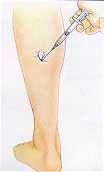
Sclerotheray
Is a technique of injecting a strong solution into the vein
that causes the vein to be irritated, makes the lining of
the inner vein sticky and with the addition of compression
will hopefully cause the vein to close up and heal
together. There are several solutions used in SCLEROTHERAPY
called sclerosant. This solution is injected with an
extremely fine needle into the affected veins.
The principle of SCLEROTHERAPY is to treat the whole
patient; that is one tends to treat the larger veins first
starting at the top of the leg and working down. The
principle of SCLEROTHERAPY is the same for Spider Vein
Disease or Varicose Vein Disease. The only real difference
is the period of compression. Spider veins can be
compressed for a much shorter period of time while varicose
veins tend to require longer compression.
After your initial assessments, which will include a
history, examination and testing of the veins with a
Doppler (ultrasound) Machine, an outline of treatment can
be offered to you. This usually requires somewhere between
2-4 sessions lasting 45 minutes each, in this time one leg
is usually treated with a sclerosing solution. You will be
asked to lie down on the examination table, anywhere from 5
to 30 injections per treatment session is given. This is
followed by the application of cotton balls and a bandage
or stocking and an immediate return to normal activities.
The real advantage of SCLEROTHERAPY is that it causes
minimal interruption to your lifestyle, is virtually
painless, is extremely safe, has very few complications and
can be done out of Hospital without loss of time at work or
from social or sporting activities. Most treatments are
spaced by a period of 2-4 weeks. One can expect a good
result with an 80% - 90% improvement in the cosmetic
appearance of the leg. You should be aware that treated
veins would look worse before they begin to look better.
When the compression dressings are removed, you will notice
bruising and reddish areas at the injection sites that last
on the average eight weeks, but may be there up to six
months.
COMPLICATIONS of SCLEROTHERAPY
Even when a highly experienced physician is performing the
treatment, there are a number of possible side effects,
including the following:
-
Aching in the leg for the first day or two following
treatment. This is usually relieved by walking, and by
keeping the pressure of the bandage or the stocking. You
may also take Tylenol (Acetaminophen) to relieve this
aching. Avoid Aspirin
-
Red raised areas at the sites of injection. These should
disappear within a day.
Back To Top
-
Pigmentation (brown lines or spots) on the skin at the
sites of treated blood vessels .
These pigmented areas are mainly composed of hemosiderin (a
form of iron stored in the blood) and may result when blood
escapes from treated veins. They are more likely to occur
in patients who have larger veins treated. In most cases,
they disappear within a year, but in about 5 per cent of
patients they may be permanent. Persistent pigmentation may
respond to laser treatment. In order to prevent this side
effect do not take any iron supplements (e.g.
multivitamins)during the course of treatment, and keep all
follow-up appointment with the Doctor. You should not be
taking Aspirin as this may increase bleeding.
-
Matting: This is the development of networks of fine red
blood vessels near the sites of injection of larger
vessels, especially on the thighs. About 10% of patients
develop these. Most resolve spontaneously, some resolve
with injection treatment, or laser therapy and a few
persist. Matting is more common in patients with extensive
surface vein and in obese patients who have poor muscle
tone. It is important to walk for at least 30 minutes per
day during the treatment to improve leg muscle tone. Other
exercise such as cycling, treadmill and low impact
aerobics may be substituted.
-
Ulcers: Rarely there is the formation of small, painful
ulcers at treatment sites within 2 weeks of injection.
Sometimes these occur because some of the solution has
escaped into the surrounding skin. Generally ulcers occur
due to sensitivity of the tissues to the concentration of
the solution entering the injected vein. They appear to
occur more frequently in patients who smoke cigarettes.
These ulcers will heal very slowly and may leave a small
scar.
-
Bruises at injected site. These will disappear in a few
weeks and are probably related to the fragility of blood
vessel walls. Blood trapped in the sclerosed vein may cause
the vein to be more noticeable in the first few weeks
following treatment, and is early sign that the treatment
has been successful.
-
Allergic reactions: Although on rare occasions such
reactions may be serious, they may be treated by immediate
injections of adrenaline. Less serious reactions are
treated with antihistamines. Minor rashes require no
specific treatment but you should inform the doctor if they
occur. Rarely, inflammation of the gums (gingivitis)
appears to be a reaction to a specific sclerosing solution.
If this occurs, a different solution can be used for
subsequent treatments.
-
Phlebitis: This is an inflammation of the treated blood
vessels. It is due to the action of the sclerosant on the
blood vessel wall. When it occurs it is treated with
anti-inflammatory medication, heat packs, compression and
regular walking. Most of the time it is caused by lack of
compression.
-
Tender dark lumps may develop in the injected vessels
particularly if larger vessels are injected. These are
areas where blood has been trapped in the sclerosed vein.
The blood may be drained out of these lumps a few weeks
after injection. This will lessen the resolution of the
tenderness, and help prevent the pigmentation that occurs
due to hemosiderin.
-
Migraine: Some people who have a history of migraine
headaches may develop symptoms of migraine within minutes
of the injection session. These symptoms generally will
include visual disturbances lasting a few minutes followed
by a throbbing headache which can be treated by taking the
regular medication.
Back To Top
Other very rare complications
Deep vein thrombosis
(clot in a deep vein). This can occur but is extremely
rare if Compression and regular daily walking are adhered
to.
Intra-arterial
injection. This is an extremely uncommon complication
which may result in muscle and skin and other tissue damage.
There are no known long term side effects of sclerotherapy.
Treatment Day
It is important that you wear comfortable clothes which is
either a loose fitting dress or shorts, it is also
important not to have shaved your legs within the last 48
hours and if you have a superficial skin infection, you
should consult your General Practitioner for treatment
prior to sclerotherapy.
Avoid the application of moisturizers or any other cream to the legs prior to
the injections. You will be able to drive home after the
treatment, but patients are encouraged to walk for a period
of 30-45 minutes immediately following the treatment.
SPIDER VEINS TREATMENT
Firstly for Spider Veins: it is important that the
stockings or the bandage are left in place for 48-72 hours
day and night. The new trend is to apply cotton balls and tapes
few hours, then the patient can use support stockings for daytime hours.
After removing the pressure it is quite common to have a
minor ache which is usually a good sign of vein collapse.
Tylenol (Acetaminophen) may be taken for minor discomfort. Exercise is an
important part of treatment and it is important to walk
briskly for at least 30 to 40 minutes every day for one week.
VARICOSE VEINS TREATMENT
After the procedure for varicose veins: it is important to
walk immediately for a period of 45 minutes and then it is
important to walk at least 45 minutes per day for the next
two weeks. The stockings or the bandage need to be left
continuously in place for a period of THREE days and night.
They may not be removed during that time and must be worn
in bed and must not be removed to shower during that time.
Again, the trend is to apply compression for shorter periods of time,
some keep cotton balls and tapes for few hours, the patient has to
put the stockings on once she/he gets home.
The commonest causes of complications relate to removing
the stockings too early. For your shower you can use a
plastic bag ( garbage bag) to cover your leg, and tape it
at the top to make it water tight; or sponge bath. Other patients prefer to leave the treated leg ( if only one leg was treated) outside the bathtub.
If you experience pain at night in the foot , or if your
toes are numb it may mean the stocking- bandage is too
tight, you can remove them and reapply with less pressure.
Back To Top