( Choose topics from the table on the left )
What is PAD?Peripheral Arterial Disease is, simply put, the same disease atherosclerosis affecting the arteries of our upper and lower extremities. How many people have peripheral arterial disease? The estimate in the United States is there is a little more than 8 million people that have this condition but only about half of them, perhaps less than half of them, actually have the symptoms of peripheral arterial disease. The other individuals have significant obstruction of peripheral arteries but in fact they have no knowledge of it, and they had no symptoms, that in fact they have a problem. And it varies obviously with age but increases rather sharply with age. The relationship with age is striking. At less than age 60 the number of individuals with PAD is 3 percent or less and by 50 it is less than 1 percent. But as you get over 60 and start going up in age, both in men and women, you get sharp increases, and so by the age of 75, and of course in the developed world and even in the Third World, the number of individuals in this age group as a proportion of the population is growing rapidly, the prevalence of disease is over 20 percent, so this is a condition that is very common in the elderly and the proportion of individuals who are elderly is growing worldwide.
What are the risk factors for peripheral arterial disease? Well there is lots of data but to make a long story short the two most powerful ones are diabetes and smoking. These risk factors dominate, and they are more specific for peripheral arterial disease than they are for either heart or brain arterial diseases. Certainly cigarette smoking and diabetes are both related to heart disease and stroke but they are even more specifically linked to peripheral arterial disease.
Other factors can be reviewed @ atherosclerosis
What are the symptoms?
The term "intermittent claudication" is used to describe the onset of pain in the muscle group of our upper or lower extremities( most of the time in the calf muscle) that occurs with walking. The patient has no pain when sitting or sleeping, he/she feels "tightness" or "cramps" or "something grabing" in the calf after walking a limited distance. The feeling gets so bad that the patient has to stop walking, rest for few minutes, after which the pain goes away. This cycle keeps repeating itself everytime he/she walks.
If the disease is allowed to progress and cause more damage to the arteries, pain at rest and even gangrene or soft tissue loss can occur.
Back To Top
How can it be diagnosed?Your family doctor can conduct a full clinical history and examination, checking your pulses, and sometimes using a Doppler ( small ultrasound machine) he/she can check the flow of blood and measure the blood pressure over the foot.
Ankle Brachial Index (ABI) can be easily calculated, it gives a general idea on the severity of PAD. Physical examination alone without the assistance of the Doppler is not very reliable. If your family doctor has any concern about your circulation, you will probably be referred to a vascular specialist.
Is PAD Serious?There is considerable overlap between peripheral arterial disease, coronary heart disease and cerebrovascular disease. All the studies indicate that the cardiovascular mortality rate is directly related to the severity of PAD. Simply put, atherosclerosis is a systemic disease, affecting all the arteries of our body. PAD is one manifestation, however its significance and importance is that it is an indication that the patient has arterial disease elsewhere ( heart, brain) and that his life expectancy gets shorter with the progression of his PAD.
How can we treat PAD?The first step is confirming the diagnosis, identifying the risk factors and the habits of the patient. Control of the risk factors is the main concern and the most difficult. Any physician involved in the treatment of arterial disease, knows how difficult it is to get his patient to quit smoking, lose weight, or follow a healthy diet.All other factors like hypertension, diabetes, etc... should be identified and treated.
The specific treatment of PAD depends on its severity and on the symptoms of the patient.
- Claudication Most of the patients can be managed by walking exercises ( 30 minutes, three time/week ) and antiplatelet (ex: Aspirin, Plavix ). The patient is instructed to walk as far as he/she can, stop when the pain gets really bad, then walk again to finish the 30 minutes of walking. It will probably take him/her one hour to complete 30 minutes of walking. 75% of patients with claudication can be managed and their disease stabilized.
- Rest painThis is a limb threatening syptom, the patient does not have to walk, he/she gets the pain while sitting or sleeping, they have to sleep with the leg hanging down the side of the bed.
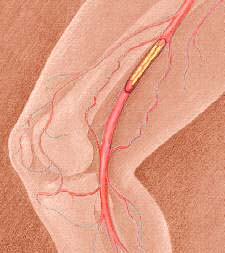
This group should be managed more aggressively with angiogram or arteriogram or die test. This will be followed by the appropriate treatment with angioplasty or surgery.
- Gangrene is an emergency, the patient should be assessed as soon as possible with angiogram, in most cases surgery rather than angioplasty is done.
|