|
|
|
What are Carotid arteries?
Paired arteries on each side of the neck, originating from the aortic arch, and supplying blood to the brain and face. Each carotid artery bifurcates into two: Internal Carotid supplying the brain, and External Carotid supplying the neck, face, and scalp.
The brain receives blood supply from two other arteries, called vertebral arteries located on the back of our neck. 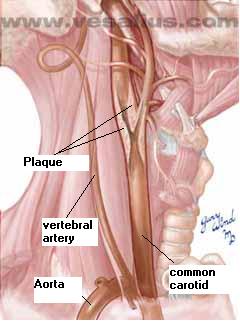
How can Carotid arteries cause strokes?
A stroke is an irreversible damage / loss of brain functions caused by lack of adequate blood supply to the brain. Atherosclerosis affects 50% of all who have strokes, but carotid artery disease is reponsible for only a small percentage.
Atherosclerotic carotid arteries can casue symptoms by reducing the flow, or small pieces of the plaque can break free and become lodged in a small brain artery causing the damage. The narrowing in the lumen is 50% or above in most of the symptomatic patients.
What are the signs and symptoms of carotid artery disease?
Carotid disease is silent in general, some patients have a bruit ( audible noise related to the blood flow turbulence) discovered by the family doctor on routine clinical examination, which prompts further investigation.
Patients can have TIA - Transient Ischemic Attack, or sometime called "mini-stroke" that produces temporary symptoms lasting less than 24 hours. A stroke is a permanent damage causing irreversible symptoms.
Symptoms can be one or a combination of the following: Weakness or total inability to move a body part, numbness or loss of sensation, tingling or other abnormal sensation, sudden dimness or loss of vision, particularly in one eye; language difficulty, swallowing difficulty, and change in the level of consciousness.
Other tests , can be required sometimes before surgery. Arteriography and Digital Subtraction Angiography (DSA). Arteriography is an X-ray of the carotid artery taken when a special dye is injected into another artery in the groin or arm. A burning sensation may be felt when the dye is injected. DSA is also an X-ray study of the carotid artery. It is similar to arteriography except that less dye is used. A person having a DSA must remain still during the test.
These invasive procedures are more expensive and carry their own small risk of causing a stroke
Magnetic Resonance Angiography (MRA). This is a very new imaging technique that is more accurate than ultrasound yet avoids the risks associated with X-rays and dye injection. An MRA is a type of magnetic resonance image that uses special software to create an image of the arteries in the brain. A magnetic resonance image uses harmless but powerful magnetic fields to create a highly detailed image of the body's tissues.
What is the treatment of carotid artery disease?
The decision to treat carotid artery disease is not always straightforward.
Most of the time the patient have other symptoms related to atherosclerosis and has been taking different medication, including Aspirin or other blood thinners. Aspirin or other blood thinners (Plavix) are the mainstay of the medical treatment of Carotid artery disease
Surgery or other interventional invasive procedures ( angioplasty and stenting) will be discussed with you by your physician emphasizing the risk weighed against the potential benefit, as well as the natural history of the disease itself. Some guidelines can be seen here
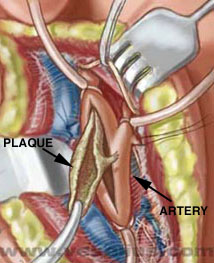
People with severe blockages in their carotid arteries should be considered for surgical treatment – called carotid endarterectomy. This procedure removes the plaque from inside the artery wall and restores the artery to normal. We can see from ultrasound exams that are done after surgery, that the plaque is gone and the blood flow is back to normal. Carotid endarterectomy is so successful because the plaque in the carotid artery is limited to a very small area in the mid-portion of the artery in the neck. This allows surgery to be done through a small incision, in many cases under local anesthesia. When everything goes well, most patients can go home the morning after surgery. Recovery from surgery is usually rapid and people can quickly resume their normal activities without any restrictions.
Of course no surgery can be done without risks. One of the most serious risks of carotid endarterectomy is that a stroke can happen during the procedure. While it seems odd that a procedure being done to prevent a stroke could actually cause one, it’s really not so hard to understand. We know we are working on a plaque that carries a dangerous risk of stroke – and that stroke could occur anytime, even during the procedure itself. What we know for certain is that the real risk is if nothing is done.
Numerous large, scientific studies in the US and Europe have confirmed that for patients with severe carotid artery disease, carotid endarterectomy was better at preventing a stroke than the best medical treatments doctors could provide. Patients receiving medical treatment alone were two to three times more likely to have a stroke than those who had surgery.
Recently, doctors specializing in the treatment of vascular problems have begun to investigate the use of balloon angioplasty and stent placement in the carotid arteries. Almost everyone today has heard of balloon procedures that have been used routinely in the coronary arteries to the heart or in the circulation to the legs, but their use in the carotid arteries has been investigational. Early results of angioplasty and stents for treatment of severe carotid disease was not as good as surgery, but significant changes have been made in the procedures and the equipment that may make these treatments safer. Studies comparing stent procedures to carotid endarterectomy are now in progress