|
|
|
What are Compression Stockings?
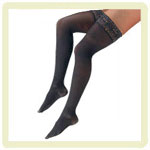
Compression stockings or compression hosiery are a special type of support stockings for your legs. These stockings are very different from the support hosiery you often see advertised or sold over the counter. They are available for men and women in a variety of styles, colours and materials. You usually buy two pairs at a time ( you wash one and wear the other), and replace them every 6 months. Many times, third party insurance will cover the cost of two pairs of stockings or more per year, if your doctor has written a prescription for the stocking. There are cheaper ( over the counter) products that do not have the appropriate compression
Your doctor prescribes compression stockings, like medication. These stockings provide one dose of compression for your legs when worn daily. The last dose of effective compression is at the end of 6 months and that is why they must be replaced. After the doctor prescribes the compression strength, and type, he/she will recommend a certified fitter/location to have your legs measured and fitted with the appropriate AND comfortable stockings. Most of the time, the store will order them for you and you will have to pick them up at a later date.
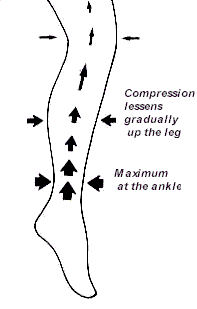
Compression stockings exert most of the pressure around the ankle and the compression lessens as it goes up the leg. This means that the stockings are going to fit snuggly around your ankle and get looser as it goes up your leg; working on your veins.
With compression stockings, the activity of the patient should be considered. If the patient will be sitting with the limb properly elevated, the stockings can remain off. If, on the other hand, the patient is spending the majority of the day standing or sitting, the stockings should be worn. If the patient is uncomfortable at menses, let her wear the hosiery (it does relieve the pain a great deal during menstruation).
The style of compression hosiery can make a big difference:
Patient comment: Some prefer to "turn the band down" carefully so as not to "form a tourniquet". The band was turned down only when sitting to avoid the band "cutting off circulation" at the knee.
Actually it is very dificult to cut off the circulation, I feel that the reason was because of this common myth and to avoid thick crease in the skin that can be painful.
This can be avoided by proper fittings and placing the stockings at least one to two fingers breadth below the knee crease.
If you have long stockings and you have to turn any legth down around the knee, take your stockinks back to the supplier and ask them for appropriately fitted pair.
Patient comment:"Stockings held up solely by the hemmed top were found to be more difficult to maintain" . They can fall and buckle, and may have to be hiked back up into place!.
The industry continues to improve on the stockings. Remember that any garment ( even your pants) need to be adjusted few times during the day, it is the same with support hosiery. Please go back to the specialized fitter to discuss other options for holding up the thigh length stockings or a different style. Thigh highs without body adhesive, garter belts or silicone bands will migrate to the highest point of strength which is the ankle.
Patient comment: "This compression stocking is one of the most comfortable but can be very annoying to unhitch and rehitch upon using the bathroom". "Although they were superior to thigh-high's with a hemmed band, the inner portion of the stocking had a tendency to cut into the thigh when sitting".
These are issues that a return visit to the fitter can solve. They have the answers to fitting concerns.
A stocking may be required on only one leg or both. Stockings come in different colors.
Compression stockings come in closed toe or open toe styles. During hot weather open-toe are cooler but the hem may become too tight after wearing for a period of time. If you find your toes swelling up below the compression stocking, take the stocking off and report this to your doctor. Again, this might be related to poor fitting or to inappropriate pressure gradient
Remember :
Don't wash the stocking in the washing machine, hand wash in cool water with the manufaturer detergent, air dry.
All stockings have a tendency to ride down because of gravity and body movements. Watch carefully for folds, buckling and so on. Stockings can buckle behind the knee. Compression stockings need to be adjusted from time to time throughout the day. Knee high stockings should not be pulled up behind the knee. Properly applied stockings fit one to two finger widths below the bend of the knee.
Always use the medical rubber gloves, recommended by your fitter, to apply and remove your stockings. This prevents damaging the fabric or tearing the stockings with your nails or jewelry. Open toe stockings come with a silky cone shaped foot slip. Put this fabric over your toes and foot and put the stocking on. Remove the foot slip and cover the compression stocking with your socks or nylons. Ask your fitter about other devices for both open and closed toe stockings. These devices will make it even easier to put on your stockings.
Wear your stockings to your physician appointments so an assessment can be made of your progress.