|
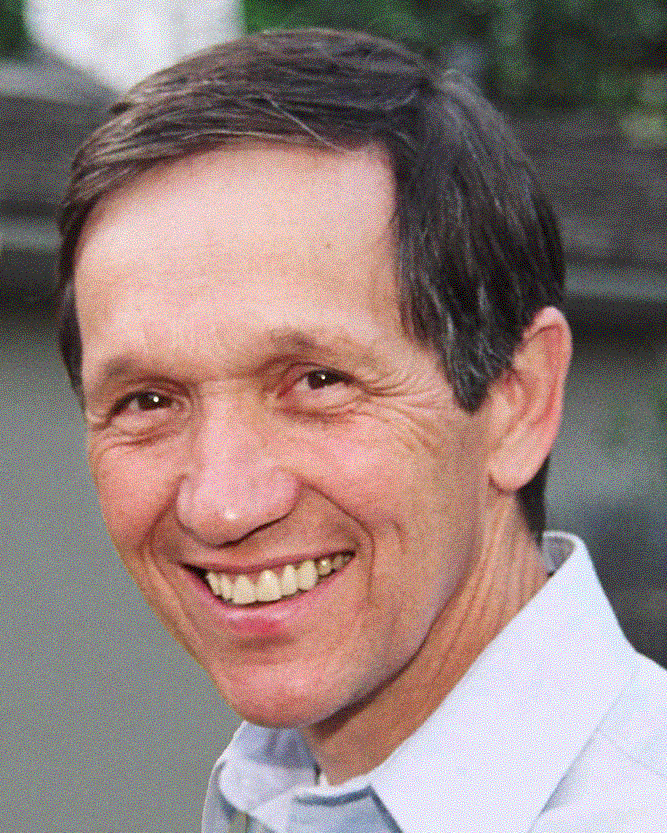
Dennis Kucinich Kucinich first came to national prominence in 1977 when he was
elected mayor of Cleveland at age 31; the youngest person ever
elected to lead a major American city. In 1978, Cleveland's banks
demanded that he sell the city's 70 year-old municipally-owned
electric system to its private competitor (in which the banks had a
financial interest) as a precondition of extending credit to city
government. Kucinich refused to sell Muny Light. In an incident
unprecedented in modern American politics, the Cleveland banks
plunged the city into default for a mere $15 million. Kucinich lost
his re-election bid in 1979. Fifteen years later, Kucinich made his
first step toward a political comeback, winning election to the Ohio
Senate on the strength of the expansion of the city's light system
which provides low-cost power to almost half the residents of
Cleveland. In 1998 the Cleveland City Council honored him for,
"having the courage and foresight to refuse to sell the city's
municipal electric system." As chairman of the Congressional Progressive Caucus (which is the
largest congressional caucus), Kucinich has promoted a national
health care system, preservation of Social Security, increased
Unemployment Insurance benefits, and the establishment of wholesales
cost-based rates for electricity, natural gas and home heating oil.
When the Supreme Court ruled that mandatory arbitration could be a
condition of employment, Kucinich introduced a bill to reverse the
Court's decision. In his Cleveland, Ohio district, Kucinich has been recognized by the Greater Cleveland AFL-CIO as a tireless advocate for the social and economic interests of his community. He is currently leading a civic crusade to save Cleveland's 90 year-old steel industry and the thousands of jobs and retiree benefits it provides. While hundreds of community hospitals have been closed throughout the country, Kucinich led a powerful citizens' movement which reopened two Cleveland neighborhood hospitals. He was prepared to block a railroad merger at the Surface Transportation Board until he gained an agreement from the nation's largest railroads which improved rail safety while diverting a heavy volume of train traffic away from heavily populated residential areas. His promotion of rail safety improvements gained him the top award from the Ohio PTA in 2000. His efforts on behalf of Cleveland's poor gained the recognition of the National Association of Social Workers. He continues to be a local and national advocate for the homeless. Congressman Kucinich acts upon his belief that protection of the global environment is fundamental to preserving the life of all species. He has been honored by Public Citizen, the Sierra Club, Friends of the Earth and the League of Conservation Voters as a champion of clean air, clean water and an unspoiled earth. He was an early critic of nuclear power as being risky economically, and environmentally, raising questions about nuclear waste byproducts. As a state senator he raised so many questions about a planned siting of a nuclear waste dump in Ohio that the idea was eventually scrapped. Early in his first term in Congress he thwarted an effort to repeal a provision of the Clean Air Act. As a congressional representative to the global climate treaty talks, Congressman Kucinich encouraged America to lead the way toward a sustainable, shared stewardship of the planet through carbon reduction, and investment in alternative energy technologies. He not only believes in sustainability, he practices it. Congressman Kucinich is one of the few vegans in Congress, a dietary decision he credits not only with improving his health, but in deepening his belief in the sacredness of all species. In the 106th Congress, his call for labeling and safety testing of all genetically engineered foods provoked a $50 million advertising campaign by the biotech industry. Kucinich hosted an international parliamentary session, attended by officials of 18 countries, on the social, economic, political and health impact of genetic food technologies. More recently he was one of the principal speakers at an international conference on water rights, where he called for governments to reserve public ownership of water resources. US Representative Dennis J. Kucinich, a Democrat of Ohio, is a dynamic, visionary leader of the Progressive Caucus of the congressional Democrats who combines a powerful activism with a spiritual sense of the essential interconnectedness of all living things. His holistic worldview carries with it a passionate commitment to public service, peace, human rights, workers rights, and the environment. His advocacy of a Department of Peace seeks not only to make nonviolence an organizing principle in our society, but to make war archaic. His is a powerful, ethical voice for nuclear disarmament, preservation of the ABM treaty, banning weapons in outer space, and a halt to the development of a 'Star Wars' - type missile defense technology. He has been recognized for his advocacy of human rights in Burma, Nigeria and East Timor. Together with the late Rep. Joe Moakley (D-Mass), he has led a concerted effort to close the School of the Americas, which has been an incubator of human rights violations in Central America. On the eve of the World Trade Organization's Seattle conference, Rep. Kucinich organized 114 Democrats to help convince President Clinton to seek human rights, workers rights and environmental quality principles as preconditions in all US trade agreements. Kucinich marched with workers through the streets of Seattle protesting the WTO's policies and with students through the streets of Washington, DC, challenging the structural readjustment policies of the IMF. From http://www.kucinich.us |
| ||||||||||||||||||


| ||||||||||||||||||
Cute cottage for rent in West Los Angeles 2/1 large patio. Click here
Best real estate services in town. Click here.
Smile for your favorite dentist. Click here.
Get back in shape. More form your physical therapist. Click here.