
Vapor Trails
Volume
15, No.1
April 30, 2005
(best
viewed in 800x600 resolution)

Editor
John Brennan
492 Sqdrn 7thBG(H) 10th AF
Eighth Air Force Historical Society
Massachusetts Chapter
Our motto "Abandon Rank,
All Ye Who Enter"
Remember the
Mighty Eighth!


Vapor Trails Contents:
Our
9-11 Tribute
Contact Us
The
President's Message
With the
many snow storms & heavy accumulation this winter, I'm sure
we all are looking forward to spring. So we kick off the year by
having our spring fling at Hillview Country Club located in North
Reading on May 5, 2005. For those golf fanatics bring your clubs
and after our meeting consider playing 9 or 18 holes. If you plan
on playing golf let us know so arrangements can be made with the
golf pro. The chapter is planning several field trips this coming
year; details will be discussed at the spring fling.
When was the
last time you attended your Bomb Group's or 8th AF reunion? If you
are in fairly good health make it a point to attend at least one
of these reunions this year. As a reminder to those members who
pay their dues annually, please send in your payment to the 8th
AFHS by December 31, 2005 in order for our chapter to receive a
rebate. We are still looking for a person to step forward &
accept the responsibility as editor of the Vapor Trails.
In checking our membership status over the past 6 years I find it
has decreased 5% annually, if we maintain that attrition rate our
chapter will expire in 14 years. If we expect the chapter to survive
after most of our members are gone we must enroll our sons, daughters
their spouses, we need young blood.
Let us support our troops in Iraq.
Al Dusey
It is the VETERAN,
not the preacher, who has given us the freedom of religion.
It is the VETERAN, not the reporter, who has given
us freedom of the press.
It is the VETERAN, not the poet, who has given
us freedom of speech.
It is the VETERAN, not the campus organizer, who
has given us the freedom to assemble.
It is the VETERAN, not the lawyer, who has given
us the right to a fair trial.
It is the VETERAN, not the politician, who has
given us the right to vote.
There have been great men and women who contributed much to our
country and many more will follow who will also achieve much greatness.
But, without the sacrifices of brave men and women, veterans, these
people would never have the opportunity.
(Courtesy of the PA chapter, the Keystone Trade Winds)
Congressman
Steve Lynch to the Rescue!
Mark Twain once said “Reports
of my death are greatly exaggerated”. Congressman Steve
Lynch was able to declare our VT Editor, John Brennan,
alive and well and living in West Roxbury when the Social Security
Admin informed him he was dead. Not only was his pension gone, so
was Medicare, and bank accounts! Steve deserves a lot of credit
for helping John out! Hats off to Steve!
Pilot
Jerome Mudge Flies "Hesitatin' Hussy" To Hell and Back
By Lt. Sam Sheffield & Sgt. Joe DiGiacomo
We claim our
pilot is the best flyer in the world, barring none. We know, because
we saw him in the roughest action possible, and he brought us through,
every one of us. Of course, our B17, "Hesitatin' Hussy"
can be credited with part of it.
On a 385th Bomb Group mission to bomb the German fighter base in
France as we headed on the bomb run one of our engines went out.
With the propeller feathered we stayed with the formation and bombed
hell out of the target. The real hell came as we headed for home.
One lone Nazi fighter whipped through our formation, turned and
went through again. This time he shot out a 2nd engine on our B17
and wounded top turret gunner Burnell Cook. Though Burnell stayed
with his guns our bomber could not keep up so we fell out of formation,
a "straggler." Over the coast we were down to 8,000 feet
and over Dunkirk we encountered very heavy antiaircraft fire-flak,
coastal defense guns, ground machine guns, even fighters, a regular
inferno. Lt. Mudge weaved and tossed our Fortress around like a
fighter plane, and that cool skill kept us from being shot down
in flames. It was a fight we'll never forget. The Germans kept up
their fire. We thought we'd never see the end of it. Over the Channel,
with Nazi fighters still after us, they thought we were dead meat.
We made them change their minds.
S/Sgt John Moniz, who was at his guns all the way, shot down a ME109
on our tail, and our guns held the fighters at bay. Taking stock
of our damage, we found the B17 was so badly battered that we can't
see how Lt. Mudge kept it under such wonderful control. We had wounded
aboard, so Lt. Sheffield and Lt. Verne Philips went to give first
aid to Sgt. Cook who was hit in the face. A 20 mm shell exploded
right in front of his turret, tearing it apart. A waist gunner,
Sgt. Hartan Villers also was wounded. Thinking we'd have to ditch
in the Channel waters McGarvey and Lt Philips started throwing stuff
out. Moniz and I (DiGiacomo) kept at our guns. Sighting England,
we found a RAF fighter field and landed there. The commander told
us "that was the prettiest landing he'd ever seen despite the
fact we had no flaps, no stabilizer, no trim tabs, and no brakes
and our ship was so full of holes that we couldn't see how it hung
together. And after we landed we learned the copilot's headset had
been shot right off his head during the big scuffle over Dunkirk.
A Note from Dag Morse
Just a quick note to all you people receiving “Vapor Trails”. I know how we all look forward to reading VT, but I also know you have stories to tell. What our Editor is searching for are a few little stories from all that means all. So all you ground grippers, and fly boys (and boys we were) sit down, write out a story, humorous if possible, and let all of us enjoy a little chuckle.
So now here is one from my own experience. After VE day, we were preparing to fly back to the States. To do this, our Navigator had to re-qualify for night navigation. So we did, we flew down over Paris, while the navigator took shots (not the kind we all prefer) at the stars, etc. When returning we approached the field to make the night landing. Before I get too far, our group identity was a full yellow tail with a square P. To continue we made a nice approach, touched down and low and behold, all the parked plans had the yellow tail but had a square K.
Whoops, wrong base, so off we went to where we were supposed to
go. Perhaps some one out there remembers the incident. I believe
our Chapter President Al was on the base at the time. So that gentlemen,
I believe is the type of tales we need submitted to our editor Jack
Brennan. We all have a few humorous tales to tell. So how about
it? Will you all share? Thanks and please give it a shot.
– Dag Morse

Anne Brennan
The members of the Massachusetts Chapter of the 8th Air Force Historical Society wish to extend their condolences to Vapor Trails Editor John Brennan for the loss of his wife of 54 years, Anne Brennan. Anne was a frequent participant at our annual fishing trip, flings, and parades. Her endearing personality and beauty will be dearly missed by all. Deepest sympathies to John, his daughter Patricia, of Alexandria, Virginia (Vapor Trail’s webmaster), and to son John & his family in Maryland.
Secretary's Minutes of 01/20/05 Meeting
The meeting
was held at the Woburn Lodge of Elks at 295 Washington Street, Woburn,
Massachusetts. The meeting was chaired by President Al Dusey and
called to order at 11:00 hours. A written agenda was presented to
the eleven (11) members in attendance.
After the opening ceremony President Dusey requested the presentation
of the following reports:
SECRETARY'S REPORT: The minutes of the December 16th meeting were
read, accepted by the membership and filed.
TREASURER'S REPORT: Treasurer Al Audette presented the Chapter's
financial status noting a balance of
$6,052.71.
MEMBERSHIP STATUS: Al Audette indicated some members are in arrears.
Carl Wood suggested to reduce the cost of VT we should consider
a format that contained a column approach. This lead to a discussion
which concluded that all changes such as the number of pages, etc.
would be left to the editor.
NEW BUSINESS: Prior to today’s meeting the Board of Directors held
a formal meeting at 10:00 hours at the Woburn Lodge. President Dusey
chaired the Board meeting and reported the results to the general
membership at today’s monthly meeting. Al reported that the Board
recommended a change in venue for the Spring Fling. Thus, the formal
luncheon will be he1d on Thursday, May 5, 2005 at the Hillview Country
Club in North Reading. A golf option is also under consideration.
The WWII museum in Natick continues under consideration for a future
field trip. George MacNeill and Bill Campbell will keep the members
informed regarding the air show held each year at the Daniel Webster
College. Henry Oi will continue to follow-up on the annual Veterans
Day fishing trip.
It was recommended that the fall fling be held during the month
of October rather than November. The 2005 8thAF National Reunion
will be held in Arlington, VA from September 27, 2005 to October
2, 2005.
Respectfully
submitted,
Retired Navy Master Gunner’s Mate
John M. McKernan, Secretary
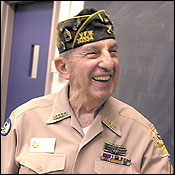 Veteran:
Bombing missions mind- and body-numbing
Veteran:
Bombing missions mind- and body-numbing
Courtesy of Max Heuer / Tribune Correspondent Friday, January 30,
2004
WALTHAM -- In the words of Bentley College history professor Richard Geehr, decorated World War II veteran Carl Mula is a piece of "living history." Enduring minus-45 degree temperatures and 11-hour tours, Mula flew 22 bombing missions over Europe while stationed in northern England in 1943 and 1944. "It's a fine line between sanity and insanity," Mula told an introductory World War II class yesterday at Bentley. The 83-year-old Mula has kept his wits as sharp as his memory. He offered students minute details of his experience as an Air Force flight engineer passing around a photo album, his dog tags and other mementos -- and answered questions about the horrors of the war with the utmost simplicity. When a student asked him if he felt remorse for killing people, Mula said, "The first time I dropped a bomb, I think I did. But then they started shooting at us and you don't think about it. " His 22nd mission came on Aug. 15, 1944. The run had gone smoothly until the 10-person B-24 crew encountered 28 German fighter planes over the coast of Holland. Mula's plane, nicknamed the "Ruptured Duck" by its crew, had fallen behind most of the 1,000 planes that had participated in the mission, and the Germans were "looking for stragglers," he said. When a 22-millimeter shell tore through Mula's midsection, rupturing his intestine and breaking his pelvis, he began to black out.
The plane was severely damaged and barely made the journey across the English Channel and over the Dover Cliffs before crashing into a forest, Mula said. When he woke up, he was in a hospital surrounded by three young female nurses. "I said, 'Look at you girls, you can't fool around with me. I'm married,'" said Mula, who received several awards, including a Purple Heart. "And there I was half dead." He had two and a half feet of intestine removed. Mula successfully coped with injury and the psychological problems many veterans face back home. "I just kept busy all the time...a lot of guys would lay around or go to the bar," he said.
Mula visits other veterans at the Bedford VA Hospital, and told students "if you ever I feel sorry for yourself, just go up there." "It's a good idea to bring people in (to the class) like this," said professor Geehr. "They can tell you from a personal perspective about a dimension of the war that no other source can." Senior Jim Thideault, 21, agreed. "I've never heard from someone who had actually been there," he said. Mula recalled how the locals in England embraced the troops, and later worried about the morale of American soldiers under fire in Iraq today. "I'd go into town and a little kid on a bike would go by and say, 'thank you yank,'" Mula said. "I just feel sorry for those poor bastards over there now. Some of these kids can't take it."
Just as Mula's
tour of duty defined him in life, it will continue to after. The
only operational
B-24 resides in Stow, Mula said. "I have it in my will,"
he said. "I want that plane to fly over my grave."
The
8th Air Force's Final Mission - 25 April 1945
By R.H. Hodges, 486 RG.
Central NY Chapter
The last mission
of the 8th A.F. in the ETO, Number 968 was accomplished on April
25, 1945 and carried out by B-17 and B-24s of the 8th Bomber Command,
escorted by P-51 Mustang fighters of the 8th Fighter Command.
307 B-17s were dispatched to the famous armament factory, the Skodawerke,
at Pilsen Czechoslovakia, now in the new Czech Republic. Prior to
this mission, a radio warning was sent to the Skodawerke to enable
Czech workers to get out of the plant. Luckily the Luftwaffe could
do little from this warning, but their flak was heavy over the plant
and six B-17s were lost as well as-five plant workers. B-17 aircrews
complained that there was more concern for civilian safety than
for their own.
That same day 282 B-24s flew to rail centers at Salzburg, Bad Reichenhall,
Hallstein and Traunstein, also escorted by P-51s. Southeast of Traunstein
a P-51 pilot saw and caught up with a twin-jet he identified as
an Arado AR-234 light bomber, which he shot down. Such was the last
air victory over the Luftwaffe by the 8th A.F. Only a few Me-262A
" Schwalbe” twin jet fighters were sighted that day near the
Prague/ Ruzyne Flugplatz (airfield) and only one was damaged in
an air encounter.
Ironically, the last Bomb Group over the Skodawerke was the 384th
RG then based at Grafton-Underwood airfield, U.K. It was from that
field that 6 B-17Es had departed on 8th A.F. Mission No.1 on Aug.
17, 1942 to the Buddicum Locomotive Works and rail yard of Rouen,
France. The other 6 B-17Es of the 12 total that day had departed
from Polebrook airfield. The air campaign against the 3rd Reich
had lasted 966 days.
 One
of WWII’s Least Known Tragedies
One
of WWII’s Least Known Tragedies
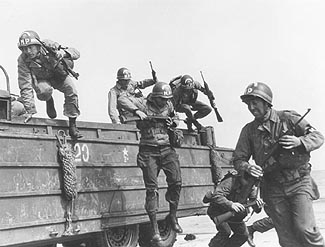
On April 27,
1944, 30,000 men of the 4th Infantry Div., 279th Eng. Battalion
and the 70th Tank Battalion, were supposed to practice landing on
the beach on the southwest coast of England at a place called Slapton
Sands. This area looked a lot like the area of Utah Beach where
the real landing would later on take place. But nine prowling German
patrol boats spotted them and got in among them and torpedoed several
of the landing crafts. Panic broke out and the soldiers started
firing on what they thought were the German crafts but were actually
their own. Many men drowned and trucks and Sherman tanks went to
the bottom of the sea. Many of the men had their life vests on wrong
and with the heavy packs on their back their heads were forced under
water and they drowned. The practice was called Operation Tiger,
and it is listed as one of the largest losses of lives since Pearl
Harbor. As the death toll reached 749, it had to be kept secret.
The injured were treated at an American Hospital in England and
the staff there was ordered to maintain secrecy under threat of
court martial. The secrecy was finally lifted in 1974 through the
Freedom of Information Act.
But over in England in 1969 a heavy storm hit the coast around Slapton
and an Inn keeper who lived there and who just happened to have
been a Corporal in the Military Police of the Royal Air Force was
walking along the beach and found a lot of items that were washed
up by the storm. He realized that these were relics from the tragedy
that took place there years ago. So he started a crusade to honor
these men that died there. He spent a great deal of his own money
and even went to the Pentagon as part of his effort. Several years
later a fisherman told him that a mile off shore there was a tank
and that the fishermen often caught their net on it. So he hired
a diving team and sure enough 60 feet down there was a Sherman Tank.
He checked with the Defense Dept. and they said yes it was still
U.S. Property but that he could buy it for $50.00 dollars which
he did. Then he raised the tank cleaned it up and placed it across
the street facing the beach where the tragedy took place as a monument
to the 749 who lost their lives there. This act prodded Americans
to set a monument to the dead of Slapton Tragedy. In January 1987
Congress passed a resolution for a memorial plaque. In Nov. 1987
officials unveiled the plaque which was placed beside the Tank and
is still there today. It is interesting to note that the death toll
of 749 was more than four times higher than that on Utah Beach on
D-Day.
Flying
Fortresses in Enemy Hands
(Courtesy of the KY Chapter)
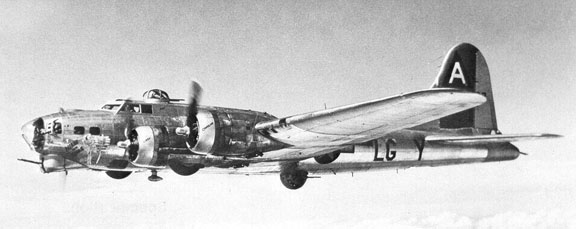
Since so many B-17s were lost over Europe it comes as no surprise
that a few Fortresses fell into Axis hands, either by being forced
to land on German airfields or by Germans piecing together flyable
examples from bits and pieces of crashed aircraft. By various means
the Germans were able to put about 40 Fortresses back in the air,
which is a rather sizeable force, so many that the Luftwaffe can
be counted as a major B-17 user.
Most captured B-17s were given high visibility German National Markings
and used for the training of fighter pilots in the development of
tactics that would be effective against USAAF-operated Fortresses.
However, some were flown in their original USAAF markings for various
clandestine purposes such as sneak penetrations of Allied territory,
the dropping of agents, and the supplying of secret bases. The most
well known Luftwaffe unit to operate the B-17s in such a fashion
was the notorious I/KG200. The exploits of I/KG200 are sort of shadowy
and not much is written about this outfit in the Histories of WWII.
One of their better known exploits took, place in the spring of
1944 in the western desert (long after Rommel had been run out of
Africa) and involved the use of captured B-17s and other Allied
aircraft for the construction and maintenance of a series of air
strips and fuel dumps. A captured Fortress was used to parachute
agents into Jordan in October 1944.
In the Luftwaffe service the B-17 was assigned to cover the designation
of "Dornier Do 200". There are reports that at least one
captured B-17 was used by the Luftwaffe as a decoy. It would follow
returning USAAF formations, pretending to be a crippled straggler
and hoping to draw B-17 out of the formation to cover it against
enemy attacks. On the way home, once the protective B-17 closed
in, the decoy would fire at it with its own guns or call in German
fighters to finish it off. This practice was enough of a threat
that the USAAF bomber formations would often fire upon an approaching
straggler that could not be positively identified. And in the Pacific
Theater, most USAAF B-17s were destroyed on the ground the first
few days of the war.
However the Japanese advance was so rapid that Allied forces were
forced to leave some of their aircraft behind as they retreated,
as a result, the Japanese forces managed to obtain a collection
of different types of Allied aircraft. What they were able to put
back in the air with fairly little effort, the Japanese obtained
at least three Fortresses, one early B-17 E and two B-17 Ds which
were flown to Japan for use in public display of captured enemy
aircraft. These captured B-17s were used in careful evaluation of
their capabilities and the development of fighter tactics against
them.
Taps
for Eddie Johnson
The officers and members of the Massachusetts Chapter of the 8th
Air Force Historical Society were saddened to learn of the passing
of Eddie Johnson. He was an active member who participated in our
monthly meetings, attended the semiannual luncheons and traveled
out of state to be present at the annual reunions. His friendly
manner and comradeship will be missed.
Ways to Die!
Ernie Pyle spent years with the infantry in Africa, Italy, and Europe and wanted to see how the Air Corps men flying long missions in heavy bombers fared. In Africa he asked to go on a mission with a B-17 Flying Fortress group. He was welcomed and issued a flying suit, parachute, and oxygen mask for the mission. They took off very early, flew across the Mediterranean Sea, bombed the target, flew through heavy flak, and enemy fighters, then struggled back to the base six hours later. When back on the ground he said he never wanted to go through that again. When asked about the different between the combat on the ground and in the air, he said “that in the air ware there were so many more ways to die than in the infantry.” In the ground forces they die when hit by a bullet or by shrapnel from a bomb, a hand grenade or enemy shell. Or run over by an enemy tank.
Below is a list of the many ways a bomber crewman could die
Fully loaded
plane crashes on take off or collides with another plane while forming
overhead. Bullets from enemy fighter plan. Piece of flak hits crewman.
Direct flak hit on plane and plan explodes. Engine fire gets to
gas tank plane explodes. Plane shot up, crash lands, crew all killed.
Man bails out, chute doesn’t open. Man bails out drowns in rough
sea. Bails out but gets shot by enemy fighter, frozen oxygen mask,
dies of anoxia. The above are but a few of the ways if danger those
airmen had to face.
 Visit the Vapor Trails Mailbag!
Need A Speaker For
Your School, Club Or Organization?
Time is running out if you
want to hear WW2 air vets describe their adventures! Call President
Al Dusey at 978-475-8832. Give us plenty of lead time because we
ain't as young as we used to be.
Join
the 8th! To print an application, click the seal above. |

 Find Out What's Going On
-
Come to our monthly meeting at Woburn Elks Club (for now). Third Thursday at Oh Eleven Hundred.
-
Come to our min-meeting, first, Oh Ten Hundred, First Tuesday. McDonald's Rte. 1 and Union Street, Walpole.
-
Call a pal who does go to the meetings.
-
Check our website: http://www.geocities.com/eighthafhs
-
Call an officer. No, not a cop! One of the officers whose phone and email address is listed on the back cover.
Serious Stuff...the DUE$ Question
All
are welcome to join the Eighth Air Force Historical Society. Dues
are $25 a year! (It was just raised by the national organization.)
You pay us $25 dollars only when you first join! After that, the
National organization will bill you for $25 once a year. That's
the only money involved. You get two issues of "Vapor Trails" and
four issues of the highly professional Time magazine-sized "The
Eighth Air Force News" as well as a chance to take part in the sort
of fun events you read about in this issue. Please do NOT send your
dues to our saintly treasurer once you've sent that first twenty.
You don't want to get on his WRONG side, do you?
Our Favorite Links
Google
Mighty Eighth
Air Force Public Message Board
Mighty Eighth Air Force Heritage
Museum
Ken
Nellis' page devoted to the 453rd BG
Commonwealth of Massachusetts
Department of Veteran's Services Air Power Museum
Confederate Air Force

November 2004
May
2004
November
2003
May
2003
December 2002
June 2002
November
2001
June
2001
November 2000
April 2000
October 1999
Vapor Trail Officers
| Vice President |
AFHS President |
Secretary |
| Treasurer |
Editor of Vapor Trails |
For comments, send email to the
Vapor Trails Editor John Brennan at: [email protected]
For
website comments or feedback, contact: Vapor Trails Webmaster
Updated: 04/15/2005