
Vapor Trails
Volume
14, No.14
May 20, 2004
(best
viewed in 800x600 resolution)

Editor
John Brennan
492 Sqdrn 7thBG(H) 10th AF
Eighth Air Force Historical Society
Massachusetts Chapter
Our motto "Abandon Rank,
All Ye Who Enter"
Remember the
Mighty Eighth!


Vapor Trails Contents:
Our
9-11 Tribute
Contact Us
The
President's Message
Welcome to the Woburn Elks Club and our Spring Fling. This is my
first president’s message to you, our dedicated and supportive members.
It is an honor for me to serve and help in the administration of
our association. I am deeply concerned for the future of our chapter.
The average age of our members is probably around 82 although our
female members continue to report themselves as 29.
It doesn’t take a rocket scientist to see what is in store for our
group. One solution would be to bring in our children and grandchildren
as associate members. Remember history buffs and non-veterans are
very welcome to join also. There are at least three men here today,
all veterans, attending their first Fling.
On a sad note you will see in Vapor Trails an obituary for one of
our most active members, Joe DeGiacomo. Bill Campbell, Al Audette
and yours truly represented the 8th at Joe’s funeral. On a happier
note we are planning a June 17 excursion to the Battleship Massachusetts.
We have a sign-up sheet for those who have never been aboard a battleship
or want to go back again.
On a personal note I flew with the 708sqdn. in the 447th BG as Flight
Engineer and Top Turret gunner. We flew from an air base called
Rattlesden aboard the B17 Ole Boomerang. We did 23 missions and
had two aborted missions. I earned a Presidential Citation and an
Air Medal with three Oak Leaf Clusters along with the usual theater
ribbons. I have a Good Conduct ribbon around here someplace. Really!
We saw plenty of action but we must have been on a lucky ship. No
one aboard was ever killed or wounded. As Top Turret gunner, though,
I had my moment of fame when I returned from a mission with a piece
of flak stuck in my parachute. Too close for comfort as they say.
I returned to the States in July 1945.
Al Ducey
WWII Memorial Dedicated in DC
Thanks to Stephen Stroik of Washington, DC who took these marvelous photos of the new World War II memorial. Click on the link below to view.
You
Can Treat the Dutch!
Lieutenant Tom Leary of the Needham, Mass. Police Dept. is a new
member of our chapter and a most welcome one. Tom is so welcome
that when he gave a brief introduction at a mini-meeting at McDonalds.
Walpole practically everyone there was so impressed with what he
had to say and how he said it that we leaped to our feet and shouted
“Don’t let him get away. Sign him up as speaker for our Spring Fling!”
AND WE DID.
Those who attended the mini-meeting and others who showed interest
received an invitation from Petrina Doherty and her sister Joan
Doherty Woody. Pat and Joan’s father, William, “Bill” Doherty was
co-pilot on a B-17 that was shot from the skies over the village
of deBilt in Holland. The 17 belonged to the 413 BS , 96th BG and
flew out of Snetterton Heath, England. The following members of
the crew became POWs: 2nd Lt. Charles Geyer, Jr. Pilot, Robert Surdez,
CP, S/Sgt. Frank Killarney who evaded for a while but then was taken.
Navigators Donald Mills and Bill Doherty evaded capture. The remaining
crew went down with the aircraft. They were all Staff Sergeants
except for Right Waist Gunner Charles Randel. The others were Radio
Aaron Becker, LWG Alex Guillianielli, Ball Turret Ed Lantron, and
Tail Gunner James A. Parker. I mention the names so that readers
will know they are remembered.
Three Dutch civilians, a mother, son and housekeeper were killed
when the crashing bomber struck their house. Watching with great
intensity was a little Dutch boy, 7 year old named Co de Swart who
many years later led a campaign to help honor those who fought to
free the Netherlands. A memorial to those killed was dedicated on
10-20-2003, the 60th anniversary of the loss of the plane, some
of the crew and the three Dutch civilians. All credit goes to Co
de Swart who was an honored guest along with his charming wife,
Louise. Also present and delighted to see old friends and members
of the Air Force was Bob Doherty, historian of the 96th BG.
One more interesting note that almost seems out of the movies! The
Luftwaffe pilot who shot down the Fortress casually landed his ME-09
in a nearby field and casually strolled to the wreckage and looked
it over. He was shot down and slain three months later by American
super-ace P47 pilot Walter Beckham who ran up 18 kills before he
was shot down and wound up in a Stalag Luft. Those were perilous
times!
Guests at Leary’s attractive home were served a light lunch and
heard a moving and emotional talk by Co de Swart. Pictures were
taken. Wartime photos examined. Friendships were formed. One of
the few good things to come out warfare! Friendships and freedom!
-JB
German
POW Ersatz Bread
Complements
of Albuquerque, N.M 8thAFHS newsletter
Vapor Trails is once more indebted to our comrades in New Mexico. They send your editor a copy of their newsletter and there is always something in it to share with our members.
Here’s the story this time. It seems Patricia Wadley, PhD (and former editor of the ex-POW Bulletin) asked Berlin some time ago for the “recipe for the Black Bread served in the Stalaglufts. (For those who don’t know Stalag Luft means a place where fliers are confined.) A lady named Martha Coke helped her to procure the necessary info. She also suggested that if one should decide to make use of the recipe the results should never be served at a dinner party.
How good are you at German accents? The recipe comes from “the official records of the food processing industry” located in Berlin. It is labeled “Top Secret Berlin 24.X1 1941” from the Director of Ministry Herr Mansfeld and Herr Moritz.
Here we go! Ingredients: 50% bruised rye grain. 20% sliced sugar beets. 20% tree flour. (That means 1/5th sawdust) and to top it off, 10% minced leaves and straw.
Dr. Wadley says cooking directions were not included. No oven temperatures, no cooking time, no instructions on mixing the “dough” and letting it rise. The doctor likes to bake her own bread and says that sometimes there are no instructions given. You are assumed to know. She says one might “assume” the grain was sufficiently “rotten” to provide gases that would allow the bread to rise and the pieces of sugar beets would provide “sugar” to “feed” the yeasty rye.
The pieces
of sugar beets were most likely pressed remnants of beet, not real
slices. More than likely whoever was preparing the bread for baking
just dumped out the dough, slapped it around and created loaves.
It should be told that the closer to the end of the war the greater
the proportion of leaves and straw in the mix. A loaf weighed 3
1/2 to 4 pounds and had to be seasoned at least three days before
it was at all edible. It is said that the stench rising from the
bread robbed many a POW of his appetite.
Joe
DeGiacomo dies!
Much Decorated Air War Veteran was Eighth Air Force Chapter Stalwart!
Joe DeGiacomo
died December 20, 2003. He left a job on the New Haven Railroad
to serve
his country and he served it well. The oldest of four children he
went to work for the New Haven Railroad after he finished high school.
When the Japanese attacked Pearl Harbor he enlisted. He was sent
to Tyndall Field in Panama City, Florida to learn aerial gunnery.
He received his silver wings and was assigned as a tail gunner flying
out of England. This was at a time when there was scant fighter
cover and the Luftwaffe was in peak form.
Joe got the Purple Heart after being wounded in both legs on his
seventh mission. At this time the odds of a flier surviving his
assigned 25 missions were just one in three. Not very good odds.
Joe was awarded the Presidential Citation which is an individual
medal and other decorations before returning home. He became a gunnery
instructor at Chatham Field in Savannah, Georgia, where yours truly
was in Operational Training. Joe was a steadfast member of the Massachusetts
Chapter of the Eighth Air Force Historical Society and really put
his heart and soul into the organization.
We surviving members of the AFHS miss him and wish the best to his family.
Secretary’s
Report “condensed”
December Meeting:
Abbreviated Version; Eight members attended the December meeting
at the Elks Club in Woburn. Nearness to the Christmas holidays,
the threat of snow and the vicissitudes of aging played a part in
our unusually low attendance. The Treasurer reported on our solvency.
Over $1500 was donated to Vapor Trails. Al Audette informed the
members of the declining health of stalwart member Joe DeGiacomo.
Al Ducey accepted the transfer of the gavel and records from the
outgoing president. After opening exercises the President called
for and received the Treasurer’s report and the Secretary’s report.
Chet Gunn of Reading, Mass. was introduced as a new member. Chet
is an 8th vet and half as they say. He flew 35 missions with the
568th Sqdn., 368 Bomb Gp. He then flew a weather ship and performed
his first mission on D-Day. As if these two tours were not enough
Chet volunteered to fly with the 4th Emergency Rescue Sqdrn in the
Pacific Theater. His geographical area was that vacation zone around
Saipan and Iwo Jima. We welcome Chet to the Massachusetts Chapter
and it’s OK if we show a little bit of awe!
Al Audette talked about VA Disability compensation and the meeting
closed.
March Meeting: Elks Club, Woburn. After the usual opening exercises
it was announced that Lt. Thomas Leary, Needham, Mass. Police, will
be the speaker at the Spring Fling. Tom is a new member and is mentioned
at length above.
Henry Sampson talked about the WWII Memorial and informed members
that a website is in the process of listing all WWII vets. Al Audette
announced that a visit to the Battleship Massachusetts is scheduled
for Bunker Hill Day, June 17.
Respectfully
submitted,
Retired Navy Master Gunner’s Mate
John M. McKernan, Secretary
Earning a Purple Heart in a Bomber and the Mud!
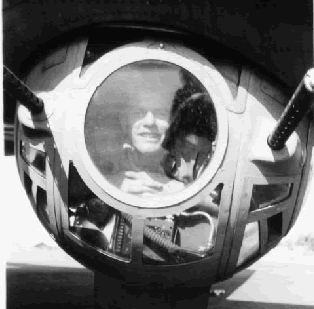
Former ball
turret gunner Dag Morse, who recently recovered from a serious illness,
likes to tell this story on himself. Dag joined the Air Corp in
Boston along with your esteemed editor-to-be and they went off to
Greensboro in July, 1943. When they got there, Dag was sent off
with the M’s and Brennan with the B’s. The war was long over before
they met again. Dag says that when he was assigned to a B-17 in
1945 they put him in the ball turret. “Not to worry!” they said.
“The ball turret is the safest place on the plane.” In a way they
were correct. The ball turret gunner of necessity was sort of rolled
up in a ball when he was in the turret. He had armor plate protecting
him, not 100% but better than the waist gunners and the “rooftop”
position of the radioman. Of course no one mentioned there might
be a slight problem in getting out of the ball in a hurry if need
be. Oh yes.
The radioman gunner and the waist gunners sometimes had to stretch
themselves while following enemy targets and offered themselves
up as long, lean bulls eyes for the 109s etc. We are told that the
waist gunners suffered the most wounds in aerial combat. We don’t
have the exact figure of how many Purple Hearts were earned at the
waist positions but we’ll bet that we’ll hear from more that a few
former gunners if this isn’t so.
But what if you weren’t up in air? What if you made the occupational
choice to become a U.S. Marine and spend your time with bugs and
in mud instead of relaxing on oxygen? We recently heard from a friend
and neighbor, John Carey, who fought an infantry war on delightful
places like Bougainville and Guadalcanal in the Solomon Islands.
John has published a terrific book called “A Marine from Boston”
(John J. Carey, 65 Martin St., Boston, Mass., 02132.) He was still
19 and suffering from tropical diseases and was in Mobile Hospital-8
awaiting return to the States.
From page 332. “We returned to our wards and beside each bed on
an end table was a form to be made out if you were wounded and rated
the Purple Heart medal. All you had to do was sign the paper and
the next morning a Naval Captain, a full four striper, would walk
by and hand you a box with a medal and a lapel pin and mumble something
about…the President of the United States takes pleasure and mumbles
the rest. This disturbed many of us.
Most everyone in the infantry battalions on Bougainville had shed a bit of blood from cuts or injuries, But that was not the same as a contact wound. Every man in our outfit respected the Purple Heart for what it stood for and would never violate its meaning, this Navy Captain really degraded its meaning. I will never forget that experience and even to this day when I see anyone wearing the Purple Heart I wonder if they actually rate it.” -JB
What is a Wound?
A wound is defined as
an injury to any part of the body from an outside force or agent
sustained under, in brief, the results of enemy action. A physical
lesion is not required. However the wound for which the award is
made must have required treatment by a medical officer and records
of the medical treatment of wounds or injuries received in action
must have been made a matter of official record. When contemplating
an award of this decoration, the key issue which commanders must
take into consideration is the degree to which the enemy caused
the injury. The fact that a proposed recipient was not participating
in direct or indirect combat operations is a necessary perquisite
but is NOT sole justification for the award.
Examples of enemy-related injuries which clearly justify the award
of the Purple Heart are as follows: a.) injuries caused by an enemy
bullet, shrapnel or other projectile created by enemy action. b.)
injury caused by enemy placed mine or trap. Enemy released chemical,
biological or nuclear agent. c.) Aircraft accident resulting from
enemy fire. d.) Self-inflicted wounds when in the heat of battle
and not involving gross negligence. e.) post traumatic stress disorders.
f.) jump injuries caused during enemy action.
It is not intended that such a strict interpretation of the requirement
that the wound or injury be caused as the direct result of hostile
action be so strict that it would preclude the reward to deserving
personnel. Commanders must take into consideration the circumstances
surrounding the injury even if it appears to meet the criteria.
Examples: A person injured parachuting from a shot down airplane
or injured in a vehicle accident caused by enemy fire should be
given a Purple Heart or Oak Leaf Cluster if appropriate. Persons
killed or wounded by “Friendly Fire” will be awarded the Purple
Heart as long as what injured or killed them was intended to inflict
damage upon enemy troops or equipment.
The
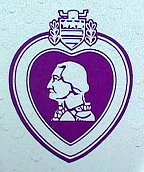
Purple Heart
The
Purple Heart is America's oldest military decoration. It was established
by General George Washington on 7 August 1782 during the War for
Independence. It is ordered currently pursuant
to Executive Order11016. Executive Order 12464 and Public Law 98-525
19 October 1984.
The Purple Heart is awarded to any member of our armed forces or any civilian national of the United States who, while serving under competent authority with one of the U.S. armed forces after 5 April, 1917, has been wounded or killed or may hereafter die after being wounded (think Wake Island where many of the civilian contractors fought alongside the Marines although it took a long time for the bravery of some of these patriot s to be recognized.)
1) The Purple Heart is awarded for wounds received in any action against enemies of the United States.
2) Pay attention! The Purple Heart is an individual decoration but the individual is not recommended for it. It is earned upon meeting specific criteria.
3) One gets
a Purple Heart only for the first wound. Oak Leaf Clusters will
be awarded to be worn on the medal or ribbon for subsequent wounds.
No more that one award will be made for than one wound or injury
received at the same instant or from the same missile, force, explosion
or agent.
Shocking news from Dixie!
Good work by our comrades who contribute to “Tall Tales”, the newsletter of the Georgia Chapter of our Historical Society!
Frank A. Kaye,
in his column “Mind if we just talk plain?” rises to the defense
of the Eighth Air Force in WWII. He writes “The last presidential
election (Bush-Gore) was an indication of just how divided we Americans
are in this great land of democracy. But who would have ever dreamed
that 60 years after WWII there could emerge individuals with these
opinions as they were published in Letters to the Editor 12-14-03.
We here in “Vapor Trails” simply do not have the space to copy all
the letters verbatim but suffice to say the writers had little good
to say about those who were so instrumental in bringing WWII to
a victorious close. “A true historian knows the conduct of the Army
Air Corp was closer to incompetence and brutality.” This from an
Andrew Amendola. Or this extract from an admirer of America’s critics,
Monika Junghans-Jones of Jesup, Georgia, (Whoever the hell she is?
-JB) “Mighty Eighth’s history brings shame, not pride.” The same
writer apparently never heard of the Marshall Plan for she says
ten million Germans starved to death in the five years following
Hitler’s defeat. In her addled view President Roosevelt was the
liar, not “Unser Adolph” as we can imagine her saying.
Editor Frank Kaye winds up his reply to these weepers for the Nazis.
“I’ll tell Mr. Amendola like it was because I was in London during
the raids and did 33 missions over the flak-filled skies of Germany.
And you know what? I am not a bit ashamed of it.
He didn’t come back and throw anything at the White House either.
-JB
Jim Conway
A most welcome note was received from Jim Conway. Jim was bombardier on the “Hey Mabel”, the B-17 that was shot down over Berlin and the exploits of the crew were featured in the previous issue of “Vapor Trails”. Jim’s group started out with 18 crews and only two survived! Jim says that was an 89% loss, the B17 crewmen either shot down or drowned in the Channel.
Jim says he met a pilot
while in Stalag Luft 111. This fellow had been shot down over France,
rescued and hidden by the French underground. The French tried to
get him to the Channel and across to England but a female double
agent betrayed him. He was taken to a concentration camp and tortured.
Remember he was in French civvies and had no US Army eyedee. The
Germans eventually realized he was a Yank flier and shipped him
to Stalag Luft 111 where he met Conway. Conway remembers asking
him “How bad was the concentration camp? Was it really as bad as
we were led to believe?” His answer was “Worse!” Note: Thomas Childer’s
book “In the Shadow of War” relates this incident.
In the novel, The Six Days of the Condor, by James Brady, there's an exchange between an older OSS officer and a younger CIA agent. The younger man turns to the older officer and he said, "Tell me something. Do you miss the good old days?" The OSS officer looked back and said, "Not really. But I do miss the clarity of it all."
A Most Welcome Visitor
Members at our March meeting were surprised when Anne Whitaker, a delightful young woman, paid us a visit. Anne brought with her many fine WW2 photos that had belonged to her father. He was the late Tom Clifford who served with the 835th Bomb Group. He was in the administrative end and kept track of who went out and who came back among other duties. I don’t know if any of us were smart enough to tell Anne about the 8th Air Force Museum in Savannah, Georgia but that is a place where photos such as Anne’s would be always most welcome and are saved for future generations to see. If at any time she wants to relieve herself of the responsibility of caring for them this is the place to go.
Veterans’ Affairs Hospital,
West Roxbury
Those vets who can go to the West Roxbury VA Hospital in time of need can consider themselves among the most fortunate. The Optometry section is where your editor goes when he has a problem with his eyes. I heard that man in the back holler “His P’s and Q’s also.” Well, I minded my P’s and Q’s and went up there with an unexpected problem and was treated with great consideration by Kristen Kenney, O.D. the Optometry Resident and hopefully set upon the road to recovery. Our thanks to all those who helped Kristen and helped me. -JB
 Visit the Vapor Trails Mailbag!
Need A Speaker For
Your School, Club Or Organization?
Time is running out if you
want to hear WW2 air vets describe their adventures! Call President
Al Ducey at 978-475-8832. Give us plenty of lead time because we
ain't as young as we used to be.
Join
the 8th! To print an application, click the seal above. |

 Find Out What's Going On
-
Come to our monthly meeting at Woburn Elks Club (for now). Third Thursday at Oh Eleven Hundred.
-
Come to our min-meeting, first, Oh Ten Hundred, First Tuesday. McDonald's Rte. 1 and Union Street, Walpole.
-
Call a pal who does go to the meetings.
-
Check our website: http://www.geocities.com/eighthafhs
-
Call an officer. No, not a cop! One of the officers whose phone and email address is listed on the back cover.
Serious Stuff...the DUE$ Question
All are welcome to join the Eighth Air Force Historical Society. Dues are $25 a year! (It was just raised by the national organization.) You pay us $25 dollars only when you first join! After that, the National organization will bill you for $25 once a year. That's the only money involved. You get two issues of "Vapor Trails" and four issues of the highly professional Time magazine-sized "The Eighth Air Force News" as well as a chance to take part in the sort of fun events you read about in this issue. Please do NOT send your dues to our saintly treasurer once you've sent that first twenty. You don't want to get on his WRONG side, do you?
TEN HUT!
SPECIAL ORDER!
Bring a gift for the Raffle Table!
The receipts from the raffle ($1.00 each) help pay
for "Vapor Trails" and other administrative costs.
Our Favorite Links
Google
Mighty Eighth
Air Force Public Message Board
Mighty Eighth Air Force Heritage
Museum
Ken
Nellis' page devoted to the 453rd BG
Commonwealth of Massachusetts
Department of Veteran's Services
Air Power Museum
Confederate Air Force

November
2003
May
2003
December 2002
June 2002
November
2001
June
2001
November 2000
April 2000
October 1999
Vapor Trail Officers
| Vice President |
AFHS President |
Secretary |
| Treasurer |
Editor of Vapor Trails |
For comments, send email to the
Vapor Trails Editor John Brennan at: [email protected]
For
website comments or feedback, contact: Vapor Trails Webmaster
Updated: 05/13/2004