 |
 |
 |
 |
 |
 |
 |
 |
 |
 |
 |
|
||
| Special Theory of Relativity | ||
|
||
| Important things to keep in mind | ||
| The Speed of Light, or "c", is always constant at 299, 792, 458 meters per second, or approx. 186, 282 miles per hour.
Motion is relative. Both an object moving at a constant velocity and an object at rest are experienceing zero acceleration. This also means there are no forces acting upon them. |
||
|
||
| Part 1: Why is Motion Relative? | ||
| Motion, or the velocity of an object, depends entirely on the frame of reference of the observer. This is something we see in everyday life. For example, when traveling on the freeway, the other cars around you don't seem to be moving very quickly, but you know that if you were standing at the side of the road they would blow right by you at 65 miles per hour. | ||
|
||
| Another example would be aboard a train that is just pulling away from the station. If there is another train across the track, sometimes it may look as if the other train is moving, when it's really your movement carrying you away from it. | |
 |
|
||
| Speed is relative, too. | ||
|
Picture this: if you were standing on top of a car that was going 50 mph, and there was another car headed straight towards going 40 mph, how fast would that car appear to be coming closer?
The correct answer is 90 mph, which combines the speeds of the cars heading towards each other. Or how about this picture: if you were standing on top of this same car, going 50 mph in one direction, and someone behind you throws a baseball at you. Only, that someone happens to be San Francisco Giants ace Jason Schmidt throwing you his 95 mph fastball? Fortunately, luck is on your side this time. Since you're moving away from the ball, it takes longer for it to catch up to you. Specifically, you would deduct your speed of 50 mph from its speed of 95 mph--making it appear as if the ball was only traveling towards you at a very catchable 45 mph. |
||
|
||
| Part 2: The Light Clock | ||
|
However, there is one speed that is always constant--the speed of light. This has been proven time and time again, and is one of the key things to keep in mind for the special theory of relativity.
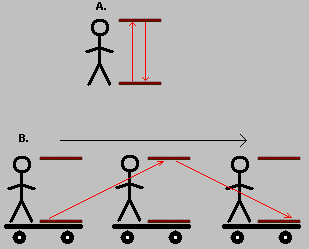
Now, suppose there was a theoretical device made, that was essentially a cylinder or tube fitted with mirrors at both ends. A "ball" of light was then put inside of this tube and made to bounce up down the two mirrors like a ping pong ball. Now, since the speed of light never changes, this ball of light would bounce up and down at very regular intervals, creating a very, very accurate "light clock". |
||
|
||
|
||
|
||
| This is, of course, theoretical, but a person standing next to the clock, like Observer A, seen here, would be able to measure the passing of time very consistently with the clock. | ||
|
||
| Part 3: The Clock in Motion | ||
| Now suppose you put this clock into a vehicle traveling at a very, very high speed, close to the speed of light. While the driver of that vehicle would continue to see the ball of light ticking up and down, an observer on the outside would see the light tracing a streaking diagonal path as it moved not only up and down, but across their field of vision. | ||
|
||
|
||
|
||
| Remember, speed is measured by distance traveled divided by time. Now, in the case of the streaking light clock, it appears to have traveled a greater distance than the light going up and down. But the speed of light is always constant. How is this possible? The only possible explanation is to factor in more time, in order to keep the distance over time ratio the same. | ||
|
||
| Part 4: The Concept of Spacetime | ||
| Einstein took this light clock idea, and concluded that not only is motion and distance relative, but time is as well. He formulated a concept known as spacetime, where the universe has not only three-dimensional space but also a fourth dimension, time. Therefore, an object traveling very, very quickly (i.e., near the speed of light) is not only moving noticeably through space but also time. As evidenced by the light clock above, the two observers would be experiencing time dilation, where time moves more quickly for one observer than for another. | ||
|
||
| Continue on to Einstein's General Theory of Relativity. | ||
|
||
[ Edmund Mao 2005 ] |
||