 |
 |
 |
 |
 |
 |
 |
 |
 |
 |
 |
|
| General Theory of Relativity |
|
| Important things to keep in mind |
| The speed of light, at approx. 186, 282 miles per hour, is constant.
Force implies mass and acceleration, or vice versa, as stated by Newton's 2nd Law of Motion [F = m (a)] The Equivalence Principle states that the effects of gravity are exactly equivalent to the effects of acceleration. That is, it would feel the same to be pulled downwards by gravity at 10 meters/second squared as it would to be held to the floor of a spacecraft accelerating up through space at 10 meters/second squared |
|
| Part 1: Spaceship in Space |
|
 |
|
|
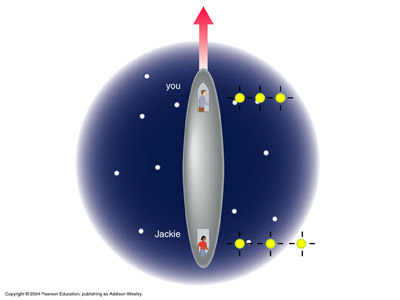
Suppose you were with a friend, named Jackie, and the two of you were in a spacecraft, floating somewhere in deep space. You are in the front of the ship, and Jackie is in the back. The two of you both have stopwatches with little flashing lights that blink once every second, and, as you float, the flashes from Jackie's and your flashlight are completely synchronized.
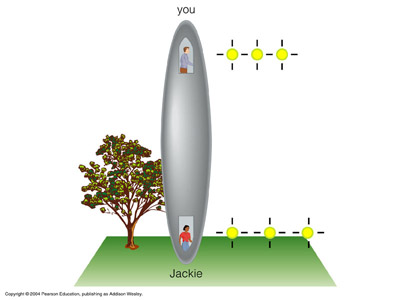
Now, imagine that the spacecraft's rocket engines fired, accelerating the ship at a rate of 10 meters/second squared. Knowing that motion is relative, you notice that the blinking lights from the two watches are now out of sync. This is because of your respective positions in the ship. Being in the front, you are accelerating away from Jackie's watch, which is in the back of the spacecraft, and the light has to take a little while longer to reach your eyes. Contrastingly, the light from your watch reaches Jackie's eyes much more quickly because she has literally "caught up" to the light as it swept backwards. From your perspective, Jackie's watch is now blinking at a slower rate than yours, and to Jackie, your light has sped up. Time is now seemingly moving faster at the front of the ship than at the end. |
|
| Part 2: Spaceship on Earth |
|
 |
|
| Now, imagine this same exact scenario except place the spacecraft within a gravity field, like that of Earth's. Instead of the rocket engine's providing the force and the 10 meters/second squared upward acceleration, it is now gravity pulling down. However, the effects are the same as they were in the spacecraft. Your eyes and Jackie's watch light are still being moved apart, resulting in a delay in her light reaching your eyes. In contrast, the light from your watch is being pulled towards Jackie's eyes. Once again your time frames differ from one another, with time seemingly moving faster at your end, the front of the spacecraft. |
|
| Part 3: Spacetime and a New Concept of Gravity |
| What you and Jackie have just experienced is known as Gravitational Time Dilation. It is yet another example of time relativity, as a result of light taking longer and shorter periods of time to reach different locations. However, the situation in the gravity field has an obvious anomaly that begs to be answered. How is it that gravity can act on light? The Newtonian principles of gravity state that gravity is an intrinsic interaction between matter. How is it that gravity can act on light, which is pure energy? This question begs for a new concept of spacetime, and gravity. |
|
|
|
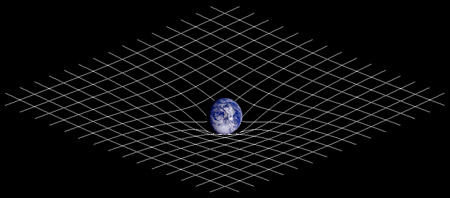
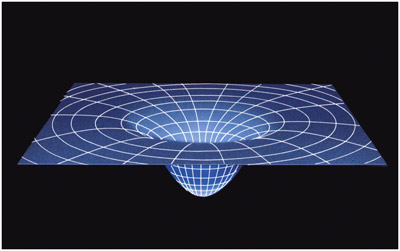
| Imagine now that spacetime is a very thin rubber sheet, like that of a trampoline, and massive objects like the stars and planets (including our Earth) are like billiard balls imbedded within. They bend the very fabric of spacetime around them, and objects who orbit them are trapped inside these "pits". Similiarly, light, operating within the confines of spacetime, would also enter these pits and revolve around the large-mass object. This new concept of gravity means large amounts of matter actually bend spacetime around them. Also, large rotating masses literally swirl spacetime around them as was recently proven by NASA. Read more about NASA's mission here. |
|
| Part 4: Black Holes and Gravitational Lensing |
|
A black hole is the result of a super massive and super dense object (i.e., the post-supernovae cores of supergiant stars) creating such a drastic "pit" in the fabric of spacetime that it actually pokes a hole through it. No one knows what lies at the end of a blackhole, besides a single point in space known as a singularity. Due to the immense warping of spacetime around a black hole, any future probe that would be launched to investigate a black hole would appear to "freeze" at the event horizon (the entrance to the hole)--at that point any light emanating from the probe would not be able to escape the gravitational pit in spacetime.
Gravitational Lensing is the result of a very massive object bending the light from an object behind it. Astronomers on Earth take advantage of this effect to see objects that would normally lie out of our line of sight. |
|
|
|
| For more information, check out these links. |
|
[ Edmund Mao 2005 ] |