
|
|
|
|
|
|
|
|
) ) The
head's episode being now over,let's continue with the modifications: changing
the pistons. So I take off the oil pan to reach the connecting rods: Wow
that's ZZZ rods! The
head's episode being now over,let's continue with the modifications: changing
the pistons. So I take off the oil pan to reach the connecting rods: Wow
that's ZZZ rods! |
) |
) |
) |
) |
|
|
(rubber fuel line) |
|
the 2nd of Aug. 2000 |
|
) I
notice that I really don't know the exact head volume of the stock pistons.
Some web surfing gives me values going from 18 to 20 cc. I
notice that I really don't know the exact head volume of the stock pistons.
Some web surfing gives me values going from 18 to 20 cc.
I proceed just like described in the page 138 of Rick Voegelin's book (Isbn 1-884089-26-7) and I find 15cc! I take many times the measurement, no problem, this is 15cc... The stock compression ratio should therefore a bit better than 7.8, I calculate even 8.12... I also measure the H3423's volume which is +14cc as Claimer claims. |
) More
measurements on the pistons and the connecting rods: the weight. More
measurements on the pistons and the connecting rods: the weight.
I use the electronic kitchen scales which are accurate to the gramm. Pistons GM 1&2: 808gr Rods 1&2: 645gr I am pleased by the identical weight of the two first connecting rods. |
) My
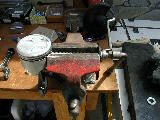
tool to extract the pins from pistons is not adapted for 8 cylinders engines,
because the screw went south during the 7th piston disassembling. (While
putting the screw in the other way, I nevertheless could finish disassembling) My
tool to extract the pins from pistons is not adapted for 8 cylinders engines,
because the screw went south during the 7th piston disassembling. (While
putting the screw in the other way, I nevertheless could finish disassembling) |
) I
have weighed everything: GM and Claimer H3423 pistons and rods. I
have weighed everything: GM and Claimer H3423 pistons and rods.
Here's the measurements I've noted. Everything is well balanced to 5 gr. near, which is very correct. But as I am perfectionist, I will adjust these small differences in weight. |
) With
rods and pistons matched in weight, let's do the Piston and Rod Assembly.
Press-fit piston pins can be installed using a hydraulic press or by heating.
The heating method (425°F) expands the small-end bore of the connecting
rod to allow the piston pin to be slip fit... Busy not burning my self
on the hot rod (!), I miss the first assembly : heated by the rod, the
pin expands too fast and locks half way. I must finish with my "screw press".
I discover then this is smoother than I thought. After checking the GM
piston pins have no scratch of disassembly, I decide to go forward with
the "screwed" press method. With
rods and pistons matched in weight, let's do the Piston and Rod Assembly.
Press-fit piston pins can be installed using a hydraulic press or by heating.
The heating method (425°F) expands the small-end bore of the connecting
rod to allow the piston pin to be slip fit... Busy not burning my self
on the hot rod (!), I miss the first assembly : heated by the rod, the
pin expands too fast and locks half way. I must finish with my "screw press".
I discover then this is smoother than I thought. After checking the GM
piston pins have no scratch of disassembly, I decide to go forward with
the "screwed" press method. |
) ) Checking
the deck height of all the pistons on the cylinder n°1 at TDC, allows
to see that manufacturing errors add or subtract them-selves.Variations
on Rod-piston n°1 and 5 lead me to disassemble , exchange and re-assemble
them, hoping thus to minimize the gaps. I saw then that the pins withstand
very good the cold press method. With these measurements and knowing the
volumes of the 8 combustion chambers, I can match each rod-piston with
its cylinder. Checking
the deck height of all the pistons on the cylinder n°1 at TDC, allows
to see that manufacturing errors add or subtract them-selves.Variations
on Rod-piston n°1 and 5 lead me to disassemble , exchange and re-assemble
them, hoping thus to minimize the gaps. I saw then that the pins withstand
very good the cold press method. With these measurements and knowing the
volumes of the 8 combustion chambers, I can match each rod-piston with
its cylinder. |
) One
small problem of the LPG conversion is starting the engine on gasoline
after it has ran on LPG. The carb's float bowl is then empty. You have
to run the engine with the starter to activate the mechanical fuel pump,
until the battery dies... That's why I mount an electrical fuel pump on
the Elcamino, which fills the float bowl as soon as I switch on the ignition.
On the 305, I've left the mechanical pump, but for the 350, I make a aluminium
plate to block the pump hole. One
small problem of the LPG conversion is starting the engine on gasoline
after it has ran on LPG. The carb's float bowl is then empty. You have
to run the engine with the starter to activate the mechanical fuel pump,
until the battery dies... That's why I mount an electrical fuel pump on
the Elcamino, which fills the float bowl as soon as I switch on the ignition.
On the 305, I've left the mechanical pump, but for the 350, I make a aluminium
plate to block the pump hole. |
|
|
|
|
)
)